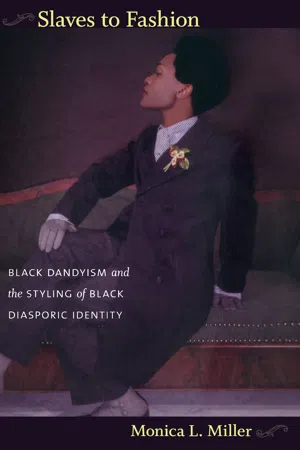
Slaves to Fashion
eBook - PDF

Slaves to Fashion

Black Dandyism and the Styling of Black Diasporic Identity

  1. English
  2. PDF
  3. Available on iOS & Android
eBook - PDF

Slaves to Fashion

Black Dandyism and the Styling of Black Diasporic Identity

About this book

Slaves to Fashion is a pioneering cultural history of the black dandy, from his emergence in Enlightenment England to his contemporary incarnations in the cosmopolitan art worlds of London and New York. It is populated by sartorial impresarios such as Julius Soubise, a freed slave who sometimes wore diamond-buckled, red-heeled shoes as he circulated through the social scene of eighteenth-century London, and Yinka Shonibare, a prominent Afro-British artist who not only styles himself as a fop but also creates ironic commentaries on black dandyism in his work. Interpreting performances and representations of black dandyism in particular cultural settings and literary and visual texts, Monica L. Miller emphasizes the importance of sartorial style to black identity formation in the Atlantic diaspora.


Dandyism was initially imposed on black men in eighteenth-century England, as the Atlantic slave trade and an emerging culture of conspicuous consumption generated a vogue in dandified black servants. "Luxury slaves" tweaked and reworked their uniforms, and were soon known for their sartorial novelty and sometimes flamboyant personalities. Tracing the history of the black dandy forward to contemporary celebrity incarnations such as Andre 3000, Miller explains how black people became arbiters of style and how they have historically used the dandy's signature tools—clothing, gesture, and wit—to break down limiting identity markers and propose new ways of fashioning political and social possibility in the black Atlantic world. With an aplomb worthy of her iconographic subject, she considers the black dandy in relation to nineteenth-century American literature and drama, W. E. B. Du Bois's reflections on black masculinity and cultural nationalism, the modernist aesthetics of the Harlem Renaissance, and representations of black cosmopolitanism in contemporary visual art.

Frequently asked questions

Yes, you can cancel anytime from the Subscription tab in your account settings on the Perlego website. Your subscription will stay active until the end of your current billing period. Learn how to cancel your subscription.
No, books cannot be downloaded as external files, such as PDFs, for use outside of Perlego. However, you can download books within the Perlego app for offline reading on mobile or tablet. Learn more here.
Perlego offers two plans: Essential and Complete
  • Essential is ideal for learners and professionals who enjoy exploring a wide range of subjects. Access the Essential Library with 800,000+ trusted titles and best-sellers across business, personal growth, and the humanities. Includes unlimited reading time and Standard Read Aloud voice.
  • Complete: Perfect for advanced learners and researchers needing full, unrestricted access. Unlock 1.4M+ books across hundreds of subjects, including academic and specialized titles. The Complete Plan also includes advanced features like Premium Read Aloud and Research Assistant.
Both plans are available with monthly, semester, or annual billing cycles.
We are an online textbook subscription service, where you can get access to an entire online library for less than the price of a single book per month. With over 1 million books across 1000+ topics, we’ve got you covered! Learn more here.
Look out for the read-aloud symbol on your next book to see if you can listen to it. The read-aloud tool reads text aloud for you, highlighting the text as it is being read. You can pause it, speed it up and slow it down. Learn more here.
Yes! You can use the Perlego app on both iOS or Android devices to read anytime, anywhere — even offline. Perfect for commutes or when you’re on the go.
Please note we cannot support devices running on iOS 13 and Android 7 or earlier. Learn more about using the app.
Yes, you can access Slaves to Fashion by Monica L. Miller in PDF and/or ePUB format, as well as other popular books in Social Sciences & Theatre History & Criticism. We have over one million books available in our catalogue for you to explore.
234
ChapterĀ 
Five
throughoutĀ 
theĀ 
film 
andĀ 
especiallyĀ 
here,Ā 
asĀ 
theĀ 
exchangeĀ 
ofĀ 
looksĀ 
inĀ 
theĀ 
clubĀ 
promptsĀ 
aĀ 
reverieĀ 
inĀ 
whichĀ 
AlexĀ 
andĀ 
Beauty,Ā 
tuxedoĀ 
andĀ 
nude,Ā 
confrontĀ 
oneĀ 
another.Ā 
TheĀ 
dreamyĀ 
natureĀ 
ofĀ 
theĀ 
film 
andĀ 
Beauty’sĀ 
nameĀ 
encourageĀ 
theĀ 
viewerĀ 
toĀ 
readĀ 
Beauty’sĀ 
interactionĀ 
withĀ 
AlexĀ 
asĀ 
allegori-
cal.Ā 
Thus,Ā 
thisĀ 
confrontationĀ 
isĀ 
notĀ 
oneĀ 
betweenĀ 
theĀ 
charactersĀ 
AlexĀ 
andĀ 
BeautyĀ 
only,Ā 
butĀ 
alsoĀ 
thatĀ 
betweenĀ 
hardĀ 
andĀ 
ā€œsoftĀ 
.Ā 
.Ā 
.Ā 
softā€Ā 
blackĀ 
maleĀ 
images,Ā 
LangstonĀ 
andĀ 
hisĀ 
deferredĀ 
dream,Ā 
andĀ 
theĀ 
HarlemĀ 
RenaissanceĀ 
aestheticsĀ 
andĀ 
itsĀ 
ultramodernĀ 
other.Ā 
If,Ā 
duringĀ 
theĀ 
HarlemĀ 
era,Ā 
dandiesĀ 
inĀ 
textsĀ 
hadĀ 
attemptedĀ 
toĀ 
promoteĀ 
NewĀ 
NegroĀ 
expressionĀ 
freeĀ 
ofĀ 
theĀ 
de-
mandsĀ 
ofĀ 
respectability,Ā 
inĀ 
LookingĀ 
forĀ 
Langston
JulienĀ 
achievesĀ 
thisĀ 
ex-
pressionĀ 
byĀ 
usingĀ 
theĀ 
figure 
toĀ 
imagineĀ 
andĀ 
imageĀ 
theĀ 
possibilityĀ 
ofĀ 
aĀ 
definition 
ofĀ 
blacknessĀ 
andĀ 
masculinityĀ 
outsideĀ 
ofĀ 
thisĀ 
positive-negative,Ā 
27.Ā 
IsaacĀ 
JulienĀ 
andĀ 
SunilĀ 
Gupta.Ā 
LookingĀ 
forĀ 
LangstonĀ 
SeriesĀ 
(No.Ā 
5)Ā 
MasqueradeĀ 
No.Ā 
4
,Ā 
1989.Ā 
© 
IsaacĀ 
JulienĀ 
andĀ 
SunilĀ 
Gupta.

Table of contents

  1. Contents
  2. Acknowledgments
  3. Introduction
  4. Mungo Marcaroni: The Slavish Swell
  5. Crimes of Fashion: Dressing the Part from Slavery to Freedom
  6. W.E.B. DuBois's "Different" Diasporic Race Man
  7. "Passing Fancies": Dandyism, Harlem Modernism, and the Politics of Visuality
  8. "You Look Beautiful Like That": Black Dandyism and Visual Histories of Black Cosmopolitanism
  9. Notes
  10. Bibliography
  11. Index