Kauanui provides an impassioned assessment of how the arbitrary correlation of ancestry and race imposed by the U.S. government on the indigenous people of Hawai'i has had far-reaching legal and cultural effects. With the HHCA, the federal government explicitly limited the number of Hawaiians included in land provisions, and it recast Hawaiians' land claims in terms of colonial welfare rather than collective entitlement. Moreover, the exclusionary logic of blood quantum has profoundly affected cultural definitions of indigeneity by undermining more inclusive Kanaka Maoli notions of kinship and belonging. Kauanui also addresses the ongoing significance of the 50-percent rule: Its criteria underlie recent court decisions that have subverted the Hawaiian sovereignty movement and brought to the fore charged questions about who counts as Hawaiian.
eBook - PDF
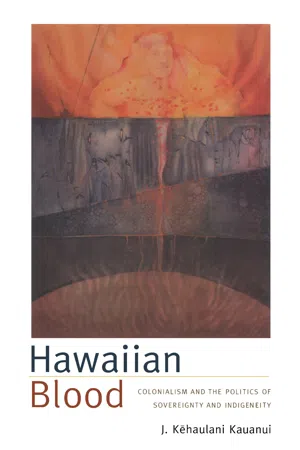
Hawaiian Blood
Colonialism and the Politics of Sovereignty and Indigeneity
- 260 pages
- English
- PDF
- Available on iOS & Android
eBook - PDF
Hawaiian Blood
Colonialism and the Politics of Sovereignty and Indigeneity
About this book
In the Hawaiian Homes Commission Act (HHCA) of 1921, the U.S. Congress defined "native Hawaiians" as those people "with at least one-half blood quantum of individuals inhabiting the Hawaiian Islands prior to 1778." This "blood logic" has since become an entrenched part of the legal system in Hawai'i. Hawaiian Blood is the first comprehensive history and analysis of this federal law that equates Hawaiian cultural identity with a quantifiable amount of blood. J. K?haulani Kauanui explains how blood quantum classification emerged as a way to undermine Native Hawaiian (Kanaka Maoli) sovereignty. Within the framework of the 50-percent rule, intermarriage "dilutes" the number of state-recognized Native Hawaiians. Thus, rather than support Native claims to the Hawaiian islands, blood quantum reduces Hawaiians to a racial minority, reinforcing a system of white racial privilege bound to property ownership.
Information
Publisher
Duke University Press BooksYear
2008Print ISBN
9780822340799
9780822340584
eBook ISBN
9780822391494
Table of contents
- Contents
- A Note to Readers
- Acknowledgments
- Introduction: Got Blood?
- 1. Racialized Beneficiaries and Genealogical Descendants
- 2. ‘‘Can you wonder that the Hawaiians did not get more?’’ Historical Context for the Hawaiian Homes Commission Act
- 3. Under the Guise of Hawaiian Rehabilitation
- 4. The Virile, Prolific, and Enterprising: Part-Hawaiians and the Problem with Rehabilitation
- 5. Limiting Hawaiians, Limiting the Bill: Rehabilitation Recoded
- 6. Sovereignty Struggles and the Legacy of the 50-Percent Rule
- Notes
- Bibliography
- Index
Trusted by 375,005 students
Access to over 1.5 million titles for a fair monthly price.
Study more efficiently using our study tools.
Frequently asked questions
Yes, you can cancel anytime from the Subscription tab in your account settings on the Perlego website. Your subscription will stay active until the end of your current billing period. Learn how to cancel your subscription
No, books cannot be downloaded as external files, such as PDFs, for use outside of Perlego. However, you can download books within the Perlego app for offline reading on mobile or tablet. Learn how to download books offline
Perlego offers two plans: Essential and Complete
- Essential is ideal for learners and professionals who enjoy exploring a wide range of subjects. Access the Essential Library with 800,000+ trusted titles and best-sellers across business, personal growth, and the humanities. Includes unlimited reading time and Standard Read Aloud voice.
- Complete: Perfect for advanced learners and researchers needing full, unrestricted access. Unlock 1.5M+ books across hundreds of subjects, including academic and specialized titles. The Complete Plan also includes advanced features like Premium Read Aloud and Research Assistant.
We are an online textbook subscription service, where you can get access to an entire online library for less than the price of a single book per month. With over 1.5 million books across 990+ topics, we’ve got you covered! Learn about our mission
Look out for the read-aloud symbol on your next book to see if you can listen to it. The read-aloud tool reads text aloud for you, highlighting the text as it is being read. You can pause it, speed it up and slow it down. Learn more about Read Aloud
Yes! You can use the Perlego app on both iOS and Android devices to read anytime, anywhere — even offline. Perfect for commutes or when you’re on the go.
Please note we cannot support devices running on iOS 13 and Android 7 or earlier. Learn more about using the app
Please note we cannot support devices running on iOS 13 and Android 7 or earlier. Learn more about using the app
Yes, you can access Hawaiian Blood by J. Kehaulani Kauanui,J. Kehaulani Kauanui, Florencia E. Mallon, Alcida Rita Ramos, Joanne Rappaport, Florencia E. Mallon,Alcida Rita Ramos,Joanne Rappaport in PDF and/or ePUB format, as well as other popular books in History & North American History. We have over 1.5 million books available in our catalogue for you to explore.