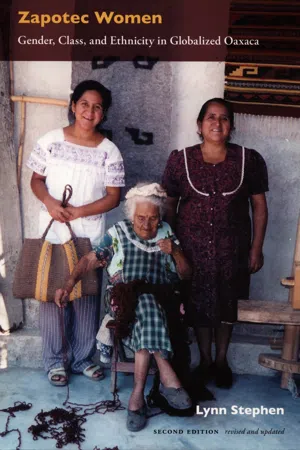
Stephen presents new information about the weaving cooperatives women have formed over the last two decades in an attempt to gain political and cultural rights within their community and standing as independent artisans within the global market. She also addresses the place of Zapotec weaving within Mexican folk art and the significance of increased migration out of Teotitlán. The women weavers and merchants collaborated with Stephen on the research for this book, and their perspectives are key to her analysis of how gender relations have changed within rituals, weaving production and marketing, local politics, and family life. Drawing on the experiences of women in Teotitlán, Stephen considers the prospects for the political, economic, and cultural participation of other indigenous women in Mexico under the policies of economic neoliberalism which have prevailed since the 1990s.
- 407 pages
- English
- PDF
- Available on iOS & Android
eBook - PDF
About this book
In this extensively revised and updated second edition of her classic ethnography, Lynn Stephen explores the intersection of gender, class, and indigenous ethnicity in southern Mexico. She provides a detailed study of how the lives of women weavers and merchants in the Zapotec-speaking town of Teotitlán del Valle, Oaxaca, have changed in response to the international demand for Oaxacan textiles. Based on Stephen's research in Teotitlán during the mid-1980s, in 1990, and between 2001 and 2004, this volume provides a unique view of a Zapotec community balancing a rapidly advancing future in export production with an entrenched past anchored in indigenous culture.
Information
Publisher
Duke University Press BooksYear
2005Print ISBN
9780822336419
9780822336037
eBook ISBN
9780822387510
Table of contents
- Contents
- List of Maps, Illustrations, and Tables
- Acknowledgments
- Introduction
- Ethnicity and Class in the Changing Lives ofZapotecWomen
- Kinship, Gender, and Economic Globalization
- SixWomen’s Stories: Julia, Cristina, Angela, Alicia,Imelda, and Isabel
- Setting the Scene: The Zapotecs of Teotitlán delValle, Oaxaca
- Contested Histories:Women, Men, and the Relationsof Production in Teotitlán, 1920–1950s
- Weaving as Heritage: Folk Art, Aesthetics, andthe Commercialization of Zapotec Textiles
- From Contract to Co-op: Gender, Commercialization,and Neoliberalism in Teotitlán
- Changes in the Civil-Religious Hierarchy andTheir Impact onWomen
- Fiesta: The Gendered Dynamics of RitualParticipation
- Challenging Political Culture:Women’sChanging Political Participation in Teotitlán
- On Speaking and Being Heard
- Notes
- Glossary of Spanish and Zapotec Terms
- Bibliography
- Index
Trusted by 375,005 students
Access to over 1.5 million titles for a fair monthly price.
Study more efficiently using our study tools.
Frequently asked questions
Yes, you can cancel anytime from the Subscription tab in your account settings on the Perlego website. Your subscription will stay active until the end of your current billing period. Learn how to cancel your subscription
No, books cannot be downloaded as external files, such as PDFs, for use outside of Perlego. However, you can download books within the Perlego app for offline reading on mobile or tablet. Learn how to download books offline
Perlego offers two plans: Essential and Complete
- Essential is ideal for learners and professionals who enjoy exploring a wide range of subjects. Access the Essential Library with 800,000+ trusted titles and best-sellers across business, personal growth, and the humanities. Includes unlimited reading time and Standard Read Aloud voice.
- Complete: Perfect for advanced learners and researchers needing full, unrestricted access. Unlock 1.5M+ books across hundreds of subjects, including academic and specialized titles. The Complete Plan also includes advanced features like Premium Read Aloud and Research Assistant.
We are an online textbook subscription service, where you can get access to an entire online library for less than the price of a single book per month. With over 1.5 million books across 990+ topics, we’ve got you covered! Learn about our mission
Look out for the read-aloud symbol on your next book to see if you can listen to it. The read-aloud tool reads text aloud for you, highlighting the text as it is being read. You can pause it, speed it up and slow it down. Learn more about Read Aloud
Yes! You can use the Perlego app on both iOS and Android devices to read anytime, anywhere — even offline. Perfect for commutes or when you’re on the go.
Please note we cannot support devices running on iOS 13 and Android 7 or earlier. Learn more about using the app
Please note we cannot support devices running on iOS 13 and Android 7 or earlier. Learn more about using the app
Yes, you can access Zapotec Women by Lynn Stephen in PDF and/or ePUB format, as well as other popular books in Social Sciences & Mexican History. We have over 1.5 million books available in our catalogue for you to explore.