Through close analyses of specific objects of art and design, Brown describes how Indian artists engaged with questions of authenticity, iconicity, narrative, urbanization, and science and technology. She explains how the filmmaker Satyajit Ray presented the rural Indian village as a socially complex space rather than as the idealized site of "authentic India" in his acclaimed Apu Trilogy, how the painter Bhupen Khakhar reworked Indian folk idioms and borrowed iconic images from calendar prints in his paintings of urban dwellers, and how Indian architects developed a revivalist style of bold architectural gestures anchored in India's past as they planned the Ashok Hotel and the Vigyan Bhavan Conference Center, both in New Delhi. Discussing these and other works of art and design, Brown chronicles the mid-twentieth-century trajectory of India's modern visual culture.
- 222 pages
- English
- PDF
- Available on iOS & Android
eBook - PDF
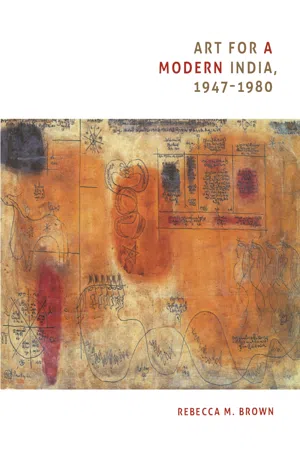
Art for a Modern India, 1947-1980
About this book
Following India's independence in 1947, Indian artists creating modern works of art sought to maintain a local idiom, an "Indianness" representative of their newly independent nation, while connecting to modernism, an aesthetic then understood as both universal and presumptively Western. These artists depicted India's precolonial past while embracing aspects of modernism's pursuit of the new, and they challenged the West's dismissal of non-Western places and cultures as sources of primitivist imagery but not of modernist artworks. In Art for a Modern India, Rebecca M. Brown explores the emergence of a self-conscious Indian modernism—in painting, drawing, sculpture, architecture, film, and photography—in the years between independence and 1980, by which time the Indian art scene had changed significantly and postcolonial discourse had begun to complicate mid-century ideas of nationalism.
Information
Publisher
Duke University Press BooksYear
2009Print ISBN
9780822343752
9780822343554
eBook ISBN
9780822392262
Table of contents
- Contents
- List of Illustrations
- Acknowledgments
- Introduction: The Modern Indian Paradox
- One. Authenticity
- Two. The Icon
- Three. Narrative and Time
- Four. Science,Technology, and Industry
- Five. The Urban
- Epilogue: The 1980s and After
- Notes
- References
- Index
Trusted by 375,005 students
Access to over 1.5 million titles for a fair monthly price.
Study more efficiently using our study tools.
Frequently asked questions
Yes, you can cancel anytime from the Subscription tab in your account settings on the Perlego website. Your subscription will stay active until the end of your current billing period. Learn how to cancel your subscription
No, books cannot be downloaded as external files, such as PDFs, for use outside of Perlego. However, you can download books within the Perlego app for offline reading on mobile or tablet. Learn how to download books offline
Perlego offers two plans: Essential and Complete
- Essential is ideal for learners and professionals who enjoy exploring a wide range of subjects. Access the Essential Library with 800,000+ trusted titles and best-sellers across business, personal growth, and the humanities. Includes unlimited reading time and Standard Read Aloud voice.
- Complete: Perfect for advanced learners and researchers needing full, unrestricted access. Unlock 1.5M+ books across hundreds of subjects, including academic and specialized titles. The Complete Plan also includes advanced features like Premium Read Aloud and Research Assistant.
We are an online textbook subscription service, where you can get access to an entire online library for less than the price of a single book per month. With over 1.5 million books across 990+ topics, we’ve got you covered! Learn about our mission
Look out for the read-aloud symbol on your next book to see if you can listen to it. The read-aloud tool reads text aloud for you, highlighting the text as it is being read. You can pause it, speed it up and slow it down. Learn more about Read Aloud
Yes! You can use the Perlego app on both iOS and Android devices to read anytime, anywhere — even offline. Perfect for commutes or when you’re on the go.
Please note we cannot support devices running on iOS 13 and Android 7 or earlier. Learn more about using the app
Please note we cannot support devices running on iOS 13 and Android 7 or earlier. Learn more about using the app
Yes, you can access Art for a Modern India, 1947-1980 by Rebecca M. Brown, Nicholas Thomas in PDF and/or ePUB format, as well as other popular books in Art & Asian Art. We have over 1.5 million books available in our catalogue for you to explore.