- English
- PDF
- Available on iOS & Android
eBook - PDF
About this book
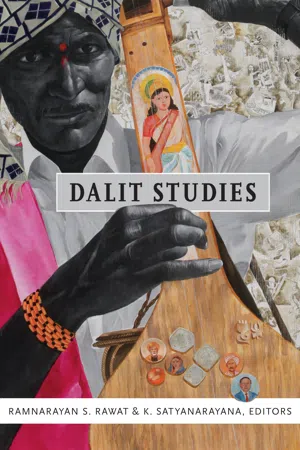
The contributors to this major intervention into Indian historiography trace the strategies through which Dalits have been marginalized as well as the ways Dalit intellectuals and leaders have shaped emancipatory politics in modern India. Moving beyond the anticolonialism/nationalism binary that dominates the study of India, the contributors assess the benefits of colonial modernity and place humiliation, dignity, and spatial exclusion at the center of Indian historiography. Several essays discuss the ways Dalits used the colonial courts and legislature to gain minority rights in the early twentieth century, while others highlight Dalit activism in social and religious spheres. The contributors also examine the struggle of contemporary middle-class Dalits to reconcile their caste and class, intercaste tensions among Sikhs, and the efforts by Dalit writers to challenge dominant constructions of secular and class-based citizenship while emphasizing the ongoing destructiveness of caste identity. In recovering the long history of Dalit struggles against caste violence, exclusion, and discrimination, Dalit Studies outlines a new agenda for the study of India, enabling a significant reconsideration of many of the Indian academy's core assumptions.
Contributors: D. Shyam Babu, Laura Brueck, Sambaiah Gundimeda, Gopal Guru, Rajkumar Hans, Chinnaiah Jangam, Surinder Jodhka, P. Sanal Mohan, Ramnarayan Rawat, K. Satyanarayana
Frequently asked questions
Yes, you can cancel anytime from the Subscription tab in your account settings on the Perlego website. Your subscription will stay active until the end of your current billing period. Learn how to cancel your subscription.
At the moment all of our mobile-responsive ePub books are available to download via the app. Most of our PDFs are also available to download and we're working on making the final remaining ones downloadable now. Learn more here.
Perlego offers two plans: Essential and Complete
- Essential is ideal for learners and professionals who enjoy exploring a wide range of subjects. Access the Essential Library with 800,000+ trusted titles and best-sellers across business, personal growth, and the humanities. Includes unlimited reading time and Standard Read Aloud voice.
- Complete: Perfect for advanced learners and researchers needing full, unrestricted access. Unlock 1.4M+ books across hundreds of subjects, including academic and specialized titles. The Complete Plan also includes advanced features like Premium Read Aloud and Research Assistant.
We are an online textbook subscription service, where you can get access to an entire online library for less than the price of a single book per month. With over 1 million books across 1000+ topics, we’ve got you covered! Learn more here.
Look out for the read-aloud symbol on your next book to see if you can listen to it. The read-aloud tool reads text aloud for you, highlighting the text as it is being read. You can pause it, speed it up and slow it down. Learn more here.
Yes! You can use the Perlego app on both iOS or Android devices to read anytime, anywhere — even offline. Perfect for commutes or when you’re on the go.
Please note we cannot support devices running on iOS 13 and Android 7 or earlier. Learn more about using the app.
Yes, you can access Dalit Studies by Ramnarayan S. Rawat, K. Satyanarayana, Ramnarayan S. Rawat,K. Satyanarayana in PDF and/or ePUB format, as well as other popular books in History & Indian & South Asian History. We have over one million books available in our catalogue for you to explore.
Information
Publisher
Duke University Press BooksYear
2016Print ISBN
9780822361329, 9780822361138eBook ISBN
9780822374312Table of contents
- Cover
- Contents
- Acknowledgments
- Introduction. Dalit Studies: New Perspectives on Indian History and Society
- 1. The Indian Nation in Its Egalitarian Conception
- Part I. Probing the Historical
- Part II. Probing the Present
- Bibliography
- Contributors
- Index