Birth draws on fieldwork he conducted in one of Trinidad's ethnically diverse rural villages to explore the relationship between music and social and political consciousness on the island. He describes how Trinidadians use the affective power of music and the physiological experience of performance to express and work through issues related to identity, ethnicity, and politics. He looks at how the performers and audience members relate to different musical traditions. Turning explicitly to politics, Birth recounts how Trinidadians used music as a means of making sense of the attempted coup d'état in 1990 and the 1995 parliamentary election, which resulted in a tie between the two major political parties. Bacchanalian Sentiments is an innovative ethnographic analysis of the significance of music, and particular musical forms, in the everyday lives of rural Trinidadians.
eBook - PDF
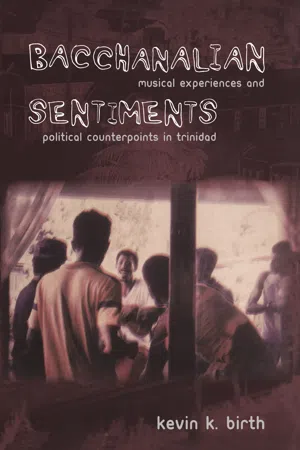
Bacchanalian Sentiments
Musical Experiences and Political Counterpoints in Trinidad
- 276 pages
- English
- PDF
- Available on iOS & Android
eBook - PDF
About this book
Trinidad is known for its vibrant musical traditions, which reflect the island's ethnic diversity. The annual Carnival, far and away the biggest event in Trinidad, is filled with soca and calypso music. Soca is a dance music derived from calypso, a music with African antecedents. In parang, a Venezuelan and Spanish derived folk music that dominates Trinidadian Christmas festivities, groups of singers and musicians progress from house to house, performing for their neighbors. Chutney is also an Indo-Caribbean music. In Bacchanalian Sentiments, Kevin K. Birth argues that these and other Trinidadian musical genres and traditions not only provide a soundtrack to daily life on the southern Caribbean island; they are central to the ways that Trinidadians experience and navigate their social lives and interpret political events.
Information
Publisher
Duke University Press BooksYear
2008Print ISBN
9780822341659
9780822341413
eBook ISBN
9780822388746
Table of contents
- Cover
- Contents
- Preface
- Note on Music References
- INTRODUCTION • Initial Connections
- ONE • Governmental Organization of Spontaneity
- TWO • Bacchanalian Counterpoints to the State
- THREE • Parang: Christmas in Anamat
- FOUR • Bakrnal: An Example of Changing Opinions
- FIVE • ‘‘Chukaipan,’’ ‘‘Lootala,’’ and the Counterpoint of ‘‘Mix Up’’
- SIX • Concluding Relations
- Appendix
- References
- Index
Trusted by 375,005 students
Access to over 1.5 million titles for a fair monthly price.
Study more efficiently using our study tools.
Frequently asked questions
Yes, you can cancel anytime from the Subscription tab in your account settings on the Perlego website. Your subscription will stay active until the end of your current billing period. Learn how to cancel your subscription
No, books cannot be downloaded as external files, such as PDFs, for use outside of Perlego. However, you can download books within the Perlego app for offline reading on mobile or tablet. Learn how to download books offline
Perlego offers two plans: Essential and Complete
- Essential is ideal for learners and professionals who enjoy exploring a wide range of subjects. Access the Essential Library with 800,000+ trusted titles and best-sellers across business, personal growth, and the humanities. Includes unlimited reading time and Standard Read Aloud voice.
- Complete: Perfect for advanced learners and researchers needing full, unrestricted access. Unlock 1.5M+ books across hundreds of subjects, including academic and specialized titles. The Complete Plan also includes advanced features like Premium Read Aloud and Research Assistant.
We are an online textbook subscription service, where you can get access to an entire online library for less than the price of a single book per month. With over 1.5 million books across 990+ topics, we’ve got you covered! Learn about our mission
Look out for the read-aloud symbol on your next book to see if you can listen to it. The read-aloud tool reads text aloud for you, highlighting the text as it is being read. You can pause it, speed it up and slow it down. Learn more about Read Aloud
Yes! You can use the Perlego app on both iOS and Android devices to read anytime, anywhere — even offline. Perfect for commutes or when you’re on the go.
Please note we cannot support devices running on iOS 13 and Android 7 or earlier. Learn more about using the app
Please note we cannot support devices running on iOS 13 and Android 7 or earlier. Learn more about using the app
Yes, you can access Bacchanalian Sentiments by Kevin K. Birth in PDF and/or ePUB format, as well as other popular books in Social Sciences & Latin American & Caribbean History. We have over 1.5 million books available in our catalogue for you to explore.