Wright argues that three nineteenth-century American and European works addressing race—Thomas Jefferson's Notes on the State of Virginia, G. W. F. Hegel's Philosophy of History, and Count Arthur de Gobineau's Essay on the Inequality of the Human Races—were particularly influential in shaping twentieth-century ideas about Black subjectivity. She considers these treatises in depth and describes how the revolutionary Black thinkers W. E. B. Du Bois, Aimé Césaire, Léopold Sédar Senghor, and Frantz Fanon countered the theories they promulgated. She explains that while Du Bois, Césaire, Senghor, and Fanon rejected the racist ideologies of Jefferson, Hegel, and Gobineau, for the most part they did so within what remained a nationalist, patriarchal framework. Such persistent nationalist and sexist ideologies were later subverted, Wright shows, in the work of Black women writers including Carolyn Rodgers and Audre Lorde and, more recently, the British novelists Joan Riley, Naomi King, Jo Hodges, and Andrea Levy. By considering diasporic writing ranging from Du Bois to Lorde to the contemporary African novelists Simon Njami and Daniel Biyaoula, Wright reveals Black subjectivity as rich, varied, and always evolving.
- 292 pages
- English
- PDF
- Available on iOS & Android
eBook - PDF
About this book
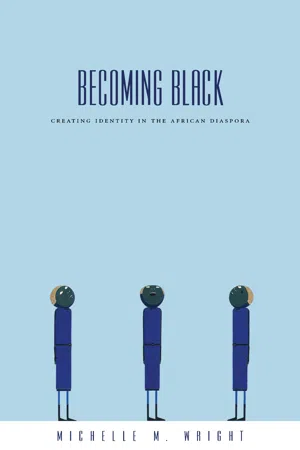
Becoming Black is a powerful theorization of Black subjectivity throughout the African diaspora. In this unique comparative study, Michelle M. Wright discusses the commonalties and differences in how Black writers and thinkers from the United States, the Caribbean, Africa, France, Great Britain, and Germany have responded to white European and American claims about Black consciousness. As Wright traces more than a century of debate on Black subjectivity between intellectuals of African descent and white philosophers, she also highlights how feminist writers have challenged patriarchal theories of Black identity.
Information
Publisher
Duke University Press BooksYear
2004Print ISBN
9780822332886
9780822332114
eBook ISBN
9780822385868
Topic
SozialwissenschaftenSubtopic
LiteraturkritikTable of contents
- CONTENTS
- Acknowledgments
- Introduction: Being and Becoming Black in the West
- 1. The European and American Invention of the Black Other
- 2. The Trope of Masking in the Works of W. E. B. Du Bois, Léopold Sédar Senghor, and Aimé Césaire
- 3. Some Women Disappear: Frantz Fanon’s Legacy in Black Nationalist Thought and the Black (Male) Subject
- 4. How I Got Ovah: Masking to Motherhood and the Diasporic Black Female Subject
- 5. The Urban Diaspora: Black Subjectivities in Berlin, London, and Paris
- Epilogue: If the Black Is a Subject, Can the Subaltern Speak?
- Notes
- Bibliography
- Index
Trusted by 375,005 students
Access to over 1.5 million titles for a fair monthly price.
Study more efficiently using our study tools.
Frequently asked questions
Yes, you can cancel anytime from the Subscription tab in your account settings on the Perlego website. Your subscription will stay active until the end of your current billing period. Learn how to cancel your subscription
No, books cannot be downloaded as external files, such as PDFs, for use outside of Perlego. However, you can download books within the Perlego app for offline reading on mobile or tablet. Learn how to download books offline
Perlego offers two plans: Essential and Complete
- Essential is ideal for learners and professionals who enjoy exploring a wide range of subjects. Access the Essential Library with 800,000+ trusted titles and best-sellers across business, personal growth, and the humanities. Includes unlimited reading time and Standard Read Aloud voice.
- Complete: Perfect for advanced learners and researchers needing full, unrestricted access. Unlock 1.5M+ books across hundreds of subjects, including academic and specialized titles. The Complete Plan also includes advanced features like Premium Read Aloud and Research Assistant.
We are an online textbook subscription service, where you can get access to an entire online library for less than the price of a single book per month. With over 1.5 million books across 990+ topics, we’ve got you covered! Learn about our mission
Look out for the read-aloud symbol on your next book to see if you can listen to it. The read-aloud tool reads text aloud for you, highlighting the text as it is being read. You can pause it, speed it up and slow it down. Learn more about Read Aloud
Yes! You can use the Perlego app on both iOS and Android devices to read anytime, anywhere — even offline. Perfect for commutes or when you’re on the go.
Please note we cannot support devices running on iOS 13 and Android 7 or earlier. Learn more about using the app
Please note we cannot support devices running on iOS 13 and Android 7 or earlier. Learn more about using the app
Yes, you can access Becoming Black by Michelle M. Wright in PDF and/or ePUB format, as well as other popular books in Sozialwissenschaften & Literaturkritik. We have over 1.5 million books available in our catalogue for you to explore.