- English
- PDF
- Available on iOS & Android
eBook - PDF
About this book
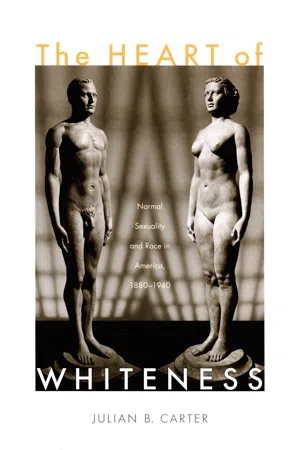
In this groundbreaking study, Julian Carter demonstrates that between 1880 and 1940, cultural discourses of whiteness and heterosexuality fused to form a new concept of the "normal" American. Gilded Age elites defined white civilization as the triumphant achievement of exceptional people hewing to a relational ethic of strict self-discipline for the common good. During the early twentieth century, that racial and relational ideal was reconceived in more inclusive terms as "normality," something toward which everyone should strive. The appearance of inclusiveness helped make "normality" appear consistent with the self-image of a racially diverse republic; nonetheless, "normality" was gauged largely in terms of adherence to erotic and emotional conventions that gained cultural significance through their association with arguments for the legitimacy of white political and social dominance. At the same time, the affectionate, reproductive heterosexuality of "normal" married couples became increasingly central to legitimate membership in the nation.
Carter builds her intricate argument from detailed readings of an array of popular texts, focusing on how sex education for children and marital advice for adults provided significant venues for the dissemination of the new ideal of normality. She concludes that because its overt concerns were love, marriage, and babies, normality discourse facilitated white evasiveness about racial inequality. The ostensible focus of "normality" on matters of sexuality provided a superficially race-neutral conceptual structure that whites could and did use to evade engagement with the unequal relations of power that continue to shape American life today.
Frequently asked questions
Yes, you can cancel anytime from the Subscription tab in your account settings on the Perlego website. Your subscription will stay active until the end of your current billing period. Learn how to cancel your subscription.
No, books cannot be downloaded as external files, such as PDFs, for use outside of Perlego. However, you can download books within the Perlego app for offline reading on mobile or tablet. Learn more here.
Perlego offers two plans: Essential and Complete
- Essential is ideal for learners and professionals who enjoy exploring a wide range of subjects. Access the Essential Library with 800,000+ trusted titles and best-sellers across business, personal growth, and the humanities. Includes unlimited reading time and Standard Read Aloud voice.
- Complete: Perfect for advanced learners and researchers needing full, unrestricted access. Unlock 1.4M+ books across hundreds of subjects, including academic and specialized titles. The Complete Plan also includes advanced features like Premium Read Aloud and Research Assistant.
We are an online textbook subscription service, where you can get access to an entire online library for less than the price of a single book per month. With over 1 million books across 1000+ topics, we’ve got you covered! Learn more here.
Look out for the read-aloud symbol on your next book to see if you can listen to it. The read-aloud tool reads text aloud for you, highlighting the text as it is being read. You can pause it, speed it up and slow it down. Learn more here.
Yes! You can use the Perlego app on both iOS or Android devices to read anytime, anywhere — even offline. Perfect for commutes or when you’re on the go.
Please note we cannot support devices running on iOS 13 and Android 7 or earlier. Learn more about using the app.
Yes, you can access The Heart of Whiteness by Julian B Carter in PDF and/or ePUB format, as well as other popular books in Social Sciences & Ethnic Studies. We have over one million books available in our catalogue for you to explore.
Information
Publisher
Duke University Press BooksYear
2007Print ISBN
9780822339489, 9780822339373eBook ISBN
9780822389583Table of contents
- Contents
- Acknowledgments
- Introduction: The Search for Norma
- 1. ‘‘Barbarians Are Not Nervous’’
- 2. The Marriage Crisis
- 3. Birds, Bees, and the Future of the Race: Making Whiteness Normal
- Epilogue: Regarding Racial/Erotic Politics
- Notes
- Bibliography
- Index