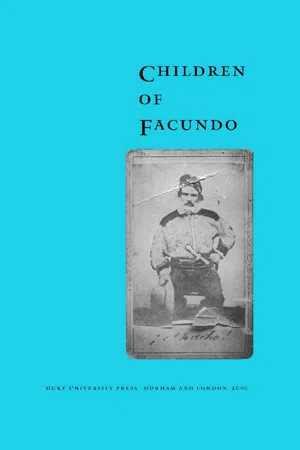
In Children of Facundo Ariel de la Fuente examines postindependence Argentinian instability and political struggle from the perspective of the rural lower classes. As the first comprehensive regional study to explore nineteenth-century society, culture, and politics in the Argentine interior—where more than 50 percent of the population lived at the time—the book departs from the predominant Buenos Aires-centered historiography to analyze this crucial period in the processes of state- and nation-building.
La Rioja, a province in the northwest section of the country, was the land of the caudillos immortalized by Domingo F. Sarmiento, particularly in his foundational and controversial book Facundo. De la Fuente focuses on the repeated rebellions in this district during the 1860s, when Federalist caudillos and their followers, the gauchos, rose up against the new Unitarian government. In this social and cultural analysis, de la Fuente argues that the conflict was not a factional struggle between two ideologically identical sectors of the elite, as commonly depicted. Instead, he believes, the struggle should be seen from the perspective of the lower-class gauchos, for whom Unitarianism and Federalism were highly differentiated party identities that represented different experiences during the nineteenth century. To reconstruct this rural political culture de la Fuente relies on sources that heretofore have been little used in the study of nineteenth-century Latin American politics, most notably a rich folklore collection of popular political songs, folktales, testimonies, and superstitions passed down by old gauchos who had been witnesses or protagonists of the rebellions. Criminal trial records, private diaries, and land censuses add to the originality of de la Fuente's study, while also providing a new perspective on Sarmiento's works, including the classic Facundo.
This book will interest those specializing in Latin American history, literature, politics, and rural issues.
La Rioja, a province in the northwest section of the country, was the land of the caudillos immortalized by Domingo F. Sarmiento, particularly in his foundational and controversial book Facundo. De la Fuente focuses on the repeated rebellions in this district during the 1860s, when Federalist caudillos and their followers, the gauchos, rose up against the new Unitarian government. In this social and cultural analysis, de la Fuente argues that the conflict was not a factional struggle between two ideologically identical sectors of the elite, as commonly depicted. Instead, he believes, the struggle should be seen from the perspective of the lower-class gauchos, for whom Unitarianism and Federalism were highly differentiated party identities that represented different experiences during the nineteenth century. To reconstruct this rural political culture de la Fuente relies on sources that heretofore have been little used in the study of nineteenth-century Latin American politics, most notably a rich folklore collection of popular political songs, folktales, testimonies, and superstitions passed down by old gauchos who had been witnesses or protagonists of the rebellions. Criminal trial records, private diaries, and land censuses add to the originality of de la Fuente's study, while also providing a new perspective on Sarmiento's works, including the classic Facundo.
This book will interest those specializing in Latin American history, literature, politics, and rural issues.