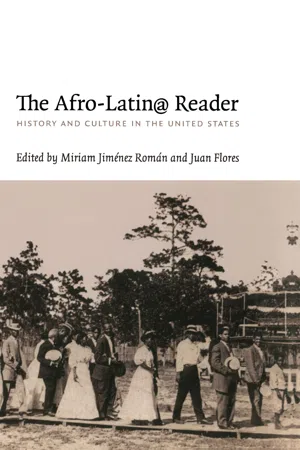
The Afro-Latin@ Reader
eBook - PDF

The Afro-Latin@ Reader

History and Culture in the United States

  1. English
  2. PDF
  3. Available on iOS & Android
eBook - PDF

The Afro-Latin@ Reader

History and Culture in the United States

About this book

The Afro-Latin@ Reader focuses attention on a large, vibrant, yet oddly invisible community in the United States: people of African descent from Latin America and the Caribbean. The presence of Afro-Latin@s in the United States (and throughout the Americas) belies the notion that Blacks and Latin@s are two distinct categories or cultures. Afro-Latin@s are uniquely situated to bridge the widening social divide between Latin@s and African Americans; at the same time, their experiences reveal pervasive racism among Latin@s and ethnocentrism among African Americans. Offering insight into Afro-Latin@ life and new ways to understand culture, ethnicity, nation, identity, and antiracist politics, The Afro-Latin@ Reader presents a kaleidoscopic view of Black Latin@s in the United States. It addresses history, music, gender, class, and media representations in more than sixty selections, including scholarly essays, memoirs, newspaper and magazine articles, poetry, short stories, and interviews.

While the selections cover centuries of Afro-Latin@ history, since the arrival of Spanish-speaking Africans in North America in the mid-sixteenth-century, most of them focus on the past fifty years. The central question of how Afro-Latin@s relate to and experience U.S. and Latin American racial ideologies is engaged throughout, in first-person accounts of growing up Afro-Latin@, a classic essay by a leader of the Young Lords, and analyses of U.S. census data on race and ethnicity, as well as in pieces on gender and sexuality, major-league baseball, and religion. The contributions that Afro-Latin@s have made to U.S. culture are highlighted in essays on the illustrious Afro-Puerto Rican bibliophile Arturo Alfonso Schomburg and music and dance genres from salsa to mambo, and from boogaloo to hip hop. Taken together, these and many more selections help to bring Afro-Latin@s in the United States into critical view.

Contributors: Afro–Puerto Rican Testimonies Project, Josefina Baéz, Ejima Baker, Luis Barrios, Eduardo Bonilla-Silva, Adrian Burgos Jr., Ginetta E. B. Candelario, Adrián Castro, Jesús Colón, Marta I. Cruz-Janzen, William A. Darity Jr., Milca Esdaille, Sandra María Esteves, María Teresa Fernández (Mariposa), Carlos Flores, Juan Flores, Jack D. Forbes, David F. Garcia, Ruth Glasser, Virginia Meecham Gould, Susan D. Greenbaum, Evelio Grillo, Pablo "Yoruba" Guzmán, Gabriel Haslip-Viera, Tanya K. Hernández, Victor Hernández Cruz, Jesse Hoffnung-Garskof, Lisa Hoppenjans, Vielka Cecilia Hoy, Alan J. Hughes, María Rosario Jackson, James Jennings, Miriam Jiménez Román, Angela Jorge, David Lamb, Aida Lambert, Ana M. Lara, Evelyne Laurent-Perrault, Tato Laviera, John Logan, Antonio López, Felipe Luciano, Louis Pancho McFarland, Ryan Mann-Hamilton, Wayne Marshall, Marianela Medrano, Nancy Raquel Mirabal, Yvette Modestin, Ed Morales, Jairo Moreno, Marta Moreno Vega, Willie Perdomo, Graciela Pérez Gutiérrez, Sofia Quintero, Ted Richardson, Louis Reyes Rivera, Pedro R. Rivera , Raquel Z. Rivera, Yeidy Rivero, Mark Q. Sawyer, Piri Thomas, Silvio Torres-Saillant, Nilaja Sun, Sherezada "Chiqui" Vicioso, Peter H. Wood

Frequently asked questions

Yes, you can cancel anytime from the Subscription tab in your account settings on the Perlego website. Your subscription will stay active until the end of your current billing period. Learn how to cancel your subscription.
At the moment all of our mobile-responsive ePub books are available to download via the app. Most of our PDFs are also available to download and we're working on making the final remaining ones downloadable now. Learn more here.
Perlego offers two plans: Essential and Complete
  • Essential is ideal for learners and professionals who enjoy exploring a wide range of subjects. Access the Essential Library with 800,000+ trusted titles and best-sellers across business, personal growth, and the humanities. Includes unlimited reading time and Standard Read Aloud voice.
  • Complete: Perfect for advanced learners and researchers needing full, unrestricted access. Unlock 1.4M+ books across hundreds of subjects, including academic and specialized titles. The Complete Plan also includes advanced features like Premium Read Aloud and Research Assistant.
Both plans are available with monthly, semester, or annual billing cycles.
We are an online textbook subscription service, where you can get access to an entire online library for less than the price of a single book per month. With over 1 million books across 1000+ topics, we’ve got you covered! Learn more here.
Look out for the read-aloud symbol on your next book to see if you can listen to it. The read-aloud tool reads text aloud for you, highlighting the text as it is being read. You can pause it, speed it up and slow it down. Learn more here.
Yes! You can use the Perlego app on both iOS or Android devices to read anytime, anywhere — even offline. Perfect for commutes or when you’re on the go.
Please note we cannot support devices running on iOS 13 and Android 7 or earlier. Learn more about using the app.
Yes, you can access The Afro-Latin@ Reader by Miriam Jiménez Román, Juan Flores, Miriam Jiménez Román,Juan Flores in PDF and/or ePUB format, as well as other popular books in Social Sciences & African American Studies. We have over one million books available in our catalogue for you to explore.
0 
virginia 
meacham 
gould
Inglis, 
e 
Spanish 
Censuses 
of 
Pensacola, 
1784–1820: 
Genealogical 
Guide 
to 
Spanish 
Pensacola
(Pensacola, 
Florida: 
Perdido 
Bay 
Press, 
1980).
23. 
e 
Spanish 
Census 
of 
New 
Orleans, 
1797: 
New 
Orleans 
in 
1805: 
Directory 
and 
Census 
(New 
Orleans, 
1936); 
Census 
de 
Mobile, 
Septiembre 
12, 
1805, 
legajo 
142, 
Terri-
torial 
Papers, 
Jackson, 
Mississippi; 
Padron 
de 
Panzacola, 
1802, 
AGi 
PC 
legajo 
59; 
Coker 
and 
Inglis, 
e 
Spanish 
Censuses 
of 
Pensacola, 
1784–1820
.
24. 
e 
Census 
of 
Pensacola, 
May 
15, 
1802, 
AGi 
PC 
legajo 
59; 
General 
de 
la 
jurisdic-
ción 
de 
la 
Mobila 
del 
Primero 
de 
Enero 
del 
Año 
1787, 
AGi 
PC 
legajo 
206, 
Mississippi 
Territorial 
Archives, 
Jackson, 
Mississippi; 
Census 
of 
New 
Orleans, 
November 
6, 
1791, 
Louisiana 
Collection, 
New 
Orleans 
Public 
Library.

Table of contents

  1. Contents
  2. Acknowledgments
  3. Editorial Note
  4. Introduction
  5. I. Historical Background before 1900
  6. II. Arturo Alfonso Schomburg
  7. III. Afro-Latin@s on the Color Line
  8. IV. Roots of Salsa: Afro-Latin@ Popular Music
  9. V. Black Latin@ Sixties
  10. VI. Afro-Latinas
  11. VII. Public Images and (Mis) Representations
  12. VIII. Afro-Latin@s in the Hip Hop Zone
  13. IX. Living Afro-Latinidades
  14. X. Afro-Latin@s: Present and Future Tenses
  15. Sources and Permissions
  16. Contributors
  17. Index