eBook - PDF
Culture of Class
Radio and Cinema in the Making of a Divided Argentina, 1920-1946
- 290 pages
- English
- PDF
- Available on iOS & Android
eBook - PDF
About this book
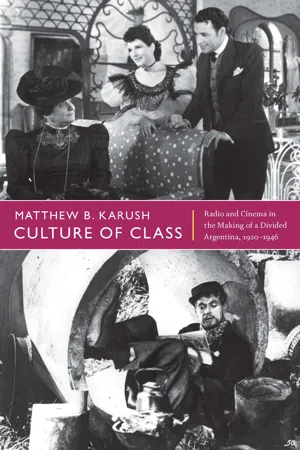
In an innovative cultural history of Argentine movies and radio in the decades before Peronism, Matthew B. Karush demonstrates that competition with jazz and Hollywood cinema shaped Argentina's domestic cultural production in crucial ways, as Argentine producers tried to elevate their offerings to appeal to consumers seduced by North American modernity. At the same time, the transnational marketplace encouraged these producers to compete by marketing "authentic" Argentine culture. Domestic filmmakers, radio and recording entrepreneurs, lyricists, musicians, actors, and screenwriters borrowed heavily from a rich tradition of popular melodrama. Although the resulting mass culture trafficked in conformism and consumerist titillation, it also disseminated versions of national identity that celebrated the virtue and dignity of the poor, while denigrating the wealthy as greedy and mean-spirited. This anti-elitism has been overlooked by historians, who have depicted radio and cinema as instruments of social cohesion and middle-class formation. Analyzing tango and folk songs, film comedies and dramas, radio soap operas, and other genres, Karush argues that the Argentine culture industries generated polarizing images and narratives that provided much of the discursive raw material from which Juan and Eva Perón built their mass movement.
Information
Publisher
Duke University Press BooksYear
2012Print ISBN
9780822352648
9780822352433
eBook ISBN
9780822395331
Table of contents
- Contents
- Acknowledgments
- Introduction
- 1. Class Formation in the Barrios
- 2. Competing in the Transnational Marketplace
- 3. Repackaging Popular Melodrama
- 4. Mass-Cultural Nation Building
- 5. Politicizing Populism
- Epilogue - The Rise of the Middle Class, 1955–1976
- Notes
- Bibliography
- Index
Trusted by 375,005 students
Access to over 1.5 million titles for a fair monthly price.
Study more efficiently using our study tools.
Frequently asked questions
Yes, you can cancel anytime from the Subscription tab in your account settings on the Perlego website. Your subscription will stay active until the end of your current billing period. Learn how to cancel your subscription
No, books cannot be downloaded as external files, such as PDFs, for use outside of Perlego. However, you can download books within the Perlego app for offline reading on mobile or tablet. Learn how to download books offline
We are an online textbook subscription service, where you can get access to an entire online library for less than the price of a single book per month. With over 1.5 million books across 990+ topics, we’ve got you covered! Learn about our mission
Look out for the read-aloud symbol on your next book to see if you can listen to it. The read-aloud tool reads text aloud for you, highlighting the text as it is being read. You can pause it, speed it up and slow it down. Learn more about Read Aloud
Yes! You can use the Perlego app on both iOS and Android devices to read anytime, anywhere — even offline. Perfect for commutes or when you’re on the go.
Please note we cannot support devices running on iOS 13 and Android 7 or earlier. Learn more about using the app
Please note we cannot support devices running on iOS 13 and Android 7 or earlier. Learn more about using the app
Yes, you can access Culture of Class by Matthew B. Karush in PDF and/or ePUB format, as well as other popular books in History & Latin American & Caribbean History. We have over 1.5 million books available in our catalogue for you to explore.