Abufarha draws on the life histories of martyrs, interviews he conducted with their families and members of the groups that sponsored their operations, and examinations of Palestinian literature, art, performance, news stories, and political commentaries. He also assesses data—about the bombers, targets, and fatalities caused—from more than two hundred martyrdom operations carried out by Palestinian groups between 2001 and 2004. Some involved the use of explosive belts or the detonation of cars; others entailed armed attacks against Israeli targets (military and civilian) undertaken with the intent of fighting until death. In addition, he scrutinized suicide attacks executed by Hamas and Islamic Jihad between 1994 and 2000. In his analysis of Palestinian political violence, Abufarha takes into account Palestinians' understanding of the history of the conflict with Israel, the effects of containment on Palestinians' everyday lives, the disillusionment created by the Oslo peace process, and reactions to specific forms of Israeli state violence. The Making of a Human Bomb illuminates the Palestinians' perspective on the conflict with Israel and provides a model for ethnographers seeking to make sense of political violence.
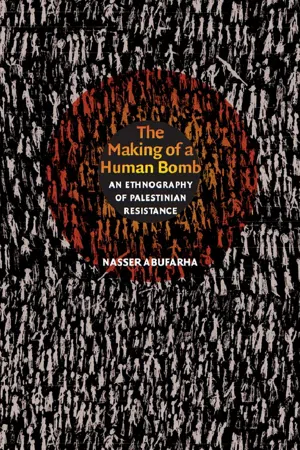
eBook - PDF
The Making of a Human Bomb
An Ethnography of Palestinian Resistance
- 289 pages
- English
- PDF
- Available on iOS & Android
eBook - PDF
The Making of a Human Bomb
An Ethnography of Palestinian Resistance
About this book
In The Making of a Human Bomb, Nasser Abufarha, a Palestinian anthropologist, explains the cultural logic underlying Palestinian martyrdom operations (suicide attacks) launched against Israel during the Al-Aqsa Intifada (2000–06). In so doing, he sheds much-needed light on how Palestinians have experienced and perceived the broader conflict. During the Intifada, many of the martyrdom operations against Israeli targets were initiated in the West Bank town of Jenin and surrounding villages. Abufarha was born and raised in Jenin. His personal connections to the area enabled him to conduct ethnographic research there during the Intifada, while he was a student at a U.S. university.
Information
Publisher
Duke University Press BooksYear
2009Print ISBN
9780822344391
9780822344285
eBook ISBN
9780822392118

24
chapter
one
cesses
is
integrated
into
military
and
political
strategies.
I
further
discuss
how
these
performances
of
violence
in
the
public
places
of
the
‘‘enemy’’
and
the
cultural
meanings
that
they
carry
move
the
battlegrounds
from
the
physical
fields
to
the
conceptual
fields.
I
point
out
that
martyrdom
strategies
rest
on
moving
the
battle
to
levels
of
identity
and
conceptual
rootedness,
thereby
altering
the
power
configurations
of
the
encounter.
Finally,
in
chapter
7
I
discuss
the
implications
of
my
research
for
the
anthropology
of
violence
and
for
a
comprehensive
analysis
of
the
vari-
ous
historical,
cultural,
political,
and
military
dimensions
of
the
human
bomb
at
the
local,
regional,
and
global
levels.
I
further
crystallize
the
development
of
this
form
of
violence
in
the
historical
context
and
the
space
that
it
occupies
in
Palestine
today.
I
also
provide
insights
into
future
research
on
possible
appropriate
responses
to
the
strategies
of
martyrdom
in
Palestine.
Table of contents
- Contents
- Acknowledgments
- Chapter One - Introduction
- Chapter Two - Histories and Historicities in Palestine
- Chapter Three - State Expansion and the Violence of "Peace Making’’ in Palestine
- Chapter Four - The Carrier
- Chapter Five - Dying to Live
- Chapter Six - The Strategies and Politics of Martyrdomi n Palestine
- Chapter Seven - Conclusion
- Appendix
- Notes
- Bibliography
- Index
Trusted by 375,005 students
Access to over 1.5 million titles for a fair monthly price.
Study more efficiently using our study tools.
Frequently asked questions
Yes, you can cancel anytime from the Subscription tab in your account settings on the Perlego website. Your subscription will stay active until the end of your current billing period. Learn how to cancel your subscription
No, books cannot be downloaded as external files, such as PDFs, for use outside of Perlego. However, you can download books within the Perlego app for offline reading on mobile or tablet. Learn how to download books offline
Perlego offers two plans: Essential and Complete
- Essential is ideal for learners and professionals who enjoy exploring a wide range of subjects. Access the Essential Library with 800,000+ trusted titles and best-sellers across business, personal growth, and the humanities. Includes unlimited reading time and Standard Read Aloud voice.
- Complete: Perfect for advanced learners and researchers needing full, unrestricted access. Unlock 1.5M+ books across hundreds of subjects, including academic and specialized titles. The Complete Plan also includes advanced features like Premium Read Aloud and Research Assistant.
We are an online textbook subscription service, where you can get access to an entire online library for less than the price of a single book per month. With over 1.5 million books across 990+ topics, we’ve got you covered! Learn about our mission
Look out for the read-aloud symbol on your next book to see if you can listen to it. The read-aloud tool reads text aloud for you, highlighting the text as it is being read. You can pause it, speed it up and slow it down. Learn more about Read Aloud
Yes! You can use the Perlego app on both iOS and Android devices to read anytime, anywhere — even offline. Perfect for commutes or when you’re on the go.
Please note we cannot support devices running on iOS 13 and Android 7 or earlier. Learn more about using the app
Please note we cannot support devices running on iOS 13 and Android 7 or earlier. Learn more about using the app
Yes, you can access The Making of a Human Bomb by Nasser Abufarha, Neil L. Whitehead, Jo Ellen Fair, Leigh A. Payne, Neil L. Whitehead,Jo Ellen Fair,Leigh A. Payne in PDF and/or ePUB format, as well as other popular books in Social Sciences & Middle Eastern History. We have over 1.5 million books available in our catalogue for you to explore.