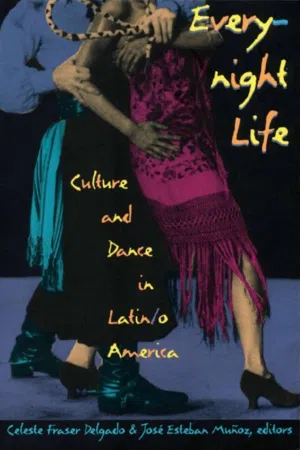
The function of dance in Latin/o American culture is the focus of the essays collected in Everynight Life. The contributors interpret how Latin/o culture expresses itself through dance, approaching the material from the varying perspectives of literary, cultural, dance, performance, queer, and feminist studies. Viewing dance as privileged sites of identity formation and cultural resistance in Latin/o America, Everynight Life translates the motion of bodies into speech, and the gestures of dance into a provocative socio-political grammar.
This anthology looks at many modes of dance—including salsa, merengue, cumbia, rumba, mambo, tango, samba, and norteño—as models for the interplay of cultural memory and regional conflict. Barbara Browning's essay on capoeira, for instance, demonstrates how dance has been used as a literal form of resistance, while José Piedra explores the meanings conveyed by women of color dancing the rumba. Pieces such as Gustavo Perez Fírmat's "I Came, I Saw, I Conga'd" and Jorge Salessi's "Medics, Crooks, and Tango Queens" illustrate the lively scope of this volume's subject matter.
This anthology looks at many modes of dance—including salsa, merengue, cumbia, rumba, mambo, tango, samba, and norteño—as models for the interplay of cultural memory and regional conflict. Barbara Browning's essay on capoeira, for instance, demonstrates how dance has been used as a literal form of resistance, while José Piedra explores the meanings conveyed by women of color dancing the rumba. Pieces such as Gustavo Perez Fírmat's "I Came, I Saw, I Conga'd" and Jorge Salessi's "Medics, Crooks, and Tango Queens" illustrate the lively scope of this volume's subject matter.
Contributors. Barbara Browning, Celeste Fraser Delgado, Jane C. Desmond, Mayra Santos Febres, Juan Carlos Quintero Herencia, Josh Kun, Ana M. López, José Esteban Muñoz, José Piedra, Gustavo Perez Fírmat, Augusto C. Puleo, David Román, Jorge Salessi, Alberto Sandoval