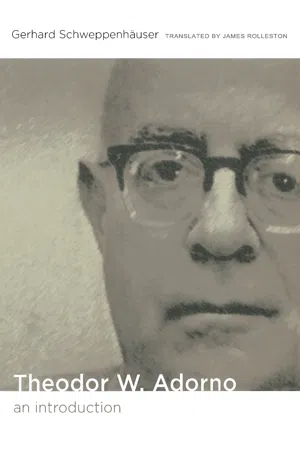
After providing a brief overview of Adorno's life, Schweppenhäuser turns to the theorist's core philosophical concepts, including post-Kantian critique, determinate negation, and the primacy of the object, as well as his view of the Enlightenment as a code for world domination, his diagnosis of modern mass culture as a program of social control, and his understanding of modernist aesthetics as a challenge to conceive an alternative politics. Along the way, Schweppenhäuser illuminates the works widely considered Adorno's most important achievements: Minima Moralia, Dialectic of Enlightenment (co-authored with Horkheimer), and Negative Dialectics. Adorno wrote much of the first two of these during his years in California (1938–49), where he lived near Arnold Schoenberg and Thomas Mann, whom he assisted with the musical aesthetics at the center of Mann's novel Doctor Faustus.
eBook - PDF
Theodor W. Adorno
An Introduction
- 200 pages
- English
- PDF
- Available on iOS & Android
eBook - PDF
Theodor W. Adorno
An Introduction
About this book
Theodor W. Adorno (1903–1969) was one of the twentieth century's most important thinkers. In light of two pivotal developments—the rise of fascism, which culminated in the Holocaust, and the standardization of popular culture as a commodity indispensable to contemporary capitalism—Adorno sought to evaluate and synthesize the essential insights of Western philosophy by revisiting the ethical and sociological arguments of his predecessors: Kant, Nietzsche, Hegel, and Marx. This book, first published in Germany in 1996, provides a succinct introduction to Adorno's challenging and far-reaching thought. Gerhard Schweppenhäuser, a leading authority on the Frankfurt School of critical theory, explains Adorno's epistemology, social and political philosophy, aesthetics, and theory of culture.
Information
Publisher
Duke University Press BooksYear
2009Print ISBN
9780822344711
9780822344544
eBook ISBN
9780822390725
Topic
PhilosophySubtopic
PhilosophersTable of contents
- Contents
- Preface to the English Edition
- Translator’s Preface
- 1 The Project of Renewing Childhood by Transforming One’s Life
- 2 Critical Theory
- 3 Reason’s Self-Criticism
- 4 Rescuing What is Beyond Hope
- 5 The Totally Socialized Society
- 6 The Goal of the Emancipated Society
- 7 The Powerless Utopia of Beauty
- 8 The Failure of Culture
- Biographical Timeline
- Notes
- Bibliography
- Index
Trusted by 375,005 students
Access to over 1.5 million titles for a fair monthly price.
Study more efficiently using our study tools.
Frequently asked questions
Yes, you can cancel anytime from the Subscription tab in your account settings on the Perlego website. Your subscription will stay active until the end of your current billing period. Learn how to cancel your subscription
No, books cannot be downloaded as external files, such as PDFs, for use outside of Perlego. However, you can download books within the Perlego app for offline reading on mobile or tablet. Learn how to download books offline
Perlego offers two plans: Essential and Complete
- Essential is ideal for learners and professionals who enjoy exploring a wide range of subjects. Access the Essential Library with 800,000+ trusted titles and best-sellers across business, personal growth, and the humanities. Includes unlimited reading time and Standard Read Aloud voice.
- Complete: Perfect for advanced learners and researchers needing full, unrestricted access. Unlock 1.5M+ books across hundreds of subjects, including academic and specialized titles. The Complete Plan also includes advanced features like Premium Read Aloud and Research Assistant.
We are an online textbook subscription service, where you can get access to an entire online library for less than the price of a single book per month. With over 1.5 million books across 990+ topics, we’ve got you covered! Learn about our mission
Look out for the read-aloud symbol on your next book to see if you can listen to it. The read-aloud tool reads text aloud for you, highlighting the text as it is being read. You can pause it, speed it up and slow it down. Learn more about Read Aloud
Yes! You can use the Perlego app on both iOS and Android devices to read anytime, anywhere — even offline. Perfect for commutes or when you’re on the go.
Please note we cannot support devices running on iOS 13 and Android 7 or earlier. Learn more about using the app
Please note we cannot support devices running on iOS 13 and Android 7 or earlier. Learn more about using the app
Yes, you can access Theodor W. Adorno by Gerhard Schweppenhäuser, James Rolleston, Stanley Fish, Fredric Jameson, James Rolleston,Stanley Fish,Fredric Jameson in PDF and/or ePUB format, as well as other popular books in Philosophy & Philosophers. We have over 1.5 million books available in our catalogue for you to explore.