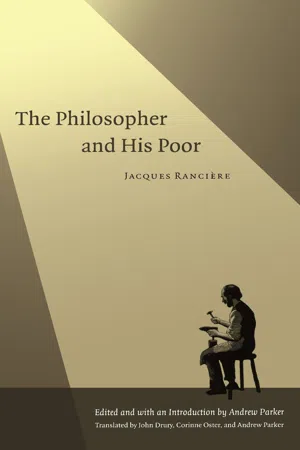
Jacques Rancière's The Philosopher and His Poor meditates on these questions in close readings of major texts of Western thought in which the poor have played a leading role—sometimes as the objects of philosophical analysis, sometimes as illustrations of philosophical argument. Published in France in 1983 and made available here for the first time in English, this consummate study assesses the consequences for Marx, Sartre, and Bourdieu of Plato's admonition that workers should do "nothing else" than their own work. It offers innovative readings of these thinkers' struggles to elaborate a philosophy of the poor. Presenting a left critique of Bourdieu, the terms of which are largely unknown to an English-language readership, The Philosopher and His Poor remains remarkably timely twenty years after its initial publication.
eBook - PDF
The Philosopher and His Poor
- 280 pages
- English
- PDF
- Available on iOS & Android
eBook - PDF
The Philosopher and His Poor
About this book
What has philosophy to do with the poor? If, as has often been supposed, the poor have no time for philosophy, then why have philosophers always made time for them? Why is the history of philosophy—from Plato to Karl Marx to Jean-Paul Sartre to Pierre Bourdieu—the history of so many figures of the poor: plebes, men of iron, the demos, artisans, common people, proletarians, the masses? Why have philosophers made the shoemaker, in particular, a remarkably ubiquitous presence in this history? Does philosophy itself depend on this thinking about the poor? If so, can it ever refrain from thinking for them?
Information
Publisher
Duke University Press BooksYear
2004Print ISBN
9780822332749
9780822332619
eBook ISBN
9780822385707
Table of contents
- Contents
- Editor’s Preface
- Editor’s Introduction: Mimesis and the Division of Labor
- A Personal Itinerary
- I . Plato’s Lie
- II . Marx’s Labor
- III . The Philosopher and the Sociologist
- For Those Who Want More
- Afterword to the English-Language Edition (2002)
- Notes
Trusted by 375,005 students
Access to over 1.5 million titles for a fair monthly price.
Study more efficiently using our study tools.
Frequently asked questions
Yes, you can cancel anytime from the Subscription tab in your account settings on the Perlego website. Your subscription will stay active until the end of your current billing period. Learn how to cancel your subscription
No, books cannot be downloaded as external files, such as PDFs, for use outside of Perlego. However, you can download books within the Perlego app for offline reading on mobile or tablet. Learn how to download books offline
Perlego offers two plans: Essential and Complete
- Essential is ideal for learners and professionals who enjoy exploring a wide range of subjects. Access the Essential Library with 800,000+ trusted titles and best-sellers across business, personal growth, and the humanities. Includes unlimited reading time and Standard Read Aloud voice.
- Complete: Perfect for advanced learners and researchers needing full, unrestricted access. Unlock 1.5M+ books across hundreds of subjects, including academic and specialized titles. The Complete Plan also includes advanced features like Premium Read Aloud and Research Assistant.
We are an online textbook subscription service, where you can get access to an entire online library for less than the price of a single book per month. With over 1.5 million books across 990+ topics, we’ve got you covered! Learn about our mission
Look out for the read-aloud symbol on your next book to see if you can listen to it. The read-aloud tool reads text aloud for you, highlighting the text as it is being read. You can pause it, speed it up and slow it down. Learn more about Read Aloud
Yes! You can use the Perlego app on both iOS and Android devices to read anytime, anywhere — even offline. Perfect for commutes or when you’re on the go.
Please note we cannot support devices running on iOS 13 and Android 7 or earlier. Learn more about using the app
Please note we cannot support devices running on iOS 13 and Android 7 or earlier. Learn more about using the app
Yes, you can access The Philosopher and His Poor by Jacques Rancière, Andrew Parker, John Drury,Corinne Oster,Andrew Parker in PDF and/or ePUB format, as well as other popular books in Politics & International Relations & Communism, Post-Communism & Socialism. We have over 1.5 million books available in our catalogue for you to explore.