- English
- PDF
- Available on iOS & Android
eBook - PDF
About this book
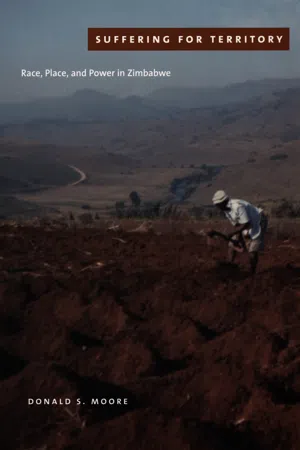
Since 2000, black squatters have forcibly occupied white farms across Zimbabwe, reigniting questions of racialized dispossession, land rights, and legacies of liberation. Donald S. Moore probes these contentious politics by analyzing fierce disputes over territory, sovereignty, and subjection in the country's eastern highlands. He focuses on poor farmers in Kaerezi who endured colonial evictions from their ancestral land and lived as refugees in Mozambique during Zimbabwe's guerrilla war. After independence in 1980, Kaerezians returned home to a changed landscape. Postcolonial bureaucrats had converted their land from a white ranch into a state resettlement scheme. Those who defied this new spatial order were threatened with eviction. Moore shows how Kaerezians' predicaments of place pivot on memories of "suffering for territory," at once an idiom of identity and entitlement. Combining fine-grained ethnography with innovative theoretical insights, this book illuminates the complex interconnections between local practices of power and the wider forces of colonial rule, nationalist politics, and global discourses of development.
Moore makes a significant contribution to postcolonial theory with his conceptualization of "entangled landscapes" by articulating racialized rule, situated sovereignties, and environmental resources. Fusing Gramscian cultural politics and Foucault's analytic of governmentality, he enlists ethnography to foreground the spatiality of power. Suffering for Territory demonstrates how emplaced micro-practices matter, how the outcomes of cultural struggles are contingent on the diverse ways land comes to be inhabited, labored upon, and suffered for.
Frequently asked questions
Yes, you can cancel anytime from the Subscription tab in your account settings on the Perlego website. Your subscription will stay active until the end of your current billing period. Learn how to cancel your subscription.
No, books cannot be downloaded as external files, such as PDFs, for use outside of Perlego. However, you can download books within the Perlego app for offline reading on mobile or tablet. Learn more here.
Perlego offers two plans: Essential and Complete
- Essential is ideal for learners and professionals who enjoy exploring a wide range of subjects. Access the Essential Library with 800,000+ trusted titles and best-sellers across business, personal growth, and the humanities. Includes unlimited reading time and Standard Read Aloud voice.
- Complete: Perfect for advanced learners and researchers needing full, unrestricted access. Unlock 1.4M+ books across hundreds of subjects, including academic and specialized titles. The Complete Plan also includes advanced features like Premium Read Aloud and Research Assistant.
We are an online textbook subscription service, where you can get access to an entire online library for less than the price of a single book per month. With over 1 million books across 1000+ topics, we’ve got you covered! Learn more here.
Look out for the read-aloud symbol on your next book to see if you can listen to it. The read-aloud tool reads text aloud for you, highlighting the text as it is being read. You can pause it, speed it up and slow it down. Learn more here.
Yes! You can use the Perlego app on both iOS or Android devices to read anytime, anywhere — even offline. Perfect for commutes or when you’re on the go.
Please note we cannot support devices running on iOS 13 and Android 7 or earlier. Learn more about using the app.
Yes, you can access Suffering for Territory by Donald S. Moore in PDF and/or ePUB format, as well as other popular books in Politics & International Relations & Environmental Law. We have over one million books available in our catalogue for you to explore.
Information
Publisher
Duke University Press BooksYear
2005Print ISBN
9780822335702, 9780822335825eBook ISBN
9780822387329Table of contents
- Contents
- Preface
- Acknowledgments
- Abbreviations
- Introduction: Situated Struggles
- Part I: Governing Space
- Part II: Colonial Cartographies
- Part III: Entangled Landscapes
- Epilogue: Effective Articulations
- Notes
- References
- Index