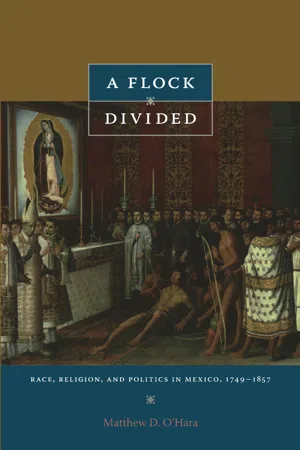
O'Hara focuses on interactions between church authorities and parishioners from the late-colonial era into the early-national period, first in Mexico City and later in the surrounding countryside. Paying particular attention to disputes regarding caste status, the category of "Indian," and the ownership of property, he demonstrates that religious collectivities from neighborhood parishes to informal devotions served as complex but effective means of political organization for plebeians and peasants. At the same time, longstanding religious practices and ideas made colonial social identities linger into the decades following independence, well after republican leaders formally abolished the caste system that classified individuals according to racial and ethnic criteria. These institutional and cultural legacies would be profound, since they raised fundamental questions about political inclusion and exclusion precisely when Mexico was trying to envision and realize new forms of political community. The modes of belonging and organizing created by colonialism provided openings for popular mobilization, but they were always stalked by their origins as tools of hierarchy and marginalization.
- 333 pages
- English
- PDF
- Available on iOS & Android
eBook - PDF
About this book
Catholicism, as it developed in colonial Mexico, helped to create a broad and remarkably inclusive community of Christian subjects, while it also divided that community into countless smaller flocks. Taking this contradiction as a starting point, Matthew D. O'Hara describes how religious thought and practice shaped Mexico's popular politics. As he shows, religion facilitated the emergence of new social categories and modes of belonging in which individuals—initially subjects of the Spanish crown, but later citizens and other residents of republican Mexico—found both significant opportunities for improving their place in society and major constraints on their ways of thinking and behaving.
Information
Publisher
Duke University Press BooksYear
2009Print ISBN
9780822346395
9780822346272
eBook ISBN
9780822392491
Topic
StoriaSubtopic
Storia messicanaTable of contents
- Contents
- Acknowledgments
- Introduction. The Children of Rebekah
- Part I. Institutions and Ideas
- Part II. Reform and Reaction
- Part III. Piety and Politics
- Notes
- Bibliography
- Index
Trusted by 375,005 students
Access to over 1.5 million titles for a fair monthly price.
Study more efficiently using our study tools.
Frequently asked questions
Yes, you can cancel anytime from the Subscription tab in your account settings on the Perlego website. Your subscription will stay active until the end of your current billing period. Learn how to cancel your subscription
No, books cannot be downloaded as external files, such as PDFs, for use outside of Perlego. However, you can download books within the Perlego app for offline reading on mobile or tablet. Learn how to download books offline
Perlego offers two plans: Essential and Complete
- Essential is ideal for learners and professionals who enjoy exploring a wide range of subjects. Access the Essential Library with 800,000+ trusted titles and best-sellers across business, personal growth, and the humanities. Includes unlimited reading time and Standard Read Aloud voice.
- Complete: Perfect for advanced learners and researchers needing full, unrestricted access. Unlock 1.5M+ books across hundreds of subjects, including academic and specialized titles. The Complete Plan also includes advanced features like Premium Read Aloud and Research Assistant.
We are an online textbook subscription service, where you can get access to an entire online library for less than the price of a single book per month. With over 1.5 million books across 990+ topics, we’ve got you covered! Learn about our mission
Look out for the read-aloud symbol on your next book to see if you can listen to it. The read-aloud tool reads text aloud for you, highlighting the text as it is being read. You can pause it, speed it up and slow it down. Learn more about Read Aloud
Yes! You can use the Perlego app on both iOS and Android devices to read anytime, anywhere — even offline. Perfect for commutes or when you’re on the go.
Please note we cannot support devices running on iOS 13 and Android 7 or earlier. Learn more about using the app
Please note we cannot support devices running on iOS 13 and Android 7 or earlier. Learn more about using the app
Yes, you can access A Flock Divided by Matthew D. O'Hara in PDF and/or ePUB format, as well as other popular books in Storia & Storia messicana. We have over 1.5 million books available in our catalogue for you to explore.