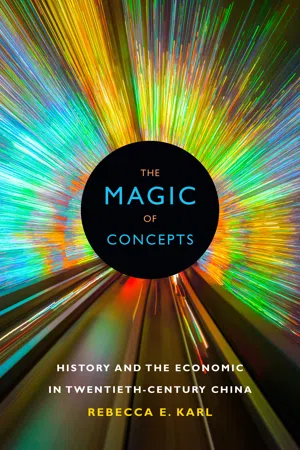
In The Magic of Concepts Rebecca E. Karl interrogates "the economic" as concept and practice as it was construed historically in China in the 1930s and again in the 1980s and 1990s. Separated by the Chinese Revolution and Mao's socialist experiments, each era witnessed urgent discussions about how to think about economic concepts derived from capitalism in modern China. Both eras were highly cosmopolitan and each faced its own global crisis in economic and historical philosophy: in the 1930s, capitalism's failures suggested that socialism offered a plausible solution, while the abandonment of socialism five decades later provoked a rethinking of the relationship between history and the economic as social practice. Interweaving a critical historiography of modern China with the work of the Marxist-trained economist Wang Yanan, Karl shows how "magical concepts" based on dehistoricized Eurocentric and capitalist conceptions of historical activity that purport to exist outside lived experiences have erased much of the critical import of China's twentieth-century history. In this volume, Karl retrieves the economic to argue for a more nuanced and critical account of twentieth-century Chinese and global historical practice.
- 233 pages
- English
- PDF
- Available on iOS & Android
eBook - PDF
About this book
Information
Publisher
Duke University Press BooksYear
2017Print ISBN
9780822363217
9780822363101
eBook ISBN
9780822373322
Topic
HistoriaSubtopic
Historia de ChinaTable of contents
- Cover
- Contents
- Preface and Acknowledgments
- Introduction. Repetition and Magic
- 1. The Economic, China, World History: A Critique of Pure Ideology
- 2. The Economic and the State: The Asiatic Mode of Production
- 3. The Economic as Transhistory: Temporality, the Market, and the Austrian School
- 4. The Economic as Lived Experience: Semicolonialism and China
- 5. The Economic as Culture and the Culture of the Economic: Filming Shanghai
- Afterword
- Notes
- Bibliography
- Index
Trusted by 375,005 students
Access to over 1.5 million titles for a fair monthly price.
Study more efficiently using our study tools.
Frequently asked questions
Yes, you can cancel anytime from the Subscription tab in your account settings on the Perlego website. Your subscription will stay active until the end of your current billing period. Learn how to cancel your subscription
No, books cannot be downloaded as external files, such as PDFs, for use outside of Perlego. However, you can download books within the Perlego app for offline reading on mobile or tablet. Learn how to download books offline
Perlego offers two plans: Essential and Complete
- Essential is ideal for learners and professionals who enjoy exploring a wide range of subjects. Access the Essential Library with 800,000+ trusted titles and best-sellers across business, personal growth, and the humanities. Includes unlimited reading time and Standard Read Aloud voice.
- Complete: Perfect for advanced learners and researchers needing full, unrestricted access. Unlock 1.5M+ books across hundreds of subjects, including academic and specialized titles. The Complete Plan also includes advanced features like Premium Read Aloud and Research Assistant.
We are an online textbook subscription service, where you can get access to an entire online library for less than the price of a single book per month. With over 1.5 million books across 990+ topics, we’ve got you covered! Learn about our mission
Look out for the read-aloud symbol on your next book to see if you can listen to it. The read-aloud tool reads text aloud for you, highlighting the text as it is being read. You can pause it, speed it up and slow it down. Learn more about Read Aloud
Yes! You can use the Perlego app on both iOS and Android devices to read anytime, anywhere — even offline. Perfect for commutes or when you’re on the go.
Please note we cannot support devices running on iOS 13 and Android 7 or earlier. Learn more about using the app
Please note we cannot support devices running on iOS 13 and Android 7 or earlier. Learn more about using the app
Yes, you can access The Magic of Concepts by Rebecca E. Karl in PDF and/or ePUB format, as well as other popular books in Historia & Historia de China. We have over 1.5 million books available in our catalogue for you to explore.