Drawing on extensive archival research and oral histories of Muslim women who lived in Calcutta and Dhaka in the first half of the twentieth century, Sarkar traces Muslim women as they surface and disappear in colonial, Hindu nationalist, and liberal Muslim writings, as well as in the memories of Muslim women themselves. The oral accounts provide both a rich source of information about the social fabric of urban Bengal during the final years of colonial rule and a glimpse of the kind of negotiations with stereotypes that even relatively privileged, middle-class Muslim women are still frequently obliged to make in India today. Sarkar concludes with some reflections on the complex links between past constructions of Muslim women, current representations, and the violence against them in contemporary India.
eBook - PDF
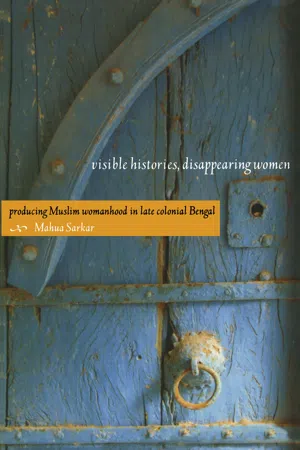
Visible Histories, Disappearing Women
Producing Muslim Womanhood in Late Colonial Bengal
- 354 pages
- English
- PDF
- Available on iOS & Android
eBook - PDF
Visible Histories, Disappearing Women
Producing Muslim Womanhood in Late Colonial Bengal
About this book
In Visible Histories, Disappearing Women, Mahua Sarkar examines how Muslim women in colonial Bengal came to be more marginalized than Hindu women in nationalist discourse and subsequent historical accounts. She also considers how their near-invisibility except as victims has underpinned the construction of the ideal citizen-subject in late colonial India. Through critical engagements with significant feminist and postcolonial scholarship, Sarkar maps out when and where Muslim women enter into the written history of colonial Bengal. She argues that the nation-centeredness of history as a discipline and the intellectual politics of liberal feminism have together contributed to the production of Muslim women as the oppressed, mute, and invisible "other" of the normative modern Indian subject.
Information
Publisher
Duke University Press BooksYear
2008Print ISBN
9780822342342
9780822342151
eBook ISBN
9780822389033
Table of contents
- Contents
- Acknowledgments
- Introduction: Writing Difference
- The Colonial Cast: The Merchant, the Soldier, the “Writer” (Clerk), Their Lovers, and the Trouble with “Native Women’s” Histories
- The Politics of (In)visibility: Muslim Women in (Hindu) Nationalist Discourse
- Negotiating Modernity: The Social Production of Muslim-ness in Late Colonial Bengal
- Difference in Memory
- Conclusion: Connections
- Notes
- Bibliography
- Index
Trusted by 375,005 students
Access to over 1.5 million titles for a fair monthly price.
Study more efficiently using our study tools.
Frequently asked questions
Yes, you can cancel anytime from the Subscription tab in your account settings on the Perlego website. Your subscription will stay active until the end of your current billing period. Learn how to cancel your subscription
No, books cannot be downloaded as external files, such as PDFs, for use outside of Perlego. However, you can download books within the Perlego app for offline reading on mobile or tablet. Learn how to download books offline
Perlego offers two plans: Essential and Complete
- Essential is ideal for learners and professionals who enjoy exploring a wide range of subjects. Access the Essential Library with 800,000+ trusted titles and best-sellers across business, personal growth, and the humanities. Includes unlimited reading time and Standard Read Aloud voice.
- Complete: Perfect for advanced learners and researchers needing full, unrestricted access. Unlock 1.5M+ books across hundreds of subjects, including academic and specialized titles. The Complete Plan also includes advanced features like Premium Read Aloud and Research Assistant.
We are an online textbook subscription service, where you can get access to an entire online library for less than the price of a single book per month. With over 1.5 million books across 990+ topics, we’ve got you covered! Learn about our mission
Look out for the read-aloud symbol on your next book to see if you can listen to it. The read-aloud tool reads text aloud for you, highlighting the text as it is being read. You can pause it, speed it up and slow it down. Learn more about Read Aloud
Yes! You can use the Perlego app on both iOS and Android devices to read anytime, anywhere — even offline. Perfect for commutes or when you’re on the go.
Please note we cannot support devices running on iOS 13 and Android 7 or earlier. Learn more about using the app
Please note we cannot support devices running on iOS 13 and Android 7 or earlier. Learn more about using the app
Yes, you can access Visible Histories, Disappearing Women by Mahua Sarkar in PDF and/or ePUB format, as well as other popular books in Social Sciences & Historiography. We have over 1.5 million books available in our catalogue for you to explore.