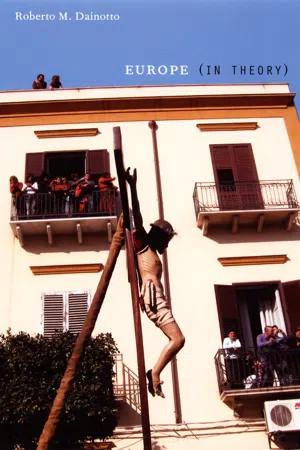
Dainotto synthesizes a vast array of literary, philosophical, and historical works by authors from different parts of Europe. He scrutinizes theories that came to dominate thinking about the continent, including Montesquieu's invention of Europe's north-south divide, Hegel's "two Europes," and Madame de Staël's idea of opposing European literatures: a modern one from the North, and a pre-modern one from the South. At the same time, Dainotto brings to light counter-narratives written from Europe's margins, such as the Spanish Jesuit Juan Andrés's suggestion that the origins of modern European culture were eastern rather than northern and the Italian Orientalist Michele Amari's assertion that the South was the cradle of a social democracy brought to Europe via Islam.
eBook - PDF
Europe (in Theory)
About this book
Europe (in Theory) is an innovative analysis of eighteenth- and nineteenth-century ideas about Europe that continue to inform thinking about culture, politics, and identity today. Drawing on insights from subaltern and postcolonial studies, Roberto M. Dainotto deconstructs imperialism not from the so-called periphery but from within Europe itself. He proposes a genealogy of Eurocentrism that accounts for the way modern theories of Europe have marginalized the continent's own southern region, portraying countries including Greece, Italy, Spain, and Portugal as irrational, corrupt, and clan-based in comparison to the rational, civic-minded nations of northern Europe. Dainotto argues that beginning with Montesquieu's The Spirit of Laws (1748), Europe not only defined itself against an "Oriental" other but also against elements within its own borders: its South. He locates the roots of Eurocentrism in this disavowal; internalizing the other made it possible to understand and explain Europe without reference to anything beyond its boundaries.
Information
Publisher
Duke University Press BooksYear
2007Print ISBN
9780822339274
9780822339052
eBook ISBN
9780822389620
Topic
LiteraturaSubtopic
Teoría de la crítica literariaTable of contents
- Contents
- Acknowledgments
- Introduction: A Pigs Eye View of Europe
- 1. The Discovery of Europe: Some Critical Points
- 2. Montesquieu's North and South: History as a Theory of Europe
- 3. Republics of Letters: What Is European Literature?
- 4. Mme de Stael to Hegel: The End of French Europe
- 5. Orientalism, Mediterranean Style: The Limits of History at the Margins of Europe
- Notes
- Works Cited
- Index
Trusted by 375,005 students
Access to over 1.5 million titles for a fair monthly price.
Study more efficiently using our study tools.
Frequently asked questions
Yes, you can cancel anytime from the Subscription tab in your account settings on the Perlego website. Your subscription will stay active until the end of your current billing period. Learn how to cancel your subscription
No, books cannot be downloaded as external files, such as PDFs, for use outside of Perlego. However, you can download books within the Perlego app for offline reading on mobile or tablet. Learn how to download books offline
We are an online textbook subscription service, where you can get access to an entire online library for less than the price of a single book per month. With over 1.5 million books across 990+ topics, we’ve got you covered! Learn about our mission
Look out for the read-aloud symbol on your next book to see if you can listen to it. The read-aloud tool reads text aloud for you, highlighting the text as it is being read. You can pause it, speed it up and slow it down. Learn more about Read Aloud
Yes! You can use the Perlego app on both iOS and Android devices to read anytime, anywhere — even offline. Perfect for commutes or when you’re on the go.
Please note we cannot support devices running on iOS 13 and Android 7 or earlier. Learn more about using the app
Please note we cannot support devices running on iOS 13 and Android 7 or earlier. Learn more about using the app
Yes, you can access Europe (in Theory) by Roberto M. Dainotto in PDF and/or ePUB format, as well as other popular books in Literatura & Teoría de la crítica literaria. We have over 1.5 million books available in our catalogue for you to explore.