Roy considers several different ways that identification with the Indian nation-state was produced and consolidated during the 1950s and 1960s. She looks at how the Films Division of India, a state-owned documentary and newsreel production agency, allowed national audiences to "see the state"; how the "unity in diversity" formation of nationhood was reinforced in commemorations of India's annual Republic Day; and how the government produced a policy discourse claiming that scientific development was the ultimate national need and the most pressing priority for the state to address. She also analyzes the fate of the steel towns—industrial townships built to house the workers of nationalized steel plants—which were upheld as the exemplary national spaces of the new India. By prioritizing the role of actual manifestations of and encounters with the state, Roy moves beyond theories of nationalism and state formation based on collective belief.
eBook - PDF
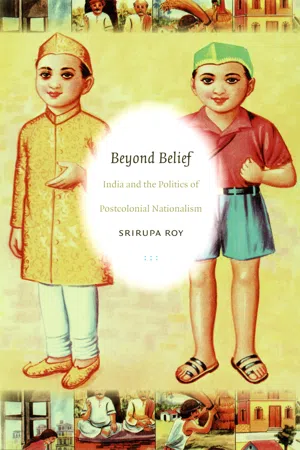
Beyond Belief
India and the Politics of Postcolonial Nationalism
- 265 pages
- English
- PDF
- Available on iOS & Android
eBook - PDF
Beyond Belief
India and the Politics of Postcolonial Nationalism
About this book
Beyond Belief is a bold rethinking of the formation and consolidation of nation-state ideologies. Analyzing India during the first two decades following its foundation as a sovereign nation-state in 1947, Srirupa Roy explores how nationalists are turned into nationals, subjects into citizens, and the colonial state into a sovereign nation-state. Roy argues that the postcolonial nation-state is consolidated not, as many have asserted, by efforts to imagine a shared cultural community, but rather by the production of a recognizable and authoritative identity for the state. This project—of making the state the entity identified as the nation's authoritative representative—emphasizes the natural cultural diversity of the nation and upholds the state as the sole unifier or manager of the "naturally" fragmented nation; the state is unified through diversity.
Information
Publisher
Duke University Press BooksYear
2007Print ISBN
9780822340010
9780822339847
eBook ISBN
9780822389910
Table of contents
- Contents
- Preface and Acknowledgments
- Introduction: Imagining Institutions, Instituting Diversity: Toward a Theory of Nation-State Formation
- Moving Pictures: The Films Division of India and the Visual Practices of the Nation-State
- Marching in Time: Republic Day Parades and the Ritual Practices of the Nation-State
- Indian Darkness: Science, Development, and the Needs Discourse of the Nation-State
- Cities of Hope: Steel Townships and the Spatial Practices of the Nation-State
- Conclusion: After Midnight
- Notes
- Bibliography
- Index
Trusted by 375,005 students
Access to over 1.5 million titles for a fair monthly price.
Study more efficiently using our study tools.
Frequently asked questions
Yes, you can cancel anytime from the Subscription tab in your account settings on the Perlego website. Your subscription will stay active until the end of your current billing period. Learn how to cancel your subscription
No, books cannot be downloaded as external files, such as PDFs, for use outside of Perlego. However, you can download books within the Perlego app for offline reading on mobile or tablet. Learn how to download books offline
Perlego offers two plans: Essential and Complete
- Essential is ideal for learners and professionals who enjoy exploring a wide range of subjects. Access the Essential Library with 800,000+ trusted titles and best-sellers across business, personal growth, and the humanities. Includes unlimited reading time and Standard Read Aloud voice.
- Complete: Perfect for advanced learners and researchers needing full, unrestricted access. Unlock 1.5M+ books across hundreds of subjects, including academic and specialized titles. The Complete Plan also includes advanced features like Premium Read Aloud and Research Assistant.
We are an online textbook subscription service, where you can get access to an entire online library for less than the price of a single book per month. With over 1.5 million books across 990+ topics, we’ve got you covered! Learn about our mission
Look out for the read-aloud symbol on your next book to see if you can listen to it. The read-aloud tool reads text aloud for you, highlighting the text as it is being read. You can pause it, speed it up and slow it down. Learn more about Read Aloud
Yes! You can use the Perlego app on both iOS and Android devices to read anytime, anywhere — even offline. Perfect for commutes or when you’re on the go.
Please note we cannot support devices running on iOS 13 and Android 7 or earlier. Learn more about using the app
Please note we cannot support devices running on iOS 13 and Android 7 or earlier. Learn more about using the app
Yes, you can access Beyond Belief by Srirupa Roy, Julia Adams, George Steinmetz, Julia Adams,George Steinmetz in PDF and/or ePUB format, as well as other popular books in History & Indian & South Asian History. We have over 1.5 million books available in our catalogue for you to explore.