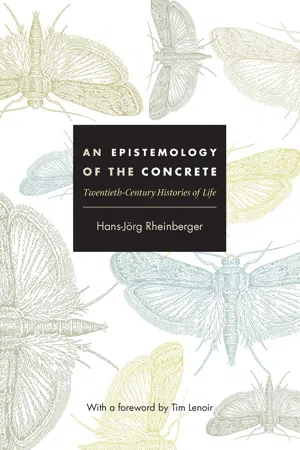
An Epistemology of the Concrete brings together case studies and theoretical reflections on the history and epistemology of the life sciences by Hans-Jörg Rheinberger, one of the world's foremost philosophers of science. In these essays, he examines the history of experiments, concepts, model organisms, instruments, and the gamut of epistemological, institutional, political, and social factors that determine the actual course of the development of knowledge. Building on ideas from his influential book Toward a History of Epistemic Things, Rheinberger first considers ways of historicizing scientific knowledge, and then explores different configurations of genetic experimentation in the first half of the twentieth century and the interaction between apparatuses, experiments, and concept formation in molecular biology in the second half of the twentieth century. He delves into fundamental epistemological issues bearing on the relationship between instruments and objects of knowledge, laboratory preparations as a special class of epistemic objects, and the note-taking and write-up techniques used in research labs. He takes up topics ranging from the French "historical epistemologists" Gaston Bachelard and Georges Canguilhem to the liquid scintillation counter, a radioactivity measuring device that became a crucial tool for molecular biology and biomedicine in the 1960s and 1970s. Throughout An Epistemology of the Concrete, Rheinberger shows how assemblages—historical conjunctures—set the conditions for the emergence of epistemic novelty, and he conveys the fascination of scientific things: those organisms, spaces, apparatuses, and techniques that are transformed by research and that transform research in turn.
eBook - PDF
An Epistemology of the Concrete
Twentieth-Century Histories of Life
- 353 pages
- English
- PDF
- Available on iOS & Android
eBook - PDF
An Epistemology of the Concrete
Twentieth-Century Histories of Life
About this book
Information
Publisher
Duke University Press BooksYear
2010Print ISBN
9780822345756
9780822345602
eBook ISBN
9780822391333
Table of contents
- Contents
- Illustrations
- Foreword by Tim Lenoir
- Prologue
- Part I. Historical Epistemology
- Part II . Model Organisms: Studies in the History of Heredity and Reproduction
- Part III. Concepts and Instruments: Studies in the History of Molecular Biology
- Part IV. Epistemic Configurations
- Acknowledgments
- Abbreviations
- Notes
- Bibliography
- Index
Trusted by 375,005 students
Access to over 1.5 million titles for a fair monthly price.
Study more efficiently using our study tools.
Frequently asked questions
Yes, you can cancel anytime from the Subscription tab in your account settings on the Perlego website. Your subscription will stay active until the end of your current billing period. Learn how to cancel your subscription
No, books cannot be downloaded as external files, such as PDFs, for use outside of Perlego. However, you can download books within the Perlego app for offline reading on mobile or tablet. Learn how to download books offline
Perlego offers two plans: Essential and Complete
- Essential is ideal for learners and professionals who enjoy exploring a wide range of subjects. Access the Essential Library with 800,000+ trusted titles and best-sellers across business, personal growth, and the humanities. Includes unlimited reading time and Standard Read Aloud voice.
- Complete: Perfect for advanced learners and researchers needing full, unrestricted access. Unlock 1.5M+ books across hundreds of subjects, including academic and specialized titles. The Complete Plan also includes advanced features like Premium Read Aloud and Research Assistant.
We are an online textbook subscription service, where you can get access to an entire online library for less than the price of a single book per month. With over 1.5 million books across 990+ topics, we’ve got you covered! Learn about our mission
Look out for the read-aloud symbol on your next book to see if you can listen to it. The read-aloud tool reads text aloud for you, highlighting the text as it is being read. You can pause it, speed it up and slow it down. Learn more about Read Aloud
Yes! You can use the Perlego app on both iOS and Android devices to read anytime, anywhere — even offline. Perfect for commutes or when you’re on the go.
Please note we cannot support devices running on iOS 13 and Android 7 or earlier. Learn more about using the app
Please note we cannot support devices running on iOS 13 and Android 7 or earlier. Learn more about using the app
Yes, you can access An Epistemology of the Concrete by Hans-Jörg Rheinberger, Joseph Dumit in PDF and/or ePUB format, as well as other popular books in Filosofía & Zoología. We have over 1.5 million books available in our catalogue for you to explore.