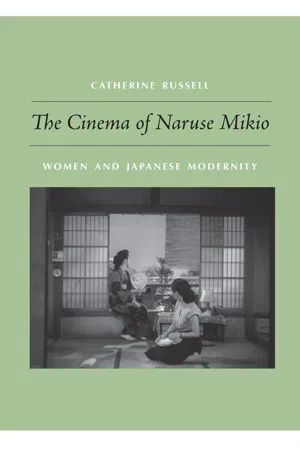
Naruse was a studio-based director, a company man renowned for bringing films in on budget and on time. During his long career, he directed movies in different styles of melodrama while displaying a remarkable continuity of tone. His films were based on a variety of Japanese literary sources and original scripts; almost all of them were set in contemporary Japan. Many were "women's films." They had female protagonists, and they depicted women's passions, disappointments, routines, and living conditions. While neither Naruse or his audiences identified themselves as "feminist," his films repeatedly foreground, if not challenge, the rigid gender norms of Japanese society. Given the complex historical and critical issues surrounding Naruse's cinema, a comprehensive study of the director demands an innovative and interdisciplinary approach. Russell draws on the critical reception of Naruse in Japan in addition to the cultural theories of Harry Harootunian, Miriam Hansen, and Walter Benjamin. She shows that Naruse's movies were key texts of Japanese modernity, both in the ways that they portrayed the changing roles of Japanese women in the public sphere and in their depiction of an urban, industrialized, mass-media-saturated society.
- 486 pages
- English
- PDF
- Available on iOS & Android
eBook - PDF
About this book
One of the most prolific and respected directors of Japanese cinema, Naruse Mikio (1905–69) made eighty-nine films between 1930 and 1967. Little, however, has been written about Naruse in English, and much of the writing about him in Japanese has not been translated into English. With The Cinema of Naruse Mikio, Catherine Russell brings deserved critical attention to this under-appreciated director. Besides illuminating Naruse's contributions to Japanese and world cinema, Russell's in-depth study of the director sheds new light on the Japanese film industry between the 1930s and the 1960s.
Information
Publisher
Duke University Press BooksYear
2008Print ISBN
9780822343127
9780822342908
eBook ISBN
9780822388685
Subtopic
Japanese HistoryTable of contents
- Contents
- Acknowledgments
- Preface
- Introduction: The Auteur as Salaryman
- 1. The Silent Films: Women in the City, 1930–1934
- 2. Naruse at P.C.L.: Toward a Japanese Classical Cinema, 1935–1937
- 3. Not a Monumental Cinema: Wartime Vernacular, 1938–1945
- 4. The Occupation Years: Cinema, Democracy, and Japanese Kitsch, 1945–1952
- 5. The Japanese Woman’s Film of the 1950s, 1952–1958
- 6. Naruse in the 1960s: Stranded in Modernity, 1958–1967
- Conclusion
- Notes
- Filmography
- Bibliography
- Index
Trusted by 375,005 students
Access to over 1.5 million titles for a fair monthly price.
Study more efficiently using our study tools.
Frequently asked questions
Yes, you can cancel anytime from the Subscription tab in your account settings on the Perlego website. Your subscription will stay active until the end of your current billing period. Learn how to cancel your subscription
No, books cannot be downloaded as external files, such as PDFs, for use outside of Perlego. However, you can download books within the Perlego app for offline reading on mobile or tablet. Learn how to download books offline
Perlego offers two plans: Essential and Complete
- Essential is ideal for learners and professionals who enjoy exploring a wide range of subjects. Access the Essential Library with 800,000+ trusted titles and best-sellers across business, personal growth, and the humanities. Includes unlimited reading time and Standard Read Aloud voice.
- Complete: Perfect for advanced learners and researchers needing full, unrestricted access. Unlock 1.5M+ books across hundreds of subjects, including academic and specialized titles. The Complete Plan also includes advanced features like Premium Read Aloud and Research Assistant.
We are an online textbook subscription service, where you can get access to an entire online library for less than the price of a single book per month. With over 1.5 million books across 990+ topics, we’ve got you covered! Learn about our mission
Look out for the read-aloud symbol on your next book to see if you can listen to it. The read-aloud tool reads text aloud for you, highlighting the text as it is being read. You can pause it, speed it up and slow it down. Learn more about Read Aloud
Yes! You can use the Perlego app on both iOS and Android devices to read anytime, anywhere — even offline. Perfect for commutes or when you’re on the go.
Please note we cannot support devices running on iOS 13 and Android 7 or earlier. Learn more about using the app
Please note we cannot support devices running on iOS 13 and Android 7 or earlier. Learn more about using the app
Yes, you can access The Cinema of Naruse Mikio by Catherine Russell in PDF and/or ePUB format, as well as other popular books in Media & Performing Arts & Japanese History. We have over 1.5 million books available in our catalogue for you to explore.