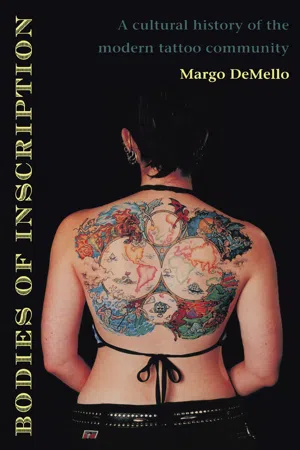
Since the 1980s, tattooing has emerged anew in the United States as a widely appealing cultural, artistic, and social form. In Bodies of Inscription Margo DeMello explains how elite tattooists, magazine editors, and leaders of tattoo organizations have downplayed the working-class roots of tattooing in order to make it more palatable for middle-class consumption. She shows how a completely new set of meanings derived primarily from non-Western cultures has been created to give tattoos an exotic, primitive flavor.
Community publications, tattoo conventions, articles in popular magazines, and DeMello's numerous interviews illustrate the interplay between class, culture, and history that orchestrated a shift from traditional Americana and biker tattoos to new forms using Celtic, tribal, and Japanese images. DeMello's extensive interviews reveal the divergent yet overlapping communities formed by this class-based, American-style repackaging of the tattoo. After describing how the tattoo has moved from a mark of patriotism or rebellion to a symbol of exploration and status, the author returns to the predominantly middle-class movement that celebrates its skin art as spiritual, poetic, and self-empowering. Recognizing that the term "community" cannot capture the variations and class conflict that continue to thrive within the larger tattoo culture, DeMello finds in the discourse of tattooed people and their artists a new and particular sense of community and explores the unexpected relationship between this discourse and that of other social movements.
This ethnography of tattooing in America makes a substantive contribution to the history of tattooing in addition to relating how communities form around particular traditions and how the traditions themselves change with the introduction of new participants. Bodies of Inscription will have broad appeal and will be enjoyed by readers interested in cultural studies, American studies, sociology, popular culture, and body art.
Community publications, tattoo conventions, articles in popular magazines, and DeMello's numerous interviews illustrate the interplay between class, culture, and history that orchestrated a shift from traditional Americana and biker tattoos to new forms using Celtic, tribal, and Japanese images. DeMello's extensive interviews reveal the divergent yet overlapping communities formed by this class-based, American-style repackaging of the tattoo. After describing how the tattoo has moved from a mark of patriotism or rebellion to a symbol of exploration and status, the author returns to the predominantly middle-class movement that celebrates its skin art as spiritual, poetic, and self-empowering. Recognizing that the term "community" cannot capture the variations and class conflict that continue to thrive within the larger tattoo culture, DeMello finds in the discourse of tattooed people and their artists a new and particular sense of community and explores the unexpected relationship between this discourse and that of other social movements.
This ethnography of tattooing in America makes a substantive contribution to the history of tattooing in addition to relating how communities form around particular traditions and how the traditions themselves change with the introduction of new participants. Bodies of Inscription will have broad appeal and will be enjoyed by readers interested in cultural studies, American studies, sociology, popular culture, and body art.