De Genova worked for two and a half years as a teacher of English in ten industrial workplaces (primarily metal-fabricating factories) throughout Chicago and its suburbs. In Working the Boundaries he draws on fieldwork conducted in these factories, in community centers, and in the homes and neighborhoods of Mexican migrants. He describes how the meaning of "Mexican" is refigured and racialized in relation to a U.S. social order dominated by a black-white binary. Delving into immigration law, he contends that immigration policies have worked over time to produce Mexicans as the U.S. nation-state's iconic "illegal aliens." He explains how the constant threat of deportation is used to keep Mexican workers in line. Working the Boundaries is a major contribution to theories of race and transnationalism and a scathing indictment of U.S. labor and citizenship policies.
eBook - PDF
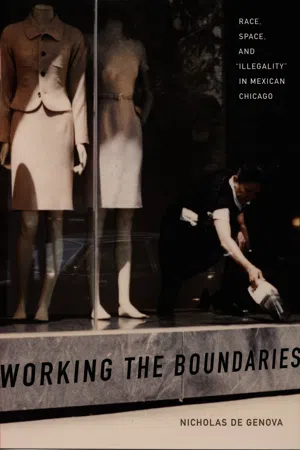
Working the Boundaries
Race, Space, and "Illegality" in Mexican Chicago
- 349 pages
- English
- PDF
- Available on iOS & Android
eBook - PDF
About this book
While Chicago has the second-largest Mexican population among U.S. cities, relatively little ethnographic attention has focused on its Mexican community. This much-needed ethnography of Mexicans living and working in Chicago examines processes of racialization, labor subordination, and class formation; the politics of nativism; and the structures of citizenship and immigration law. Nicholas De Genova develops a theory of "Mexican Chicago" as a transnational social and geographic space that joins Chicago to innumerable communities throughout Mexico. "Mexican Chicago" is a powerful analytical tool, a challenge to the way that social scientists have thought about immigration and pluralism in the United States, and the basis for a wide-ranging critique of U.S. notions of race, national identity, and citizenship.
Information
Publisher
Duke University Press BooksYear
2005Print ISBN
9780822336150
9780822336266
eBook ISBN
9780822387091
Table of contents
- CONTENTS
- ACKNOWLEDGMENTS
- PREFACE
- INTRODUCTION: WORKING THE BOUNDARIES
- I: POLITICS OF KNOWLEDGE/POLITICS OF PRACTICE
- I I . EVERYDAY LIFE: THE LOCATION OF POLITICS
- I I I . HISTORICITY: THE POLITICS OF LOCATION
- CONCLUSION
- NOTES
- BIBLIOGRAPHY
- INDEX
Trusted by 375,005 students
Access to over 1.5 million titles for a fair monthly price.
Study more efficiently using our study tools.
Frequently asked questions
Yes, you can cancel anytime from the Subscription tab in your account settings on the Perlego website. Your subscription will stay active until the end of your current billing period. Learn how to cancel your subscription
No, books cannot be downloaded as external files, such as PDFs, for use outside of Perlego. However, you can download books within the Perlego app for offline reading on mobile or tablet. Learn how to download books offline
Perlego offers two plans: Essential and Complete
- Essential is ideal for learners and professionals who enjoy exploring a wide range of subjects. Access the Essential Library with 800,000+ trusted titles and best-sellers across business, personal growth, and the humanities. Includes unlimited reading time and Standard Read Aloud voice.
- Complete: Perfect for advanced learners and researchers needing full, unrestricted access. Unlock 1.5M+ books across hundreds of subjects, including academic and specialized titles. The Complete Plan also includes advanced features like Premium Read Aloud and Research Assistant.
We are an online textbook subscription service, where you can get access to an entire online library for less than the price of a single book per month. With over 1.5 million books across 990+ topics, we’ve got you covered! Learn about our mission
Look out for the read-aloud symbol on your next book to see if you can listen to it. The read-aloud tool reads text aloud for you, highlighting the text as it is being read. You can pause it, speed it up and slow it down. Learn more about Read Aloud
Yes! You can use the Perlego app on both iOS and Android devices to read anytime, anywhere — even offline. Perfect for commutes or when you’re on the go.
Please note we cannot support devices running on iOS 13 and Android 7 or earlier. Learn more about using the app
Please note we cannot support devices running on iOS 13 and Android 7 or earlier. Learn more about using the app
Yes, you can access Working the Boundaries by Nicholas De Genova in PDF and/or ePUB format, as well as other popular books in Social Sciences & Cultural & Social Anthropology. We have over 1.5 million books available in our catalogue for you to explore.