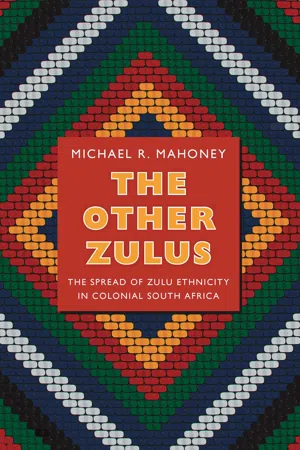
In 1879, the British colony of Natal invaded the neighboring Zulu kingdom. Large numbers of Natal Africans fought with the British against the Zulus, enabling the British to claim victory and, ultimately, to annex the Zulu kingdom. Less than thirty years later, in 1906, many of those same Natal Africans, and their descendants, rebelled against the British in the name of the Zulu king. In The Other Zulus, a thorough history of Zulu ethnicity during the colonial period, Michael R. Mahoney shows that the lower classes of Natal, rather than its elites, initiated the transformation in ethnic self-identification, and they did so for multiple reasons. The resentment that Natal Africans felt toward the Zulu king diminished as his power was curtailed by the British. The most negative consequences of colonialism may have taken several decades to affect the daily lives of most Africans. Natal Africans are likely to have experienced the oppression of British rule more immediately and intensely in 1906 than they had in 1879. Meanwhile, labor migration to the gold mines of Johannesburg politicized the young men of Natal. Mahoney's fine-grained local history shows that these young migrants constructed and claimed a new Zulu identity, both to challenge the patriarchal authority of African chiefs and to fight colonial rule.
- 308 pages
- English
- PDF
- Available on iOS & Android
eBook - PDF
About this book
Information
Publisher
Duke University Press BooksYear
2012Print ISBN
9780822353096
9780822352952
eBook ISBN
9780822395584
Table of contents
- Contents
- Acknowledgments
- Maps
- Introduction
- 1. The Failure of Zulu Ethnic Integration in the Precolonial Zulu Kingdom
- 2. A Zulu King Too Strong to Love, a Colonial State Too Weak to Hate, 1838–1879
- 3. Increasing Conflict among Natal Africans, 1879–1906
- 4. The Role of Migrant Labor in the Spread of Zulu Ethnicity, 1886–1906
- 5. Natal Africans’ Turn to Dinuzulu, 1898–1905
- 6. The Poll Tax Protests and Rebellion, 1905–1906
- Epilogue
- Notes
- Bibliography
- Index
Trusted by 375,005 students
Access to over 1.5 million titles for a fair monthly price.
Study more efficiently using our study tools.
Frequently asked questions
Yes, you can cancel anytime from the Subscription tab in your account settings on the Perlego website. Your subscription will stay active until the end of your current billing period. Learn how to cancel your subscription
No, books cannot be downloaded as external files, such as PDFs, for use outside of Perlego. However, you can download books within the Perlego app for offline reading on mobile or tablet. Learn how to download books offline
Perlego offers two plans: Essential and Complete
- Essential is ideal for learners and professionals who enjoy exploring a wide range of subjects. Access the Essential Library with 800,000+ trusted titles and best-sellers across business, personal growth, and the humanities. Includes unlimited reading time and Standard Read Aloud voice.
- Complete: Perfect for advanced learners and researchers needing full, unrestricted access. Unlock 1.5M+ books across hundreds of subjects, including academic and specialized titles. The Complete Plan also includes advanced features like Premium Read Aloud and Research Assistant.
We are an online textbook subscription service, where you can get access to an entire online library for less than the price of a single book per month. With over 1.5 million books across 990+ topics, we’ve got you covered! Learn about our mission
Look out for the read-aloud symbol on your next book to see if you can listen to it. The read-aloud tool reads text aloud for you, highlighting the text as it is being read. You can pause it, speed it up and slow it down. Learn more about Read Aloud
Yes! You can use the Perlego app on both iOS and Android devices to read anytime, anywhere — even offline. Perfect for commutes or when you’re on the go.
Please note we cannot support devices running on iOS 13 and Android 7 or earlier. Learn more about using the app
Please note we cannot support devices running on iOS 13 and Android 7 or earlier. Learn more about using the app
Yes, you can access The Other Zulus by Michael R. Mahoney in PDF and/or ePUB format, as well as other popular books in History & African History. We have over 1.5 million books available in our catalogue for you to explore.