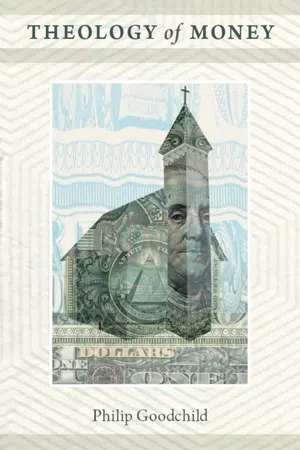
Engaging with Christian theology and the thought of Carl Schmitt, Georg Simmel, Karl Marx, Adam Smith, and many others, Goodchild develops a theology of money based on four contentions, which he elaborates in depth. First, money has no intrinsic value; it is a promise of value, a crystallization of future hopes. Second, money is the supreme value in contemporary society. Third, the value of assets measured by money is always future-oriented, dependent on expectations about how much might be obtained for those assets at a later date. Since this value, when realized, will again depend on future expectations, the future is forever deferred. Financial value is essentially a degree of hope, expectation, trust, or credit. Fourth, money is created as debt, which involves a social obligation to work or make profits to repay the loan. As a system of debts, money imposes an immense and irresistible system of social control on individuals, corporations, and governments, each of whom are threatened by economic failure if they refuse their obligations to the money system. This system of debt has progressively tightened its hold on all sectors and regions of global society. With Theology of Money, Goodchild aims to make conscious our collective faith and its dire implications.
eBook - PDF
Theology of Money
- 315 pages
- English
- PDF
- Available on iOS & Android
eBook - PDF
Theology of Money
About this book
Theology of Money is a philosophical inquiry into the nature and role of money in the contemporary world. Philip Goodchild reveals the significance of money as a dynamic social force by arguing that under its influence, moral evaluation is subordinated to economic valuation, which is essentially abstract and anarchic. His rigorous inquiry opens into a complex analysis of political economy, encompassing markets and capital, banks and the state, class divisions, accounting practices, and the ecological crisis awaiting capitalism.
Information
Publisher
Duke University Press BooksYear
2009Print ISBN
9780822344506
9780822344384
eBook ISBN
9780822392552
Topic
Theologie & ReligionSubtopic
Geschichte & Theorie der PolitikTable of contents
- Contents
- Preface to the U.S. Edition
- Introduction
- Part I. Of Politics
- Part II. A Treatise on Money
- Part III. Of Theology
- Conclusion. Of Redemption
- Notes
- Bibliography
- Index
Trusted by 375,005 students
Access to over 1.5 million titles for a fair monthly price.
Study more efficiently using our study tools.
Frequently asked questions
Yes, you can cancel anytime from the Subscription tab in your account settings on the Perlego website. Your subscription will stay active until the end of your current billing period. Learn how to cancel your subscription
No, books cannot be downloaded as external files, such as PDFs, for use outside of Perlego. However, you can download books within the Perlego app for offline reading on mobile or tablet. Learn how to download books offline
We are an online textbook subscription service, where you can get access to an entire online library for less than the price of a single book per month. With over 1.5 million books across 990+ topics, we’ve got you covered! Learn about our mission
Look out for the read-aloud symbol on your next book to see if you can listen to it. The read-aloud tool reads text aloud for you, highlighting the text as it is being read. You can pause it, speed it up and slow it down. Learn more about Read Aloud
Yes! You can use the Perlego app on both iOS and Android devices to read anytime, anywhere — even offline. Perfect for commutes or when you’re on the go.
Please note we cannot support devices running on iOS 13 and Android 7 or earlier. Learn more about using the app
Please note we cannot support devices running on iOS 13 and Android 7 or earlier. Learn more about using the app
Yes, you can access Theology of Money by Philip Goodchild, Creston Davis, Kenneth Surin, Creston Davis,Kenneth Surin in PDF and/or ePUB format, as well as other popular books in Theologie & Religion & Geschichte & Theorie der Politik. We have over 1.5 million books available in our catalogue for you to explore.