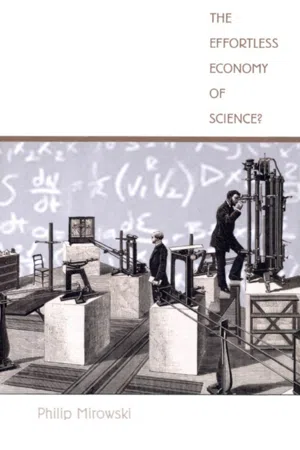
Mirowski contends that neoclassical economists have persistently presumed and advanced an "effortless economy of science," a misleading model of a self-sufficient and conceptually self-referential social structure that transcends market operations in pursuit of absolute truth. In the stunning essays collected here, he presents a radical critique of the ways that neoclassical economics is used to support, explain, and legitimate the current social practices underlying the funding and selection of "successful" science projects. He questions a host of theories, including the portraits of science put forth by Karl Popper, Michael Polanyi, and Thomas Kuhn. Among the many topics he examines are the social stabilization of quantitative measurement, the repressed history of econometrics, and the social construction of the laws of supply and demand and their putative opposite, the gift economy. In The Effortless Economy of Science? Mirowski moves beyond grand abstractions about science, truth, and democracy in order to begin to talk about the way science is lived and practiced today.
- 473 pages
- English
- PDF
- Available on iOS & Android
eBook - PDF
The Effortless Economy of Science?
About this book
A leading scholar of the history and philosophy of economic thought, Philip Mirowski argues that there has been a top-to-bottom transformation in how scientific research is organized and funded in Western countries over the past two decades and that these changes necessitate a reexamination of the ways that science and economics interact. Mirowski insists on the need to bring together the insights of economics, science studies, and the philosophy of science in order to understand how and why particular research programs get stabilized through interdisciplinary appropriation, controlled attributions of error, and funding restrictions.
Information
Publisher
Duke University Press BooksYear
2004Print ISBN
9780822333227
9780822333104
eBook ISBN
9780822385646
Table of contents
- Contents
- Part One. From Economic to Science Studies
- Part Two. Science as an Economic Phenomenon
- Part Three. Rigorous Quantitative Measurement as a Social Phenomenon
- Part Four. Is Econometrics an Empirical Endeavor?
- Part Five. Episodes from the History of the "Laws of Supply and Demand"
- Notes
- References
- Index
Trusted by 375,005 students
Access to over 1.5 million titles for a fair monthly price.
Study more efficiently using our study tools.
Frequently asked questions
Yes, you can cancel anytime from the Subscription tab in your account settings on the Perlego website. Your subscription will stay active until the end of your current billing period. Learn how to cancel your subscription
No, books cannot be downloaded as external files, such as PDFs, for use outside of Perlego. However, you can download books within the Perlego app for offline reading on mobile or tablet. Learn how to download books offline
We are an online textbook subscription service, where you can get access to an entire online library for less than the price of a single book per month. With over 1.5 million books across 990+ topics, we’ve got you covered! Learn about our mission
Look out for the read-aloud symbol on your next book to see if you can listen to it. The read-aloud tool reads text aloud for you, highlighting the text as it is being read. You can pause it, speed it up and slow it down. Learn more about Read Aloud
Yes! You can use the Perlego app on both iOS and Android devices to read anytime, anywhere — even offline. Perfect for commutes or when you’re on the go.
Please note we cannot support devices running on iOS 13 and Android 7 or earlier. Learn more about using the app
Please note we cannot support devices running on iOS 13 and Android 7 or earlier. Learn more about using the app
Yes, you can access The Effortless Economy of Science? by Philip Mirowski in PDF and/or ePUB format, as well as other popular books in Economics & Economic History. We have over 1.5 million books available in our catalogue for you to explore.