- 256 pages
- English
- ePUB (mobile friendly)
- Available on iOS & Android
eBook - ePub
About this book
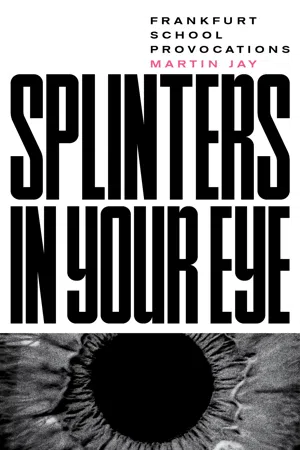
Although successive generations of the Frankfurt School have attempted to adapt Critical Theory to new circumstances, the work done by its founding members continues in the 21st century to unsettle conventional wisdom about culture, society and politics. Exploring unexamined episodes in the School's history and reading its work in unexpected ways, these essays provide ample evidence of the abiding relevance of Horkheimer, Adorno, Benjamin, Marcuse, L?wenthal, and Kracauer in our troubled times. Without forcing a unified argument, they range over a wide variety of topics, from the uncertain founding of the School to its mixed reception of psychoanalysis, from Benjamin's ruminations on stamp collecting to the ironies in the reception of Marcuse's One-Dimensional Man, from L?wenthal's role in Weimar's Jewish Renaissance to Horkheimer's involvement in the writing of the first history of the Frankfurt School. Of special note are their responses to visual issues such as the emancipation of color in modern art, the Jewish prohibition on images, the relationship between cinema and the public sphere, and the implications of a celebrated Family of Man photographic exhibition. The collection ends with two essays tracing the still metastasizing demonization of the Frankfurt School by the so-called Alt Right as the source of "cultural Marxism" and "political correctness," which has gained alarming international resonance and led to violence by radical right-wing fanatics.
Information
Topic
PhilosophySubtopic
Critical Theory1
Ungrounded: Horkheimer and the Founding of the Frankfurt School
A perennial issue in the reception of Critical Theory is the difficulty of locating secure ground for critique once the traditional Marxist reliance on either the partisan standpoint of the proletariat or the scientific nature of Marxist theory is questioned.1 Can we establish a firm foundation—either transcendentally or immanently, in a particular history—for the normative impulse, the conviction that the current order can and should be replaced by a more just and humane alternative that distinguishes a critical from a traditional theory, as Horkheimer contended in his seminal essay of 1937? Taking seriously the parallel question of the historical founding of the Institute for Social Research, out of which the Frankfurt School developed, this chapter argues that, in both cases, there is sufficient uncertainty to warrant rethinking the apparent necessity of explicit origins, firm grounds and identifiable points d’appui in assessing the ability of an intellectual tradition to claim critical purchase for its work. Even conventional attempts to situate Critical Theory firmly in the tradition of Hegelian Marxism may falter if we take seriously the less appreciated role played by anti-Hegelian figures such as Schelling in stimulating doubts about his legacy.2 The temporal underpinning of normativity, it turns out, may well be more an imagined future than a remembered past.
In the 1962 preface to the republication of The Theory of the Novel, Georg Lukács introduced an epithet that has served ever since to belittle the Frankfurt School’s alleged pessimism, distance from political practice and privileged personal lives:
A considerable part of the leading German intelligentsia, including Adorno, has taken up residence in the “Grand Hotel Abyss” which I described in connection with my critique of Schopenhauer as “a beautiful hotel, equipped with every comfort, on the edge of an abyss, of nothingness, of absurdity. And the daily contemplation of the abyss between excellent meals or artistic entertainments, can only heighten the enjoyment of the subtle comforts offered.”3
As he admitted, Lukács had used the term before, but, as it turns out, not only in reference to Schopenhauer in his 1954 Destruction of Reason. It had, in fact, been coined even earlier, in a piece he wrote in 1933, but never published in his lifetime, to mock soi-disant progressive intellectuals like Upton Sinclair or Thomas Mann, who refused to abandon their bourgeois lifestyles and affiliate themselves with the Communist Party.4 This more diffuse usage did not, however, resonate publicly, and it was not really until the identification with Adorno and his colleagues that it gained any real traction. Although normally employed by leftist detractors of the Frankfurt School, the term gained enough familiarity that a sympathetic “photobiography” of the School, edited in 1990 by Willem van Reijin and Gunzelin Schmid Noerr, could be titled, without apparent irony, Grand Hotel Abgrund.5
I want to pause for a moment with this term because it raises an important question that goes beyond the easy condemnation of unaffiliated radical intellectuals for their alleged betrayal of the link between theory and practice. The German word Abgrund has a connotation that is absent in the English equivalent “abyss,” for it suggests the loss of the foundation or ground (Grund) on which one might securely support critique. For a Communist militant like Lukács, the only way for an intellectual to avoid hurtling into the abyss was to stand firmly on the ground of the vanguard party of the workers’ movement, subordinating himself to the dictates of its enlightened leadership. No matter how brilliant the analysis of an anticapitalist critic might be or how intense his moral indignation, it was only by joining with the forces that would change society that he could avoid impotence and be on the right side of history. The metaphor of a firm ground or foundation was also evident in the frequent use of the word “Standpunkt” by other Marxists of Lukács’s generation like Karl Korsch, who insisted on the proletarian standpoint of historical materialism.6 Although located in a world still riven with class divisions, it was potentially that of the universal class that would end those very divisions, and as such transcended relativism. Whether it be the consciousness of the proletariat, either actual or ascribed, an objective historical process leading to the terminal crisis of capitalism or a subtle combination of both, there was assumed to be ground on which the critical intellectual could stand, a concrete location like the French military point d’appui where forces could gather before an assault, a foundation to support a solid critique of the status quo.
In labeling the Frankfurt School “the Grand Hotel Abyss,” Lukács was thus not only denigrating the supposedly comfortable existence of its members, but also their refusal to credit the necessary role of the party and class as the concrete historical ground of radical ideas. Whether or not he was right about the former—their “damaged lives” in exile, to cite the celebrated subtitle of Minima Moralia, suggests otherwise—his second reproach was on target. From its inception, the intellectuals who gathered around the Institut für Sozialforschung knew that critique could not be directly grounded in the praxis or consciousness of the class that Marx had assigned the historical role of incipient universal class, let alone the vanguard party that claimed to be the repository of its imputed or ascribed class consciousness.7 They understood the limits of the claim, classically expressed in Vico’s verum factum principle, that those who made the world were able to know what they had made better than those who were merely contemplating it.8
Was it possible to ground it instead in an objective “scientific” grasp of the totality of social relations to allow an unaffiliated nonpartisan theoretician to decipher not only the surface phenomena of contemporary society but also the deeper, more essential trends that foreshadowed a potential future? Could intellectuals who “floated freely,” to borrow the metaphor that Karl Mannheim would make famous at the end of the decade when the Institute set up shop, have a totalizing perspective on the world below? Or is it a dangerous myth to assume anyone might have a disinterested view above the fray, especially when the very distinction between facts and values was itself being questioned? Max Horkheimer had little use, however, for Mannheim’s solution, which assumed intellectuals from different classes could somehow harmonize their positions and turn them into complementary perspectives on the whole.9 Neither rooted nor free-floating, critique was located somewhere else on a map that included utopias still to be realized.10
One possible alternative drew on the unconstrained will, in which the act of founding was ex nihilo, a gesture of assertion that drew whatever legitimacy it might have entirely from itself rather than any preceding authority, whether based in tradition, rationality or the practical activity of a privileged social group. Here the ground was temporal more than spatial, an origin more than a place.11 It was established through what came to be called decisionist fiat, most famously defended by the Weimar and then Nazi jurist Carl Schmitt, who argued that the decision to found a legal order could not itself be rooted in a prior legality. But this alternative was frankly irrationalist. Drawing as it did on an analogy from the purely voluntarist version of God that had been promulgated in the Middle Ages by nominalists like William of Ockham, who denied the limitations on divine will placed by any notion of rational intelligibility or ideal form, it relied solely on a spontaneous act of a sovereign subject. As such, it implied a unified metasubject, prior to individual subjects, with the power to do the founding—a subject whose unconstrained will might also lead to material world domination. Consequently, Critical Theory was never tempted by it.12
For a while, the alternative favored by Horkheimer and his colleagues was what became known as “immanent critique”—that is, eschewing any universal or transcendent vantage point above the fray and seeking an alternative in the specific normative claims of a culture that failed to live up to them in practice. Or, in more explicitly Hegelian terms, it meant finding some critical purchase in the gap between a general concept and the specific objects subsumed under it. As a recent champion of this approach, Robert Hullot-Kentor, put it, “Immanent criticism turns the principle of identity, which otherwise serves the subordination of object to subject, into the power for the presentation of the way in which an object resists its subjective determination and finds itself lacking.” To criticize without an Archimedean point beyond or outside of the target of criticism, he continues, “is the development of the idea as the object’s self-dissatisfaction that at every point moves toward what is not idea; it potentiates from within the requirement of an objective transformation.”13
But what if immanent critique acknowledges the possibility that objects are always in excess of the concepts that define them or, in other words, that the Hegelian presupposition of an immanent dialectical totality fails to acknowledge the nonsublatable quality of radical otherness? Interestingly, in his analysis of phenomenology in The Metacritique of Epistemology, Adorno himself came precisely to this conclusion. Although claiming that “dialectic’s very procedure is immanent critique,” he conceded:
The concept of immanence sets the limits on immanent critique. If an assertion is measured by its presuppositions, then the procedure is immanent, i.e. it obeys formal-logical rules and thought becomes a criterion of itself. But it is not decided as a necessity of thought in the analysis of the concept of being that not all being is consciousness. The inclusiveness of such an analysis is thus halted. To think non-thinking [Nichtdenken] is not a seamless consequence of thought. It simply suspends claims to totality on the part of thought. Immanence, however, in the sense of that equivocation of consciousness and thought, is nothing other than such totality. Dialectic negates both together.14
What this convoluted passage suggests is that the folding of all objects into a field of conceptual immanence is an idealist fantasy in which the nonidentical is absorbed into the identical with no remainder. Thus, immanent critique cannot be in itself fully grounded, as the totality is itself never fully self-contained and concepts are never fully able to subsume all objects under them.
In addition to the problems in the dialectical concept of total immanence, what if “the self-dissatisfaction of the object,” its striving to be adequate to its concept, fails to manifest itself in a society that Herbert Marcuse could call “one-dimensional” and Adorno “totally administered”? What if the possibility of “objective transformation” is thwarted by the ideological seamlessness of a social order that actually functionalizes apparent dissatisfaction in the service of system maintenance? What if the totality that prevails is not one whose contradictions and antinomies threaten to undermine it, but rather one in which they serve to keep it going through a kind of autoimmune equilibrium? In Minima Moralia, Adorno acknowledged precisely this danger with reference to the decline of irony:
Irony’s medium, the difference between ideology and reality, has disappeared. The former resigns itself to confirmation of reality by its mere duplication … There is not a crevasse in the cliff of the established order into which the ironist might hook a fingernail … Pitted against the deadly seriousness of total society, which has absorbed the opposing voice, the impotent objection earlier quashed by irony, there is now only the deadly seriousness of the comprehended truth.15
With all possible grounds for critique thus, in one way or another, insufficient, was it then perhaps simply a vain quest to seek a legitimating point d’appui? If there was no social subject position or historical agent whose praxis could be the source of critique, no purely philosophical first principles or a priori, transcendental grounds from which to launch such an analysis, and no immanent totality in which objects might become adequate to their concepts, might looking for such ground be itself part of the problem, rather than the solution?16 In the subsequent history of the Frankfurt School, this antifoundationalist conclusion became increasingly hard to avoid, as the material basis for critique grew ever more remote and both the appeal of a philosophy of transcendent principles and the confidence in immanent critique diminished. Even the call for an “objective” or “emphatic” notion of reason, which Horkheimer still desperately undertook as late as Eclipse of Reason in 1947, lost its capacity to inspire much confidence, as rationality itself seemed to suffer a self-liquidation embedded from its very beginnings in the need for self-preservation against a hostile nature.17
And yet Critical Theory did not, as we know, give up the mission of critically analyzing the status quo in the hope of enabling a radically different and better future. Might not some explanation of its stubborn refusal to abandon that task be found not in abstract principles, or at least not in them alone, but also in the history of its own institutional foundation in the Weimar era? The remainder of this chapter explores the school’s historical origins so as to interrogate its assumption of a critical vantage point on the world it inhabited. How can we characterize the literal foundation of the Frankfurt School and what kind of authority, if any, did it provide for the work that followed? Might its willingness to draw intellectual sustenance from a heteroclite variety of sources—including, as I will suggest, even the anti-Hegelian philosophy of Schelling—be illuminated by acknowledging those origins?
The details of the origins of the Institute of Social Research have, of course, been known for some time.18 What must be emphasized is the ragged, inadvertent, adventitious quality of its beginnings. Nothing expresses this dimension of the story as explicitly as the source of its financial support, which came from the fortune of German-Jewish grain merchant Hermann Weil, who had cornered the Argentine trade in wheat in the late nineteenth century and came to play a critical role in the economic policies of Germany during World War I, when he advised the kaiser and the general staff. He shared the ambitious war aims that fueled German aggression in 1914, but, by the end of the war, had come to argue for a negotiated peace with England to avoid economic disaster. After the armistice, he turned away from politics to philanthropy, joining the many other generous bourgeois donors who had helped create a “Stiftungsuniversität” in Frankfurt before the war.19 Weil’s pol...
Table of contents
- Cover Page
- Halftitle Page
- Title Page
- Copyright Page
- Dedication
- Contents
- Acknowledgments
- Introduction
- 1. Ungrounded: Horkheimer and the Founding of the Frankfurt School
- 2. “The Hope That Earthly Horror Does Not Possess the Last Word”: Max Horkheimer and The Dialectical Imagination
- 3. Max Horkheimer and The Family of Man
- 4. “In Psychoanalysis Nothing Is True but the Exaggerations”: Freud and the Frankfurt School
- 5. Leo Löwenthal and the Jewish Renaissance
- 6. Adorno and Blumenberg: Nonconceptuality and the Bilderverbot
- 7. Chromophilia: Der Blaue Reiter, Walter Benjamin and the Emancipation of Color
- 8. Timbremelancholy: Walter Benjamin and the Fate of Philately
- 9. The Little Shopgirls Enter the Public Sphere: Miriam Hansen on Kracauer
- 10. Irony and Dialectics: One-Dimensional Man and 1968
- 11. Dialectic of Counter-Enlightenment: The Frankfurt School as Scapegoat of the Lunatic Fringe
- Notes
- Index
Trusted by 375,005 students
Access to over 1.5 million titles for a fair monthly price.
Study more efficiently using our study tools.
Frequently asked questions
Yes, you can cancel anytime from the Subscription tab in your account settings on the Perlego website. Your subscription will stay active until the end of your current billing period. Learn how to cancel your subscription
No, books cannot be downloaded as external files, such as PDFs, for use outside of Perlego. However, you can download books within the Perlego app for offline reading on mobile or tablet. Learn how to download books offline
Perlego offers two plans: Essential and Complete
- Essential is ideal for learners and professionals who enjoy exploring a wide range of subjects. Access the Essential Library with 800,000+ trusted titles and best-sellers across business, personal growth, and the humanities. Includes unlimited reading time and Standard Read Aloud voice.
- Complete: Perfect for advanced learners and researchers needing full, unrestricted access. Unlock 1.5M+ books across hundreds of subjects, including academic and specialized titles. The Complete Plan also includes advanced features like Premium Read Aloud and Research Assistant.
We are an online textbook subscription service, where you can get access to an entire online library for less than the price of a single book per month. With over 1.5 million books across 990+ topics, we’ve got you covered! Learn about our mission
Look out for the read-aloud symbol on your next book to see if you can listen to it. The read-aloud tool reads text aloud for you, highlighting the text as it is being read. You can pause it, speed it up and slow it down. Learn more about Read Aloud
Yes! You can use the Perlego app on both iOS and Android devices to read anytime, anywhere — even offline. Perfect for commutes or when you’re on the go.
Please note we cannot support devices running on iOS 13 and Android 7 or earlier. Learn more about using the app
Please note we cannot support devices running on iOS 13 and Android 7 or earlier. Learn more about using the app
Yes, you can access Splinters in Your Eye by Martin Jay in PDF and/or ePUB format, as well as other popular books in Philosophy & Critical Theory. We have over 1.5 million books available in our catalogue for you to explore.