In 1971, Newsweek heralded The Last Picture Show as "the most impressive work by a young American director since Citizen Kane." Indeed, few filmmakers rivaled Peter Bogdanovich's popularity over the next decade. Riding the success of What's Up, Doc? (1972) and Paper Moon (1973), Bogdanovich became a bona fide celebrity, making regular appearances in his own movie trailers, occasionally hosting late-night television shows, and publicly advocating for mentors John Ford and Howard Hawks. No director of his era surpassed his ability to capture an audience's imagination.
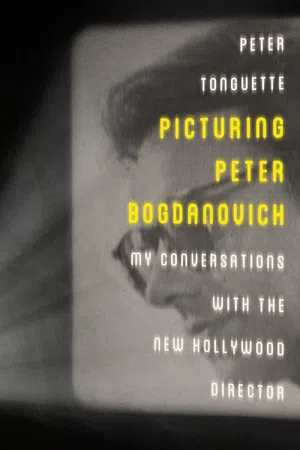
In Picturing Peter Bogdanovich: My Conversations with the New Hollywood Director, journalist and critic Peter Tonguette offers a film-by-film journey through the director's life and work. Beginning with a string of 1970s classics, Tonguette explores well-known films such as Saint Jack (1979), They All Laughed (1981), and Noises Off (1992), as well as the director's work on stage and television. Drawing on interviews conducted over sixteen years, Tonguette pairs his analysis with an extensive, previously unpublished series of Q&As with Bogdanovich. These exclusive interviews reveal behind-the-scenes details about the director's life, work, and future plans. Part memoir, part biography, this book offers a uniquely intimate portrait of one of Hollywood's most underappreciated directors.
eBook - ePub
Picturing Peter Bogdanovich
My Conversations with the New Hollywood Director
- 246 pages
- English
- ePUB (mobile friendly)
- Available on iOS & Android
eBook - ePub
About this book
Information
PART 1
“Call Me Peter, Peter”
The Giants were my delight, my folly, my anodyne, my intellectual stimulation.
— Frederick Exley, A Fan’s Notes: A Fictional Memoir
But how seldom two imaginations coincide!
— Saul Bellow, The Adventures of Augie March
I dialed the number his assistant had given me.
Brrring.
No answer.
Brrring.
No answer.
Brrring.
No answer.
For some reason, calling Peter Bogdanovich for the first time for an interview made me feel like Tom Sawyer.
Could it have been because I was so young? Not Tom Sawyer young, but close enough. When I called Peter Bogdanovich on the night before Thanksgiving in 2003 (the date must have some sort of cosmic significance, but for the life of me I cannot imagine what it might be), I was several months’ shy of my twenty-first birthday. I had a right to be nervous. If I measured myself against Peter Bogdanovich, as I often did, I was supposed to have done something by that age.
When he was twenty-one, he was already well on his way to the fortune and glory he would later gain as the director of a batch of extraordinary films that were all the rage—with both the critics and the public—in the early 1970s. The native New Yorker—born on July 30, 1939, to Borislav (a painter) and Herma (a homemaker and maker of frames)—started early. At the age of fourteen, while a student at the Collegiate School, he began penning frighteningly perceptive movie and theater reviews in his column “As We See It.” This anticipated his subsequent career writing feature articles for Esquire and New York, among other august publications.
But the prodigy was not consumed with writing alone—oh, there was more.
Acting was his first passion. His “earliest performances,” he wrote, were recitations of poetry and stories at dinner parties thrown by his parents: “After the meal they would ask me to recite … poems like Poe’s Annabel Lee’ or ‘The Raven,’ or Whitman’s ‘O Captain! My Captain!’ or Robert W. Service’s ‘The Shooting of Dan McGrew’—or to read a short story like Poe’s ‘The Tell-Tale Heart.’”1
Soon, though, he moved out of the dining room and onto the boards.
In an introduction to Bogdanovich’s collection of essays Pieces of Time, his editor at Esquire, Harold Hayes, noted with pride that Bogdanovich was all of fifteen when he became an acting student of Stella Adler—“having lied about his age and cut his gym class to make time available.”2 His classes with Adler—no matter the, ahem, fraudulent means through which they were obtained—resulted in appearances on stage and on live television, making him a seasoned trouper when he was not yet out of short pants.
More: “In 1959, at nineteen,” Hayes continued, “he somehow managed to raise the money to stage an off-Broadway production of Clifford Odets’ The Big Knife.”3 Are you keeping track? Good: journalist, actor, stage director—and barely old enough to drive. He was not tranquil with his success, either. Hollywood beckoned. It would not be too many more years before he and his first wife—production and costume designer Polly Platt—headed from New York to California, armed with a little money, a plethora of contacts obtained through his writing career, and the general notion that they wanted to make movies—not just see them or write about them.
By the time he was twenty-one, then, Peter Bogdanovich had done his share of Big Things and was destined for even Bigger Things. Me? In between shoveling snow in my suburb of Columbus, Ohio, I was just trying to launch my writing career—not exactly the sort of thing that Harold Hayes would have considered worth commemorating in print.
Nonetheless, on that Thanksgiving Eve in 2003, I found myself dialing Peter Bogdanovich’s number and waiting for him—or anyone—to pick up. I imagined the phone ringing off the hook in his handsome Upper West Side apartment, the one I had seen in a photograph when the New Yorker profiled him the previous year, just as his most recent film, The Cat’s Meow, was about to come out.
On this night, however, it seemed that no one was home—or answering, anyway. I hung up. What to do? I had a backup plan. In case he did not pick up when I called at the appointed time, his assistant had given me a second number to try. It was, she told me, the number to his cell phone. I leaned back in my chair for a long moment. I grabbed the receiver and thought, What the hell—why not?
Brrring.
Brrring.
This time—improbably, because he still felt out of reach to me—he answered. “Yeah?” he said. He sounded impatient—a little testy. I did not know then that this was how he almost always answered the phone—“Yeah?”—no matter his mood, and that his tone was not unfriendly but quizzical. It suggested that he had … things … going on … important things. He simply wanted assurance that he was being interrupted for a damn good reason.
So: “Yeah?”
I gulped and began: Who I was. Why I was calling. When—ahem—we had been scheduled to talk.
He listened patiently, without saying a word in response, and I began to wonder if any of what I said rang a bell. Had his assistant bungled our phoner? When I finally stopped talking, he calmly explained that he was being driven home from the New York set of The Sopranos, the popular HBO television series on which he had the plum role of the Lorraine Bracco character’s psychiatrist. Could I call him when he got home in fifteen minutes? He was, it turned out, perfectly polite, asking only that I give him some time—you know—to walk in the door and turn on the lights and have a sip of water before I started grilling him.
Shoot, I thought to myself. I should have just waited.
You may be wondering why I was calling Peter Bogdanovich in the first place.
Ostensibly, I was interviewing him for an article I was writing about his films, but I have to level with you: this was a bit of a ruse. In truth, I had loved his movies for years, and I simply wanted to talk about them with him. My mind was overflowing with questions: How did he cajole Ben Johnson into taking the part of Sam the Lion in The Last Picture Show? Why did he open Paper Moon with a close-up of its young star, Tatum O’Neal? Was it just the way I saw it, or was They All Laughed more personal—more him—than anything else he’d ever done? If the only way I could ask him these (and many other) questions was by becoming a professional journalist and talking my way into an assignment to write an article about his work—well, so be it.
Let’s face facts: I began writing about movies in the hope that my job would one day give me an excuse to talk to Peter Bogdanovich. There are worse reasons to select an occupation, right?
I was, to put it bluntly, a fan—but if you knew all that I did, you would be, too. What was there not to like? Following his detours in print and on stage, Bogdanovich jumped into moviemaking with gusto, and he met with such instantaneous success—laudatory reviews, big box office—that it was as though the public and industry had been waiting for him. What took you so long? they might have been asking.
By 1971, when The Last Picture Show was released, it had been a rough few years for anyone who prized classical filmmaking and its attendant virtues. Tapping into the antiestablishment mood of some in the country, films such as Midnight Cowboy and Woodstock seemed to be multiplying—like a virus. For all their differences, they had much in common: they were morally incoherent and visually ugly, bearing scant relation to the art form built by the likes of D. W. Griffith, John Ford, and Orson Welles.
Into this noxious environment stepped Peter Bogdanovich, and the contrast could not have been more striking. Pauline Kael was never his most sympathetic critic, but she got one big thing right. “He has a real gift for simple, popular movies,” she wrote. “He can tell basic stories that will satisfy a great many people, and this is not a common gift.”4 Introducing Bogdanovich’s book Pieces of Time, Harold Hayes quoted a studio executive expressing a similar sentiment: “People don’t want to be reminded of their problems. They want to be diverted and entertained. They want a Paper Moon by Bogdanovich, not a reprise on the tragedy of Bobby Kennedy.”5
Recognizing an ally, veteran directors saw that Peter Bogdanovich was part of their tradition—“one of us,” as the cabal in Tod Browning’s great horror film Freaks says. But these were no freaks—these were the normal people, and Bogdanovich joined their ranks eagerly. He became a friend to Ford and Welles and many others, and the only thing that stood in the way of an apprenticeship with Griffith was that the maker of Intolerance and Broken Blossoms had died in 1948, when the future filmmaker was nine. Bad timing.
Director George Stevens, he said, sought him out and gave him a pat on the back: “You know what it’s about. These guys don’t know what it’s about. That’s why we need you.”6 Well, George Stevens wasn’t D. W. Griffith, but, still, he was the man who had made Shane and Giant and A Place in the Sun. “These guys” meant, of course, Bogdanovich’s peers—those much-honored filmmakers who emerged at about the same time he did, including Martin Scorsese, Francis Ford Coppola, and William Friedkin—but the most honest of them knew that Stevens spoke the truth. “The last person to make classical American cinema was Peter,” Scorsese said. “To really utilize the wide frame and the use of the deep focal length. He really understood it.”7 Observed writer Judy Stone in the New York Times in 1968: “Peter is under 30, but he doesn’t identify with his own generation.”8
Howard Hawks immodestly pointed out that Bogdanovich, in his capacity as a journalist, “sat on my set for two and a half years and on Ford’s for two and a half years, so he learned a few things.”9 Yes, yes, Howard—he had studied well. But he also benefitted from a more hands-on opportunity that presented itself soon after he made it to California with Polly Platt: he was brought on as an assistant on Roger Corman’s low-budget biker film The Wild Angels. So when Corman—as a kind of thank-you present—told Bogdanovich that could direct a movie, Bogdanovich was raring to go.
Rebellion was in the air in 1968, and it usually took the form of the young rising up against the old. In his debut film, Targets, Peter Bogdanovich reversed the equation, pitting a chivalrous senior citizen against a murderous postadolescent.
The hero of the story is Byron Orlok (Boris Karloff), a star of antediluvian horror epics. As the film opens, we find Orlok watching his current effort (actually recut scenes from the Karloff flick The Terror) in a dingy screening room in downtown Los Angeles. With its shots of crows shrieking and floods washing away damsels in distress, what we see of The Terror looks remarkably démodé, and by the time it is all over, Orlok—sitting stoop-shouldered in the third row—has decided to call it a career. With murder and mayhem having become daily realities, who in their right mind would be spooked by such stuff?
Before Orlok can slink away into the night, however, he has to answer to Sammy Michaels (expertly played by Bogdanovich), a greenhorn writer-director with whom he had promised to collaborate on a future project. Sammy implores Orlok to think twice about hanging it up, but Orlok refuses to budge. In their stubbornness, however, they prove themselves to be two of a kind: with his conservative dress and respectful manner, Sammy looks as out of place as Orlok in the Southern California of the late 1960s. About the worst you can say about Sammy is that he rudely tells Orlok to hush when the two find themselves watching one of Orlok’s old films on television (another Karloff project—this one, though, far more creditable than The Terror: Howard Hawks’s top-notch thriller The Criminal Code).
The character of Sammy makes for a ready-made contrast to Bobby Thompson (Tim O’Kelly), a Vietnam veteran who, apropos of nothing, morphs into a serial killer. Like Sammy, Bobby is in his late twenties and sports a clean-cut appearance, but in every other way he is Sammy’s shadow. A dim fellow with a toothy, heartless smile, we first see him as he purchases munitions at a gun store across the street from the screening room where Orlok and Sammy haggle. Orlok goes out of his way to call Sammy “a sweet boy,” and one glimpse of Bobby explains why: in the world of Targets, civility and virtue are rare qualities indeed.
Yet the screenplay (written by Bogdanovich and Polly Platt, with uncredited rewrites courtesy of Samuel Fuller) avoids pinning Bobby’s crimes on his war experience. After all, unlike many of his comrades, Bobby has returned home in one piece and seemingly none the worse for wear. What—we might ask—does he have to complain about? His placid family life is also exempted from blame: the single-story suburban house he shares with his parents and wife may be bland and uninviting, but so are many other houses, and few of them incubate mass murderers. “We tried to avoid a specific reason,” Bogdanovich told Judy Stone. “We did a lot of research, and the most terrifying aspect of these crimes is that there is no answer. We can find no reason commensurate with the size of the crime.”10 Yet the not-so-subtle suggestion in Targets is that culture makes the difference: Sammy, with his appreciation of old movies, has it, whereas Bobby, forever gobbling Baby Ruths and listening to rock music, does not.
Bobby and Orlok encounter each other at the drive-in theater at which Orlok is to put in an appearance before sailing to retirement in England. Mayhem ensues...
Table of contents
- Cover
- Half title
- Title
- Copyright
- Contents
- Prologue: “I Hadn’t Realized It Was So Late in Ohio”
- Part 1. “Call Me Peter, Peter”
- Part 2. Q&A
- Acknowledgments
- Notes
- Index
Trusted by 375,005 students
Access to over 1.5 million titles for a fair monthly price.
Study more efficiently using our study tools.
Frequently asked questions
Yes, you can cancel anytime from the Subscription tab in your account settings on the Perlego website. Your subscription will stay active until the end of your current billing period. Learn how to cancel your subscription
No, books cannot be downloaded as external files, such as PDFs, for use outside of Perlego. However, you can download books within the Perlego app for offline reading on mobile or tablet. Learn how to download books offline
Perlego offers two plans: Essential and Complete
- Essential is ideal for learners and professionals who enjoy exploring a wide range of subjects. Access the Essential Library with 800,000+ trusted titles and best-sellers across business, personal growth, and the humanities. Includes unlimited reading time and Standard Read Aloud voice.
- Complete: Perfect for advanced learners and researchers needing full, unrestricted access. Unlock 1.5M+ books across hundreds of subjects, including academic and specialized titles. The Complete Plan also includes advanced features like Premium Read Aloud and Research Assistant.
We are an online textbook subscription service, where you can get access to an entire online library for less than the price of a single book per month. With over 1.5 million books across 990+ topics, we’ve got you covered! Learn about our mission
Look out for the read-aloud symbol on your next book to see if you can listen to it. The read-aloud tool reads text aloud for you, highlighting the text as it is being read. You can pause it, speed it up and slow it down. Learn more about Read Aloud
Yes! You can use the Perlego app on both iOS and Android devices to read anytime, anywhere — even offline. Perfect for commutes or when you’re on the go.
Please note we cannot support devices running on iOS 13 and Android 7 or earlier. Learn more about using the app
Please note we cannot support devices running on iOS 13 and Android 7 or earlier. Learn more about using the app
Yes, you can access Picturing Peter Bogdanovich by Peter Tonguette in PDF and/or ePUB format, as well as other popular books in Mezzi di comunicazione e arti performative & Film e video. We have over 1.5 million books available in our catalogue for you to explore.