- English
- ePUB (mobile friendly)
- Available on iOS & Android
eBook - ePub
About this book
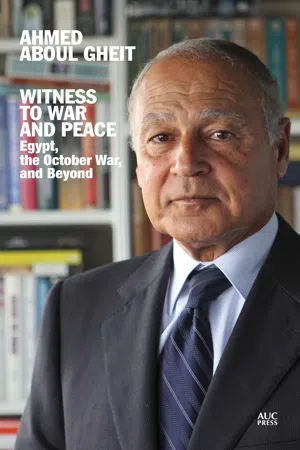
The son of a fighter pilot, raised in an air force barracks, Ahmed Aboul Gheit was privy to the confidential meetings, undisclosed memoranda, and battle secrets of Egyptian diplomacy for many decades. After a stint at military college, he began his career at the Egyptian embassy in Cyprus before later going on to become permanent representative to the United Nations and eventually, Egypt's minister of foreign affairs under Hosni Mubarak. In this fascinating memoir, Aboul Gheit looks back on the 1973 October War and the diplomatic efforts that followed it, revealing the secrets of his long career for the first time.
In vivid detail he describes the deliberations of Egypt's political leadership in the run-up to the war, including the process of articulating Egypt's war aims, the secret communications between President Sadat and U.S. Secretary of State Henry Kissinger, the role of the Soviet Union during the war, and the unfolding of events on the battlefront in Sinai. He then gives a detailed and deeply personal account of the arduous process of peacemaking that followed, covering the 1973 Geneva Conference, the 1977 Mena House Conference, Sadat's visit to Israel, the 1978 Camp David Accords, and the subsequent 1979 Egyptian–Israeli Peace Treaty.
From Sadat's impassioned address to his cabinet on the eve of the war to delegations ripping out the wiring at their respective hotels, from Jimmy Carter cycling through the bungalows at Camp David to Yitzhak Shamir's blunt admissions to his Arab counterparts in the 1991 Madrid conference, Aboul Gheit offers an information-packed, first-person account of a turbulent time in Middle Eastern history.
Information
Witness to War
1 Silent War, Secret War: 1968–73
War begins not with the roar of gunfire but with months, indeed years, of painstaking preparation. The tasks are varied and endless, but the most important are performed in silence: covert operations aimed at divining the enemy’s intentions and capacities, while preserving your own secrets. Such operations are an integral part of armed conflict before, during, and after the first shot is fired.
In the 1973 war, more commonly known in the west as the Yom Kippur War, and the politics that followed, both Egypt and Israel engaged—had to engage—in continual, unrelenting espionage against one another. Many of these tales have come to light on both sides, starting with the Lavon Affair in 1954, when Israel attempted to sabotage Egyptian–American relations and panic Egyptian Jews into emigrating to Israel. Others have become common knowledge and found their way into Egyptian pop culture and drama, such as the case of famous Egyptian spy Ra’fat al-Haggan or the bombing of the drill Israel imported from Canada to extract oil from our regional waters in the Red Sea. There is a long list of intelligence and counterintelligence operations between the two countries, which had varying degrees of success. One of Israel’s successes was blocking Egypt’s Nasser-era attempts to collaborate with German experts and scientists on developing and producing Egyptian missiles similar to those used by Germany in the Second World War. It is common knowledge that the Mossad was one of the most powerful intelligence agencies of that time. It is also no secret that the first generation of that agency’s main operatives—polyglots from various countries, with the loyalty of Jewish communities there—originally manned the Allies’ covert operations in the Second World War. These operatives were well-versed in covert operations before Israel was even declared a state.
The upshot of all this is that reconnaissance, observation, intelligence gathering, and counterintelligence operations were always difficult tasks for Egyptian Intelligence, especially as that agency admittedly, at least at the start, lacked the experience, expertise, and human resources of its Zionist—and later Israeli—counterpart. With the reader’s permission, I will share an anecdote about an affair that took place nearly forty-three years ago—a covert operation against Israel. Naturally, no classified data will be disclosed, even though this was a long time ago; I mean merely to recount decisive Egyptian successes I witnessed in the silent war against Israel.
The story starts when my wife Leila and I landed, two months after our marriage, at Nicosia Airport, on September 3, 1968, on an Egypt Air flight in the late afternoon. The flight, on an Antonov An-24, took over two hours. The Egyptian national carrier used that model for short flights at that time. It was a relatively long flight; there were airspace restrictions in Egypt due to the state of war at the time, so all Europe-bound flights had to take a circuitous route, first southward to southern Cairo, then west to Fayoum, keeping a healthy distance from the defenses and air bases in the Nile Delta and well out of range of their ground-to-air missiles. No sooner had we stepped out of the aircraft when I was welcomed by a smartly dressed man, dark-skinned and wiry, who introduced himself as Magdy Omar, first secretary at the Egyptian embassy. I already knew that he was also the head of the Egyptian Intelligence station in Cyprus. This double duty was common practice at the time in most countries; it facilitated the operations of intelligence officers under the umbrella of their countries’ embassies abroad. The Israelis followed the same protocol; in fact, it remains in use by many countries today.
Magdy welcomed us warmly as though he had known us for years. We had been introduced to his good wife a few days before in Cairo, where she was on vacation with their new baby Mohamed. Magdy’s demeanor at the airport, and the way he was treated, indicated that airport officials recognized him as a personage of some importance. They showed him great respect and seemed eager to help him in any way possible—an indication of the good relations between Egypt and Archbishop Macarius’ Cyprus. Egypt has always stood with that island nation against British occupation and assisted the efforts of Ethniki Organosis Kyprion Agoniston (EOKA) against British forces, which used their military bases on the island to bomb Egypt in 1956.
Gradually, over several months, I got to know Magdy Omar better. With the speed and profound understanding of an intelligence officer, he too familiarized himself with my personality and my career. We grew closer, and he took note of how interested I was in his work and how much I liked his style. My passion for military matters became clear; not only military history, but weaponry and armaments, fighter and bomber aircraft, and so on. We slowly became friends. From him, I learned the methods of covert intelligence, information gathering, intelligence analysis, and how to enlist agents and friends, and to fulfill Egyptian interests in handling opponents and enemies. Magdy Omar and his men were a hive of worker bees, humming along intelligently yet circumspectly, in a location teeming with intelligence apparatuses from all over the region, indeed the world, all working toward the interests of their own countries. It was only natural that all these competing intelligence teams on the island of Cyprus were the best of the best, the elite of their respective countries, with each state bent on achieving its interests via this vitally located island. As I grew closer to Magdy Omar, instead of watching him work at a distance I took part in some of his operations. But it was still at a distance; there must always be distance between the professional diplomat and the intelligence agent masquerading as a diplomat. However, what we shared was a loyalty to the interests of our country.
One day in October 1969, I walked into my office to find the secretary—a local, a Greek Cypriot—saying, “There’s an elderly man here asking to speak to the person responsible for cultural activity at the embassy.” That was me. I went to the meeting room off the main reception office to hear him out.
“I have a collection of 16-millimeter films of nature reserves I took when I lived in Rhodesia (currently Zimbabwe), full of plants and wildlife,” he noted. He added that he was currently showing the films at schools in Cyprus for a nominal fee. He also said that he made regular trips to Israel to show them at various schools. I would like to remind the reader that television in 1969 was still in its infancy and lacked the variety of natural history and science channels we now take for granted. As soon as he said he made frequent trips to Israel, I leaned forward in my seat. Now decidedly interested, I went about finding out exactly what he sought from this interview. He said he would be happy to go to Egypt to show his films at schools in our country in exchange for a small living wage.
I told him I would have to check with my superiors in Cairo. He left, promising to come back in a week, during which time he would be showing his films in schools in Paphos, a district in the western part of the island, prior to a three-week trip to Israel. During the meeting, I learned a few things about his background and profession: he had been a railway engineer in India during the Second World War, then spent the remainder of his life traveling among India, South Africa, Northern and Southern Rhodesia (today, Zambia and Zimbabwe, respectively), and Great Britain, during which time he had learned to take photographs and make films. I hurried to Magdy Omar and told him about what had happened with the gentleman. We wondered whether he was bait. What was his real objective, and his hidden motive?
Magdy Omar sent to Cairo for any information about this man. He also asked some colleagues of his in the countries where the mysterious man had resided to find out more about his alleged stay there. The day after I met the man—not a young fellow by any means, for he was in his mid-seventies—he was back at the embassy, asking for another meeting! This time, he offered to leave a copy of one of his films with me for us to send to Cairo and watch at our leisure, to assess its usefulness and suitability for viewing in Egyptian schools. “Where are you staying in Nicosia?” I asked him. I also asked him to provide the names of the schools in Cyprus and Israel where he showed his films.
As we spoke, I noticed—and this was, let us note, a conversation between a twenty-six-year-old and a man in his mid-seventies—that he was wary of every question, answering as guardedly as possible. He seemed nervous, which made me even more apprehensive that he was some sort of mole sent to find out more about us (the embassy, I mean) and what we were really doing in Cyprus.
I kept the reel. Magdy Omar and I discussed the issue at length, and the man’s odd insistence on visiting Egypt. We agreed to visit him at his hotel that same night, to check the veracity of the information he had given us.
At 1900 hours, I went to his hotel and asked for him. I was surprised at his apparent shock and his refusal to come downstairs to meet me in the lobby. He absolutely insisted that I come up to meet him in his room. I must add here that, to put it kindly, this was the most modest hotel in Nicosia.
Up in his room, I found a dismal standard of living indeed: the man was in dire need of assistance to keep body and soul together. I told him we really had no use for the film he had left with me, and that I would call him when the response arrived from Cairo.
Magdy thought long and hard about this person, contemplating the possibility—and usefulness—of enlisting him in our intelligence operations on Israeli soil. Having assessed the situation, we agreed that I would be the one to make the attempt to enlist him.
This process proved extraordinarily difficult due to his suspicious nature; he refused to take anything at face value. He was eventually persuaded to work for our side, and visited Israel many times, bringing us a variety of important information that eventually proved invaluable. This information cannot, as mentioned above, be described in detail, even after all these years. Unfortunately, after a long while, he was eventually detected and captured by Israeli intelligence. After his trial, he was released due to advanced age. Most probably, Israel never did find out just how much information we obtained thanks to this man, nor its true value.
I must admit to experiencing a great deal of personal conflict when he was caught. I felt his pain and suffering in Israeli prison. Still, I knew that Egypt’s interests trumped any personal emotions. When he was finally sent home after his release, we paid him in full as per our agreement.
I resumed assisting Magdy Omar in Cyprus. We did anything and everything to uncover the enemy’s secrets and networks. I know for a fact that our labors bore fruit in terms of assisting Egyptian Intelligence operations in Cyprus. Some great successes were the result. There was a constant battle to enlist agents and sources, fueled by enthusiasm and patriotism. Sometimes we sensed danger, feeling that our enthusiasm and zeal might provoke the enemy into actions that might endanger us or our families. Still, we were emboldened by knowing that our colleagues and friends were fighting on the front. The late Magdy Omar, who died in mid-2009, used to say, “The Israelis know that if they hurt us, there will be repercussions that’ll hurt them as well.” By this, he meant the mutual understanding in the intelligence community that neither side should engage in personal attacks against its counterpart.
Nevertheless, I was always checking everything: my apartment, my car, the routes I took, and so on. The minute I got home, I would search everywhere in the apartment, looking into things, afraid of explosives. I assiduously applied every rule of personal safety just as we had been trained at the Foreign Ministry back home.
I hope that this chapter’s account of my experience in Cyprus—just one of many that I personally witnessed or took part in—has helped to illustrate the sterling performance of Egyptian Intelligence and its agents. This apparatus performed with great efficiency in locations around the world during that era, from Europe to Africa. They fought this secret war in silence and altruism, in preparation for the military confrontation they knew was coming.
Today, I reaffirm my conviction that with imagination, daring, and determination, nothing is impossible: they are the recipe for success in covert operations against an opponent as efficient as the Mossad. I end this chapter by saying that Magdy Omar and his men in Cyprus from 1968 to 1973 had these vital components of success in generous supply.
I must not forget to give a certain Egyptian citizen his due. A Coptic Christian, he is a man I remember well. He lived in Cyprus from the mid-1950s and was in the maritime shipping business. His initials are R.K. He was an active and loyal member of the intelligence services who took many risks and accomplished many missions for Egypt and our country’s interests. He died in 1989. It is in his memory and the memory of my dear friend Magdy Omar, and all those who assisted them, that I write this chapter.
2 Twenty-Four Decisive Hours in My Life with Hafiz Ismail
On the morning of Saturday, October 6, 1973, a watershed day in the history of Egypt, I was out strolling with my lifelong friend, Ahmed Maher al-Sayed, in the garden of Abd al-Moneim Palace, a small villa in Heliopolis, in a mainly residential area close to what is now the presidential palace in al-Qubba. We noticed that a great many people were looking out of their windows intently, intrigued at the sudden appearance of a number of the Presidential Guard in the garden of the villa and all around it, plus a number of officials in civilian clothes. This activity was accompanied by the din of cleaning staff and maintenance workers repairing or replacing phone lines with newer ones offering better networks—networks able to ensure efficient communications with the palace to prepare it for its new occupant, the Egyptian national security advisor, and his staff. This personage was Mr. Mohamed Hafiz Ismail. At that time, he was mandated to assist President Sadat by managing the diplomatic and political side of the October 1973 strike.
We were discussing our preparations, what the military action we were planning might have in store, and simultaneous and concordant diplomatic and political maneuvers. That day, we were overcome by anticipation and not a little apprehension regarding what might or might not come to pass. For no matter how intently we examined the efforts made and the preparations in progress, the in-depth planning for everything—of which there was a great deal, and in which every element of the national security apparatus was taking part, including operatives working with Hafiz Ismail (a collection of the best young men from the Ministry of Defense, Egyptian Intelligence, the Ministry of the Interior, and the Foreign Ministry)—we were by no means certain that military action was indeed in the offing, and that our forces were indeed about to storm the Bar-Lev line. This would initiate a major military operation into which Egypt would pour all its efforts, an operation which might lead to great military and diplomatic success, or to ignominious defeat that would damage Egypt’s standing in a manner unparalleled in the twentieth century.
It was a great gamble, requiring the most ingenious and insightful preparation. It had been skillfully concealed, with the highest level of strategic deception. I say gamble because the truth of the matter is that despite the...
Table of contents
- Cover
- Half Title Page
- Title Page
- Copyright
- Dedication
- Contents
- Foreword to the English Edition
- Foreword to the Arabic Edition
- Introduction
- Part 1: Witness to War
- Part 2: Witness to Peace
Trusted by 375,005 students
Access to over 1.5 million titles for a fair monthly price.
Study more efficiently using our study tools.
Frequently asked questions
Yes, you can cancel anytime from the Subscription tab in your account settings on the Perlego website. Your subscription will stay active until the end of your current billing period. Learn how to cancel your subscription
No, books cannot be downloaded as external files, such as PDFs, for use outside of Perlego. However, you can download books within the Perlego app for offline reading on mobile or tablet. Learn how to download books offline
Perlego offers two plans: Essential and Complete
- Essential is ideal for learners and professionals who enjoy exploring a wide range of subjects. Access the Essential Library with 800,000+ trusted titles and best-sellers across business, personal growth, and the humanities. Includes unlimited reading time and Standard Read Aloud voice.
- Complete: Perfect for advanced learners and researchers needing full, unrestricted access. Unlock 1.5M+ books across hundreds of subjects, including academic and specialized titles. The Complete Plan also includes advanced features like Premium Read Aloud and Research Assistant.
We are an online textbook subscription service, where you can get access to an entire online library for less than the price of a single book per month. With over 1.5 million books across 990+ topics, we’ve got you covered! Learn about our mission
Look out for the read-aloud symbol on your next book to see if you can listen to it. The read-aloud tool reads text aloud for you, highlighting the text as it is being read. You can pause it, speed it up and slow it down. Learn more about Read Aloud
Yes! You can use the Perlego app on both iOS and Android devices to read anytime, anywhere — even offline. Perfect for commutes or when you’re on the go.
Please note we cannot support devices running on iOS 13 and Android 7 or earlier. Learn more about using the app
Please note we cannot support devices running on iOS 13 and Android 7 or earlier. Learn more about using the app
Yes, you can access Witness to War and Peace by Ahmed Aboul Gheit in PDF and/or ePUB format, as well as other popular books in Política y relaciones internacionales & Biografías políticas. We have over 1.5 million books available in our catalogue for you to explore.