The "magnificent" (Robert L. Tignor, Princeton University) story of the Greeks in Egypt from Muhammad Ali to Nasser
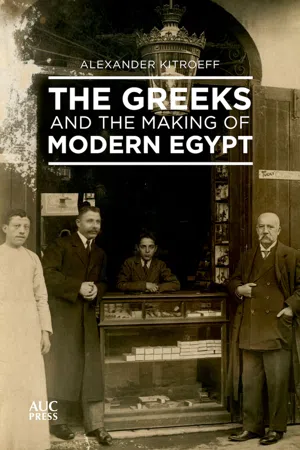
From the early nineteenth century through to the 1960s, the Greeks formed the largest, most economically powerful, and geographically and socially diverse of all European communities in Egypt. Although they benefited from the privileges extended to foreigners and the control exercised by Britain, they claimed nonetheless to enjoy a special relationship with Egypt and the Egyptians, and saw themselves as contributors to the country’s modernization.
The Greeks and the Making of Modern Egypt is the first account of the modern Greek presence in Egypt from its beginnings during the era of Muhammad Ali to its final days under Nasser. It casts a critical eye on the reality and myths surrounding the complex and ubiquitous Greek community in Egypt by examining the Greeks’ legal status, their relations with the country’s rulers, their interactions with both elite and ordinary Egyptians, their economic activities, their contacts with foreign communities, their ties to their Greek homeland, and their community life, which included a rich and celebrated literary culture.
Alexander Kitroeff suggests that although the Greeks’ self-image as contributors to Egypt’s development is exaggerated, there were ways in which they functioned as agents of modernity, albeit from a privileged and protected position. While they never gained the acceptance they sought, the Greeks developed an intense and nostalgic love affair with Egypt after their forced departure in the 1950s and 1960s and resettlement in Greece and farther afield.
- English
- ePUB (mobile friendly)
- Available on iOS & Android
eBook - ePub
The Greeks and the Making of Modern Egypt
About this book
Information
1
The Muhammad Ali Era
and Beyond
and Beyond
In 1873, the advertising section of the Elpis, a Greek-language daily newspaper in Alexandria, bore witness to the diversity of occupations of the city’s Greek population, which numbered about 25,500, meaning that one in four of Alexandria’s foreign residents was Greek.1 The advertisements were for the Hotel Bosphorus owned by D. Dilaras, which had recently been refurbished; Georgios Lekkas’s bakery, next to the Greek-owned Café Paradeisos on Rue des Soeurs, which sold quality breads and flour; P. Sarandis’s Phoenix bookshop, which sold instructional books at reasonable prices and also carried Greek newspapers published in Trieste. The advertisements also showed Alexandria’s close connection with Europe. K. Fardoulis’s Grand Restaurant et Brasserie Universelle Entresol, located opposite the public gardens, served Viennese beer and quality wines from France, Germany, Hungary, and Greece; a young woman of Christian morals who had been educated at the Hill School and graduated from the Arsakeion (among the best schools in Athens) offered private lessons in Greek, French, and English as well as piano lessons; and the newspaper informed its readers it could offer translation services for Greek, French, Italian, English, German, and Arabic. The “well-known merchant” Constantinos Peleides, who was from the Greek town of Volos, informed the public he had recently returned from Paris bringing a large collection of clothes of the latest fashion.2
The Elpis, a newspaper of commerce and one of the first Greek-language newspapers to appear in Egypt—the first was the Egyptos that appeared in 1862—reported the prices of the different cultivars of cotton and cottonseed at the Alexandria cotton exchange and markets in towns in the Nile Delta region on its front page. It was the prospective wealth in the cotton business that had brought Greek merchants to Egypt in the early 1800s. Their presence grew steadily over the years despite several political and diplomatic upheavals, and they soon branched out from purchasing, exporting, and shipping cotton to investing in banking, cotton ginning, real estate, and transport. Hoping they could also make money, thousands of other Greeks also began arriving in Alexandria. They did not have the capital to invest in cotton but they willingly became employees of the exporters and bankers or took up jobs in the service industries and retail trade that flourished in Alexandria, Cairo, and Egypt’s smaller towns.
Arrival
It all began when Muhammad Ali, Egypt’s wali (ruler) from 1805 to 1849 invited several Greek merchants to work with him to support his plan to push Egypt toward economic modernization, albeit with himself as a main beneficiary. When Muhammad Ali took power Egypt was a province of the Ottoman Empire, but during his rule he managed to carve out significant administrative autonomy for himself and gained the right to hand down power to his descendants who were recognized as Egypt’s khedives, an Ottoman title akin to viceroy. Initially a small group that functioned as the wali’s commercial agents in the eastern Mediterranean, the Greeks grew in number as others also came to staff Egypt’s fleet as captains or offer other services in maritime trade. The Greek presence in Alexandria began to expand as Egypt’s economic needs grew and the opportunities it offered foreigners began to increase. Throughout the period that Muhammad Ali and his successors ruled Egypt until 1882 when the British arrived to assume—informally—the reigns of power, the Greeks were the largest and most socially diverse of all the Europeans who came to assist as well as profit from Egypt’s drive toward modernization. If the ‘pull’ factors in this process were Muhammad Ali’s invitation and the encouragement of his successors, especially Sa‘id, who ruled between 1854 and 1863, and Ismail, who succeeded him and ruled through 1879, the ‘push’ factors were as important. They included Egypt’s geographical proximity to Greece, the existence of Greek merchant networks throughout the Mediterranean, always eager to pursue new commercial projects, and the lack of economic opportunity on many Aegean islands. Those Greeks fleeing the poverty of barren windswept islands were prepared to endure the difficult conditions in small rural towns.
Another attraction Egypt held for the Greeks was the privileges they enjoyed. Muhammad Ali maintained the Ottoman approach to non-Muslim minorities, the so-called millet system that allowed confessional communities to rule themselves in matters of personal law. Greeks could also seek and receive official protection from one of the European powers. From the mid-nineteenth century onward, Greeks were able to benefit from the Capitulations. These were bilateral agreements between the Ottoman Empire and foreign governments granting extraterritorial rights and privileges to foreign subjects resident or doing business in Ottoman domains. Greece became one of those governments in 1856. By virtue of Egypt’s nominal status as a province of the Ottoman Empire, notwithstanding its considerable autonomy, the Capitulatory regime was transferred to Egypt, where it functioned with even greater force than it did in the Ottoman Empire. In Egypt, foreigners enjoyed almost complete tax immunity, along with freedom of movement and commerce and freedom from any legal or judicial control. In those cases when the litigants were from the same nationality, their own Consular Court adjudicated. In 1875 the creation of the Mixed Courts of Egypt brought some consistency to judging disputes between foreigners of different nationalities and foreigners and Egyptians.
There was already a small Greek presence in Egypt before Muhammad Ali took power in the early 1800s. Much later on, in the 1920s and 1930s, when the Greeks felt threatened by the rise of Egyptian nationalism, several writers produced studies claiming there had been a continuous close contact between Egypt and Greece that went back to antiquity and flourished during the Hellenistic era. The most comprehensive defense of the continuity thesis came in a well-documented and comprehensive two-volume study of the Greeks in Egypt through the ages and since the rule of Muhammad Ali, authored by Athanasios Politis and entitled Ο Ελληνισμός και η Νεωτέρα Αίγύπτος(Hellenism and Modern Egypt), published in the late 1920s in Alexandria and appearing in both Greek and French.3 Politis, who was a diplomat serving at the Greek general consulate in Alexandria at the time, purposely chose the term “Hellenism” rather than “the Greeks” in order to allude to the ties between ancient and modern Greece. The evidence of a Greek presence in Egypt during the Ottoman era, which began in the fifteenth century, is thin if we don’t count those who converted to Islam. It was sporadic at best and connected with maritime trade. The big exception was the existence of the Christian Church, established by Mark the Evangelist in ad 49 according to church sources. In its formative period the church, known as the Patriarchate of Alexandria, produced two of the major thinkers of early Christianity—known as ‘fathers’—Athanasius and Cyril, who were both Patriarchs of Alexandria. After an important meeting of the Christian Church, the Council of Chalcedon in 451, the Church of Alexandria split in two over a doctrinal dispute over the nature of Jesus Christ. This led to the creation of the Coptic Orthodox Church of Alexandria, which represented the majority of Christians in Egypt, and the Greek Orthodox Church of Alexandria. The Greek Orthodox Church used Greek as its liturgical language and remained in communion with the Ecumenical Patriarchate of Constantinople. It is considered one of the four ‘historic’ patriarchates of Eastern Orthodox Christianity along with those of Constantinople, Antioch, and Jerusalem.
After the Arab conquest of North Africa in the seventh century—which permanently separated the region from the Byzantine Empire—the Greek Orthodox became an isolated minority in Egypt, even among Christians, and the church remained small for many centuries. On several occasions its patriarchs had been forced to move away from Egypt temporarily. The two oldest Greek Orthodox churches in Egypt are the monasteries of St. Savva in Alexandria and St. George in Cairo. Out in the Sinai Desert was the monastery of St. Catherine, built in the sixth century.
After Egypt fell under Ottoman rule, the predominance of Greeks in the Ottoman navy brought small numbers of Greeks to Egypt. The Mamluks, the military caste that continued to rule Egypt in the Ottoman era, enlisted the help of Greeks to develop and operate a navy. Craftsmen also began making their way to Egypt from the Greek lands, especially the islands. When the French landed in Egypt in 1798, the Patriarch of Alexandria reported at the time that his flock amounted to two hundred families. A good estimate of the number of Greeks in Cairo would be around two thousand; one of the streets they lived on was known as Haret al-Rum, the street of the Greeks. The presence of a Greek Orthodox bishop in the small port of Damietta suggests there was a small number of Greeks there as well. The Greeks welcomed the French and the prospect of the end of Mamluk rule, and many joined the French forces so that Napoleon created a Greek regiment, although his treatment of them was uneven. He had to be dissuaded from pulling down the Greek Orthodox Church of St. Savva—supposedly to build military fortifications in its place—and, along with the other indigenous Christians, the French authorities taxed the Greeks fairly heavily.4
Muhammad Ali emerged as ruler in Egypt in the wake o...
Table of contents
- Cover
- Half Title Page
- Title Page
- Copyright
- Dedication
- Introduction
- Acknowledge
- Chronology
- Choremi_Family_Tree
- Note_Family_Tree
- 1
- 2
- 3
- 4
- 5
- 6
- 7
- 8
- Notes
- Bibliography
Trusted by 375,005 students
Access to over 1.5 million titles for a fair monthly price.
Study more efficiently using our study tools.
Frequently asked questions
Yes, you can cancel anytime from the Subscription tab in your account settings on the Perlego website. Your subscription will stay active until the end of your current billing period. Learn how to cancel your subscription
No, books cannot be downloaded as external files, such as PDFs, for use outside of Perlego. However, you can download books within the Perlego app for offline reading on mobile or tablet. Learn how to download books offline
Perlego offers two plans: Essential and Complete
- Essential is ideal for learners and professionals who enjoy exploring a wide range of subjects. Access the Essential Library with 800,000+ trusted titles and best-sellers across business, personal growth, and the humanities. Includes unlimited reading time and Standard Read Aloud voice.
- Complete: Perfect for advanced learners and researchers needing full, unrestricted access. Unlock 1.5M+ books across hundreds of subjects, including academic and specialized titles. The Complete Plan also includes advanced features like Premium Read Aloud and Research Assistant.
We are an online textbook subscription service, where you can get access to an entire online library for less than the price of a single book per month. With over 1.5 million books across 990+ topics, we’ve got you covered! Learn about our mission
Look out for the read-aloud symbol on your next book to see if you can listen to it. The read-aloud tool reads text aloud for you, highlighting the text as it is being read. You can pause it, speed it up and slow it down. Learn more about Read Aloud
Yes! You can use the Perlego app on both iOS and Android devices to read anytime, anywhere — even offline. Perfect for commutes or when you’re on the go.
Please note we cannot support devices running on iOS 13 and Android 7 or earlier. Learn more about using the app
Please note we cannot support devices running on iOS 13 and Android 7 or earlier. Learn more about using the app
Yes, you can access The Greeks and the Making of Modern Egypt by Alexander Kitroeff in PDF and/or ePUB format, as well as other popular books in History & 19th Century History. We have over 1.5 million books available in our catalogue for you to explore.