eBook - ePub
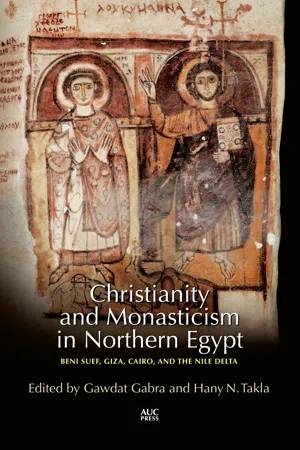
Christianity and Monasticism in Northern Egypt
Beni Suef, Giza, Cairo, and the Nile Delta
- English
- ePUB (mobile friendly)
- Available on iOS & Android
eBook - ePub
Christianity and Monasticism in Northern Egypt
Beni Suef, Giza, Cairo, and the Nile Delta
About this book
Christianity and monasticism have long flourished in the northern part of Upper Egypt and in the Nile Delta, from Beni Suef to the Mediterranean coast. The contributors to this volume, international specialists in Coptology from around the world, examine various aspects of Coptic civilization in northern Egypt over the past two millennia. The studies explore Coptic art and archaeology, architecture, language, and literature. The artistic heritage of monastic sites in the region is highlighted, attesting to their important legacies.
Information
Topic
Theology & ReligionSubtopic
Middle Eastern History1 | John of Barullos (540–615) |
Bishop Kyrillos |
Introduction
There are many notable leaders in the annals of Coptic history whose names are well known. John of Barullos is not one of them. The Synaxarium entry for 19 Kiyahk mentions only that John was the bishop of Barullos, and author of some articles. This chapter is only a preliminary survey of John of Barullos, intended to open up doors for future research into his life and writings.1
Barullos
The name of the region John was from is as obscure as his life. Al-Barullos is equated with many Greek variants (Parallos, Parallou, and Parhalos), as well as Coptic ones (Nikedjoou [O’Leary 1937b: 168]; Naqizah (Coquin and Martin 1991d: 1174b–1175a, citing Maspero and Wiet 1919; and Nafwah2). The north-central Delta contained two cities with similar names: al-Burlus and al-Burlus al-Ramla (Kosack 1971: 49, cited in Vivian 2008: 342n138). According to ancient hieroglyphic records, at least one of these cities is situated on a peninsula that connected Lake Barullos with the sea (Budge 1920: 2:1030: “Sai Ta her sept Uatch ur”). But it seems that the Barullos associated with John was situated somewhere between present-day Baltim and al-Burj, on the eastern shore of Lake Barullos, in the northern Delta (Stewart 1991c: 2:427).
The city seems to have had an important religious role in the life of the Copts. According to a homily delivered by Bishop Zakariya of Sakha (seventh–eighth century), Barullos was the location of the fig tree where the Holy Family rested during their flight to Egypt.3 Moreover, St. Thecla, the disciple of St. Paul, was associated with the city when the story of this most popular female virgin martyr in late antique Egypt was assimilated into the native Egyptian veneration of the martyrs (Armanios 2003: 109–10, citing Davis 2001: 172).
A diocese was located in al-Barullos as early as the beginning of the fourth century, until at least the eleventh century (Stewart 1991c, citing Munier 1943a: 28). One of its earliest bishops was Athanasius, who attended the Council of Ephesus in 431 (Stewart 1991c, citing Munier 1943a: 15). Al-Barullos was the hometown of Patriarch Isaac (686–89), the dwelling place of the hermit George during the papacy of John IV (775–79), and the hometown of the recluse Christodoulus, who became the sixty-sixth pope of Alexandria, from 1047 to 1077. Among the most notable of its bishops was John, who lived from around 540 to 615.
Early Life
John of Barullos was probably born around 540, of a respected clerical family of Lower Egypt.4 Like his parents, he was recognized for his charity (O’Leary 1937b: 427; al-Siniksar 1978: 211–12 [19 Kiyahk]). As a young man, John used his inheritance to build a shelter for pilgrims and the sick (Stewart 1991c; Budge Synaxarium: 223). He learned Greek, Coptic, and probably Syriac. Encouraged by one of the monk-pilgrims who probably visited his home (al-Siniksar, 19 Kiyahk), John entered the Monastery of St. Macarius in Shiheet, under the leadership of St. Daniel the Hegumen (Müller 1991b: 5:1367, citing al-Siniksar, 19 Kiyahk).
The Coptic and Ethiopian Synaxaria recall that while John lived in a secluded building, Satan painfully attacked him so that he was sick for several days. After his miraculous healing, he was called to be a bishop, probably by Pope Peter IV in 576 (Müller 1991b: 5:1368), at one of the most challenging periods in the history of the Coptic Church.5
Writings
John was one of the most significant Coptic theologians of his time. He used all available means to root out various heresies—delivering homilies, writing articles, or visiting monasteries to burn the heretical books he found there (Müller 1991b: 5:1368). He even journeyed abroad to Syria for about four months to resolve the dogmatic controversy between Pope Damian of Alexandria (570–607) and Peter of Callinicum (also known as Peter III of Raqqa [Taylor 2006: 15n1], or Petrus of Antioch).6 Unfortunately, only a few of his writings survive in Coptic, Arabic, and Ethiopic (Armanios 2003, citing Müller 1991b: 1367–68).
Homilies
Perhaps John is most famous for his homilies concerning the Resurrection and the Last Judgment, the Book of Adam,7 and “On the Archangel Michael and on Heretical Books,”8 most of which are responses to heresies that emerged from the Sa‘id with Gnostic claims of secret revelations. One such Gnostic writer claimed to have been visited by the prophet Habakkuk.9 When a monk from Upper Egypt claimed that Archangel Michael revealed to him certain mysteries in The Book of the Investiture of the Archangel Michael, John refuted the heresy in his homily noted above (Budge Synaxarium: 223).
These homilies seem to be directed toward priests (Müller 1954b: 242). In his homily on Archangel Michael, John often expresses his desire to equip the “servants of God” to prevent the heretics who are confusing the “simple people” or the “uneducated” in the villages, and the zealots (Σπουδαῖοι) in the cities (Stewart 1991c, citing al-Siniksar; Kelly 2004: 237).
While much of the heresy at this time involves Gnosticism, several issues involve Trinitarian theology. At one point in his Archangel Michael homily, John refers to the uncreated, eternal divine nature (Lantschoot 1946: 321n16). He also speaks of the orders of angels, which he lists as the “innumerable orders of angels and archangels, cherubim and seraphim, the four creatures with multiple eyes, the dominions and virtues” (Lantschoot 1946: 321).
Primarily, John is reliant on scriptures and emphasizes precisely what is not revealed therein to mark the limitations outside of which the Gnostic, apocryphal, or heretical works venture to describe. Mainly from the work of Lantschoot, we have come to realize that John also seems to rely heavily on the writings of Origen, St. Basil, St. Gregory Nazianzen, St. John Chrysostom, and John the Grammarian.10 Perhaps the greatest influence of the arguments contained in this homily (as well as his homily on the Resurrection and the Last Judgment) is seen most directly in the Homily on Riches attributed to Peter of Alexandria, which contains an encomium on the Archangel Michael (82–117), sandwiched between two sections on the Judgment and Resurrection (75–81, 118–19) (Pearson and Vivian 1993: 15–25).
Synaxaria
The second main work attributed to John of Barullus are the Coptic and Ethiopian Synaxaria.11 While the prologue of the Coptic Synaxarium lists among its authors “John, bishop of Barullos,” this is probably not the same figure as the sixth-century bishop who lived from 540 to 610 or 620. The bishop of Barullos, in this prologue, explains that after observing the ruins of his church in Za‘farana, he spent much time thinking about investigating the lives of the martyrs of the Church, until a saintly monk visited him with old and damaged books, seeking repair. The text reads as follows:
I was bishop of Barullos and I had always attended the church in Za‘farana.12 I saw that it was in ruin because of the passing of time and the destruction of people. Thus it came to my mind that I should investigate the lives of the martyrs of this church. After some time passed, as I thought more about this matter and was unable either to eat or sleep because of my preoccupation, a saintly monk from Dayr al-Mayma13 came to me. He carried old and damaged books from that church.… He said “Father, take these books in order to prepare the orders of the church since you are our father and have authority over this church.”… I was overjoyed and I searched in the books and found the orders of the church, in both Coptic and Arabic. While I searched, I [also] found the story in question, the hagiography of the saint martyr Dimyana.… I began to transcribe it, as it had been written in the handwriting of a boy from the slave of Julius al-Aqfahsi, whose name was Ikhristodolo.14
The mention that these books were in the Coptic and Arabic languages suggests that this is not the sixth-century Bishop John of Barullos, but a much later figure. We are aware that John knew Coptic and Greek, and perhaps Syriac. But 541 is far too early to see the Synaxarium in both Coptic and Arabic. According to Cardinal Angelo Mai’s work on the Arabic Synaxarium, its reputed compiler was Michael, bishop of Atrib and Malig in 1425 (Burmester 1938: 249); Michael’s work was then adopted by most scholars working on the Arabic and Ethiopian Synaxaria (Burmester 1938: 249, citing Zotenberg 1877: 152; Wüstenfeld 1879: 152; Hyvernat 1909: 362; O’Leary 1937b: 32).
While it is nearly impossible that the entire Synaxarium can have been composed by John, at least two manuscripts do attribute the life of St. Dimiana to John of Barullos.15 If this is the case, then some revision must be made to the introductory preface of the current Coptic Synaxarium.
Other writings
Two other works deserving of scholarly attention are attributed to John. Ibn Kabar’s (d. 1324) catalog attributes thirteen anathemas to John, without express citation or elaboration.16 The only other mention of this seems to be the Antiphonarion, which praises John for delivering the apostolic canons to the faithful. I have not yet been able to locate these anathemas in any collection. A lesser-known work is the Coptic life of Pope Damian attributed to the bishop of Barullos, found in the White Monastery.17
The Divine Fire Motif in the Life of John of Barullos
One of the unique features of John’s Synaxarium entries is their strange infatuation with fire. We are told that every time John would celebrate the Divine Liturgy, his face and his body would flush red, as if in a furnace. He wept at beholding the heavenly Host on the altar.18 When he placed his finger on the chalice to make the sign of the cross, he found the cup hot with fire.19 In the Ethiopian version, John would also find the korban20 burning like fire (Budge Synaxarium: 224).
In the Coptic Synaxarium, John excommunicated those who would partake of the mysteries without fasting. According to the Ethiopian version, these “evil men and heretics… [would] offer up the Offering twice a day, after they had eaten.”21 After John excommunicated them, “God sent fire from heaven and consumed their leader; when those who remained saw this, they feared exceedingly and entered the True Faith.”
What is the reason for this strange emphasis on fire in the Coptic and Ethiopian accounts? One possibility could be that in the Ethiopian Synaxarium, the entry for John of Barullos on 19 Tahisas (28 December) is followed by that for the Three Holy Youths, Ananias, Azarias, and Misael. Yet this does not seem to provide an adequate connection to John, since the Ethiopian account is a translation from the Coptic, which commemorates the Three Holy Youths five months later, on 10 Bashans (18 May). Perhaps the inclusion of the Three Holy Youths on a different date in the Ethiopian version could be the effect of the emphasis on fire, rather than its cause or explanation.
Another possibility comes from the fourteenth-century manuscript concerning the life of St. Pisentius (Psenthaisus or Psenda), a contemporary of John of Barullos, who is also described in a very similar manner.22 Pisentius also had a strong connection to Pope Damian (who ordained him) and was known for his generosity to travelers. We are told that when he ascended the altar, his face glowed like fire while he watched the Holy Spirit descending on the oblations. Yet the Coptic Synaxarium entry on 13 Abib only me...
Table of contents
- Cover
- Title Page
- Copyright Page
- Dedication
- Contents
- List of Illustrations
- Contributors
- Foreword
- Introduction
- Language and Literature
- Art, Archaeology, and Material Culture
- Preservation
- Abbreviations
- Bibliography
Trusted by 375,005 students
Access to over 1.5 million titles for a fair monthly price.
Study more efficiently using our study tools.
Frequently asked questions
Yes, you can cancel anytime from the Subscription tab in your account settings on the Perlego website. Your subscription will stay active until the end of your current billing period. Learn how to cancel your subscription
No, books cannot be downloaded as external files, such as PDFs, for use outside of Perlego. However, you can download books within the Perlego app for offline reading on mobile or tablet. Learn how to download books offline
Perlego offers two plans: Essential and Complete
- Essential is ideal for learners and professionals who enjoy exploring a wide range of subjects. Access the Essential Library with 800,000+ trusted titles and best-sellers across business, personal growth, and the humanities. Includes unlimited reading time and Standard Read Aloud voice.
- Complete: Perfect for advanced learners and researchers needing full, unrestricted access. Unlock 1.5M+ books across hundreds of subjects, including academic and specialized titles. The Complete Plan also includes advanced features like Premium Read Aloud and Research Assistant.
We are an online textbook subscription service, where you can get access to an entire online library for less than the price of a single book per month. With over 1.5 million books across 990+ topics, we’ve got you covered! Learn about our mission
Look out for the read-aloud symbol on your next book to see if you can listen to it. The read-aloud tool reads text aloud for you, highlighting the text as it is being read. You can pause it, speed it up and slow it down. Learn more about Read Aloud
Yes! You can use the Perlego app on both iOS and Android devices to read anytime, anywhere — even offline. Perfect for commutes or when you’re on the go.
Please note we cannot support devices running on iOS 13 and Android 7 or earlier. Learn more about using the app
Please note we cannot support devices running on iOS 13 and Android 7 or earlier. Learn more about using the app
Yes, you can access Christianity and Monasticism in Northern Egypt by Gawdat Gabra, Hany N. Takla, Gawdat Gabra,Hany N. Takla in PDF and/or ePUB format, as well as other popular books in Theology & Religion & Middle Eastern History. We have over 1.5 million books available in our catalogue for you to explore.