- English
- ePUB (mobile friendly)
- Available on iOS & Android
eBook - ePub
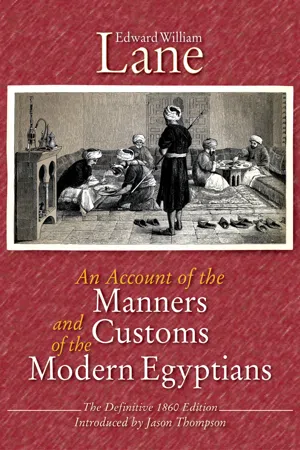
An Account of the Manners and Customs of the Modern Egyptians
About this book
Few works about the Middle East have exerted such wide and long-lasting influence as Edward William Lane's An Account of the Manners and Customs of the Modern Egyptians. First published in 1836, this classic book has never gone out of print, continuously providing material and inspiration for generations of scholars, writers, and travelers, who have praised its comprehensiveness, detail, and perception. Yet the editions in print during most of the twentieth century would not have met Lane's approval. Lacking parts of Lane's text and many of his original illustrations (while adding many that were not his), they were based on what should have been ephemeral editions, published long after the author's death. Meanwhile, the definitive fifth edition of 1860, the result of a quarter century of Lane's corrections, reconsiderations, and additions, long ago disappeared from bookstore shelves. Now the 1860 edition of Manners and Customs of the Modern Egyptians is available again, with a useful general introduction by Jason Thompson. Lane's greatest work enters the twenty-first century in precisely the form that he wanted.
Information
Subtopic
Middle Eastern HistoryIndex
HistoryCHAPTER I.
PERSONAL CHARACTERISTICS, AND DRESS, OF THE
MUSLIM EGYPTIANS.
MUSLIM EGYPTIANS.
MUSLIMS, in a great degree of Arabian origin, have, for many centuries, mainly composed the population of Egypt: they have changed its language, laws, and general manners; and its metropolis they have made the principal seat of Arabian learning and arts. To the description of this people, and especially of the middle and higher classes in the Egyptian capital, will be devoted the chief portion of the present work. In every point of view, Maṣr (or Cairo) must be regarded as the first Arab city of our age; and the manners and customs of its inhabitants are particularly interesting, as they are a combination of those which prevail most generally in the towns of Arabia, Syria, and the whole of Northern Africa, and in a great degree in Turkey. There is no other place in which we can obtain so complete a knowledge of the most civilized classes of the Arabs.
From statements made in the introduction to this work, it appears that Muslim Egyptians (or Arab-Egyptians) compose nearly four-fifths of the population of the metropolis, and just seven-eighths of that of all Egypt.
The Muslim Egyptians are a mixed race, in a great measure descended from various Arab tribes and families which have settled in Egypt at different periods, mostly soon after the conquest of this country by ’Amr, its first Arab governor. These Arab immigrants were chiefly tribes of the desert; but their abandonment of the life of wanderers for that of agriculturists or citizens, and the frequent intermarriages of themselves and their descendants with Copts who became proselytes to the faith of El-Islám, have resulted in the production of a race bearing, in general, much resemblance to the ancient Egyptians; whose type was predominantly Caucasian, but inclining in various degrees towards that of the Negro. In many individuals among them we find this resemblance to be strikingly exact, though more frequently in Copts and in Nubians; and in the Muslim Egyptians (as well as in the Copts) it is generally most observable in Middle and Upper Egypt. Yet they are to be regarded as not less genuine Arabs than many of the townspeople of Arabia itself; among whom has long and very generally prevailed a custom of keeping Galla and Abyssinian female slaves, either instead of marrying their own countrywomen, or (as is commonly the case with the opulent) in addition to their Arab wives: so that they now bear almost as much resemblance to the Gallas and Abyssinians as to the Bedawees, or Arabs of the Desert. Such, at least, is the case in the towns of the south-western side of Arabia: in the southern parts of that country, the townspeople are much intermixed with Indian and Malayan races, as well as with Africans. In the Egyptians in general, and in the Arabians also though in a less degree, an admixture of aboriginal African blood is plainly discernible. The term “’Arab,”1 it should here be remarked, is now used, wherever the Arabic language is spoken, only to designate the Bedawees, collectively: in speaking of a tribe, or of a small number of those people, the word “’Orban” is also used; and a single individual is called “Bedawee.”2 In the metropolis and other towns of Egypt, the distinction of tribes is almost wholly lost; but it is preserved among the peasants, who have retained many Bedawee customs, of which I shall have to speak. In various parts of the country, there are families, or small tribes, descended from Arab settlers who have generally disdained marrying women of less pure race than themselves; and these are hardly, if at all, to be distinguished in their persons from the tribes in the Arabian deserts. The native Muslim inhabitants of Cairo commonly call themselves “El-Maṣreeyeen,” “Owlád-Maṣr” (or “Ahl-Maṣr”), and “Owlád-el-Beled,” which signify People of Maṣr, Children of Maṣr, and Children of the Town: the singular forms of these appellations are “Maṣree,” “Ibn-Maṣr,” and “Ibn-el-Beled.”3 Of these three terms, the last is most common in the town itself. The country people are called “El-Felláḥeen” (or the agriculturists), in the singular “Felláḥ.”4 The Turks often apply this term to the Egyptians in general in an abusive sense, as meaning the “boors,” or “the clowns; “and improperly stigmatize them with the appellation of “Ahl-Far’oon,”1 or “the People of Pharaoh;” the latter, when they dare to do so, retorting by calling the former “Ahl-Nemrood,” or “the People of Nimrod.”
In general, the Muslim Egyptians attain the height of about five feet eight, or five feet nine inches. Most of the children under nine or ten years of age have spare limbs and a distended abdomen; but, as they grow up, their forms rapidly improve: in mature age, most of them are remarkably well-proportioned; the men, muscular and robust; the women, very beautifully formed, and plump; and neither sex is too fat. I have never seen corpulent persons among them, except a few in the metropolis and other towns, rendered so by a life of inactivity. In Cairo, and throughout the northern provinces, where immigrants from more temperate climates have been most numerous, those who have not been much exposed to the sun have a yellowish, but very clear complexion, and soft skin; the rest are of a considerably darker and coarser complexion. The people of Middle Egypt are of a more tawny colour; and those of the more southern provinces are of a deep bronze or brown complexion, darkest towards Nubia, where the climate is hottest, and where Egyptians gradually give place to Nubians. In general, the countenance of the Muslim Egyptian (I here speak of the men) is of a fine oval form: the forehead, of moderate size, seldom high, but generally prominent: the eyes are deep sunk, or appear to be so in consequence of a common habit of depressing the eyebrows for the sake of shade; and are black and brilliant; but not without some resemblance to those of Ethiopian races: the nose is straight, but rather thick: the mouth well formed: the lips are rather full than otherwise: the teeth particularly beautiful; and so, if we may judge from the generality of the mummies, were those of the ancient Egyptians:2 the beard is commonly black and curly, but scanty. I have seen very few individuals among them with gray eyes; and these may be reasonably regarded as the offspring or descendants of Egyptian women by Europeans or by other foreigners. The Felláḥeen, from constant exposure to the sun, have a habit of half-shutting their eyes: this is also characteristic of the Bedawees. Great numbers of the Egyptians are blind in one or both of the eyes. They generally shave portions of the beard above and below the lower jaw, and likewise a small portion under the lower lip, leaving, however, after the example of the Prophet, the hairs that grow in the middle under the mouth; or, instead of shaving these parts, they pluck out the hair. Very few shave the rest of the beard,1 and none the mustache. The former they suffer to grow to the length of about a hand’s breadth below the chin (such, at least, is the general rule, and such was the custom of the Prophet); and (in imitation of the Prophet) the mustache they do not allow to become so long as to hide completely the skin beneath, or to extend in the least over the upper lip and thus incommode them in eating and drinking. The practice of dyeing the beard is not common; for a gray beard is much respected. The Egyptians shave all the rest of the hair, or leave only a small tuft (called “shoosheh”) upon the crown of the head.2 This last custom (which is almost universal among them) is said to have originated in the fear that if the Muslim should fall into the hands of an infidel, and be slain, the latter might cut off the head of his victim, and, finding no hair by which to hold it, put his impure hand into the mouth, in order to carry it; for the beard might not be sufficiently long: but it was probably adopted from the Turks; for it is generally neglected by the Bedawees; and the custom of shaving the head is of late origin among the Arabs in general, and practised for the sake of cleanliness.3 With the like view of avoiding impurity, the Egyptians observe other customs, which need not here be described.4 Many men of the lower orders, and some others, make blue marks upon their arms, and sometimes upon the hands and chest, as do the women, in speaking of whom this operation will be described.
The dress of the men of the middle and higher classes consists of the following articles.5 First, a pair of full drawers6 of linen or cotton, tied round the body by a running string or band,1 the ends of which are embroidered with coloured silks, though concealed by the outer dress. The drawers descend a little below the knees, or to the ankles; but many of the Arabs will not wear long drawers, because prohibited by the Prophet. Next is worn a shirt,2 with very full sleeves, reaching to the wrist: it is made of linen, of a loose, open texture, or of cotton stuff, or of muslin, or silk, or of a mixture of silk and cotton, in stripes, but all white.3 Over this, in winter, or in cool weather, most persons wear a “ṣudeyree,”4 which is a short vest of cloth, or of striped coloured silk and cotton, without sleeves.5 Over the shirt and the ṣudeyree, or the former alone, is worn a long vest of striped silk and cotton6 (called “ḳafṭán,” or more commonly “ḳufṭán”), descending to the ankles, with long sleeves extending a few inches beyond the fingers’ ends, but divided from a point a little above the wrist, or about the middle of the fore-arm; so that the hand is generally exposed, though it may be concealed by the sleeve when necessary; for it is customary to cover the hands in the presence of a person of high rank. Round this vest is wound the girdle,7 which is a coloured shawl, or a long piece of white figured muslin. The ordinary outer robe is a long cloth coat, of any colour, called by the Turks “jubbeh,” but by the Egyptians “gibbeh,” the sleeves of which reach not quite to the wrist.8 Some persons also wear a “beneesh,” or “benish;” which is a robe of cloth, with long sleeves, like those of the ḳufṭán, but more ample:9 it is, properly, a robe of ceremony, and should be worn over the other cloth coat; but many persons wear it instead of the gibbeh. Another robe, called “farageeyeh,” nearly resembles the beneesh: it has very long sleeves; but these are not slit...
Table of contents
- Cover
- Halftitle Page
- Title Page
- Copyright
- Contents
- Illustrations
- Editor’s Preface
- Author’s Preface
- Advertisement to the Third Edition
- Introduction.
- Chapter I.
- Chapter II.
- Chapter III.
- Chapter IV.
- Chapter V.
- Chapter VI.
- Chapter VII.
- Chapter VIII.
- Chapter IX.
- Chapter X.
- Chapter XI.
- Chapter XII.
- Chapter XIII.
- Chapter XIV.
- Chapter XV.
- Chapter XVI.
- Chapter XVII.
- Chapter XVIII.
- Chapter XIX.
- Chapter XX.
- Chapter XXI.
- Chapter XXII.
- Chapter XXIII.
- Chapter XXIV.
- Chapter XXV.
- Chapter XXVI.
- Chapter XXVII.
- Chapter XXVIII.
- Supplement.
- Appendix A.
- Appendix B.
- Appendix C.
- Appendix D.
- Appendix E.
- Appendix F.
- Index
Trusted by 375,005 students
Access to over 1.5 million titles for a fair monthly price.
Study more efficiently using our study tools.
Frequently asked questions
Yes, you can cancel anytime from the Subscription tab in your account settings on the Perlego website. Your subscription will stay active until the end of your current billing period. Learn how to cancel your subscription
No, books cannot be downloaded as external files, such as PDFs, for use outside of Perlego. However, you can download books within the Perlego app for offline reading on mobile or tablet. Learn how to download books offline
Perlego offers two plans: Essential and Complete
- Essential is ideal for learners and professionals who enjoy exploring a wide range of subjects. Access the Essential Library with 800,000+ trusted titles and best-sellers across business, personal growth, and the humanities. Includes unlimited reading time and Standard Read Aloud voice.
- Complete: Perfect for advanced learners and researchers needing full, unrestricted access. Unlock 1.5M+ books across hundreds of subjects, including academic and specialized titles. The Complete Plan also includes advanced features like Premium Read Aloud and Research Assistant.
We are an online textbook subscription service, where you can get access to an entire online library for less than the price of a single book per month. With over 1.5 million books across 990+ topics, we’ve got you covered! Learn about our mission
Look out for the read-aloud symbol on your next book to see if you can listen to it. The read-aloud tool reads text aloud for you, highlighting the text as it is being read. You can pause it, speed it up and slow it down. Learn more about Read Aloud
Yes! You can use the Perlego app on both iOS and Android devices to read anytime, anywhere — even offline. Perfect for commutes or when you’re on the go.
Please note we cannot support devices running on iOS 13 and Android 7 or earlier. Learn more about using the app
Please note we cannot support devices running on iOS 13 and Android 7 or earlier. Learn more about using the app
Yes, you can access An Account of the Manners and Customs of the Modern Egyptians by Edward William Lane in PDF and/or ePUB format, as well as other popular books in History & Middle Eastern History. We have over 1.5 million books available in our catalogue for you to explore.