eBook - ePub
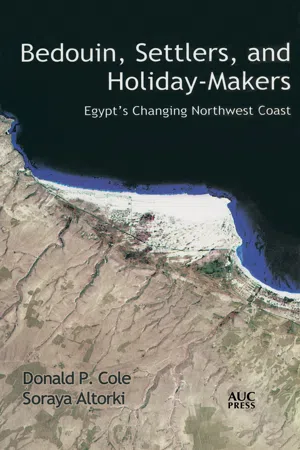
Bedouin, Settlers, and Holiday-Makers
Egypt's Changing Northwest Coast
- English
- ePUB (mobile friendly)
- Available on iOS & Android
eBook - ePub
About this book
The arid regions impose strict limits upon human existence and activity. And yet by respecting those limits, the flourishing and stable culture of these regions has for centuries been sustained. In the late twentieth century, however, forces such as modernization, globalization, and the politics and economics of nations became so great that major changes in the old ways had to take place for the sake of survival.
Egypt's northwest coast, where meager coastal rains have supported a sparse but thriving population of Bedouin, saw the arrival of settlers from the Nile Valley, accustomed to a very different way of life and production, and hordes of tourists whose "empty, silent structures" effectively turned the most productive strip of the coastal range into an artificial desert. This study documents the great accommodations that took place to ensure the arid rangelands of the northwest coast continue to be viable for the demands of human existence imposed on them.
"A main thesis of this study," the authors write, "is that change in the northwest coast of Egypt has strong parallels in other arid regions of the wider Arab world; and specific comparisons are made to change underway elsewhere-especially regarding the transformation of Arab nomadic pastoralist production to a new form of ranching, and the related changes of sedentarization and the monetization of most aspects of livelihood."
Information
Subtopic
Development EconomicsIndex
Social SciencesCHAPTER 1
DESERTS AND DESERT DEVELOPMENT IN EGYPT
The northwest coast and the other parts of desert Egypt share their country with the Nile Valley. The ancient floodplain of the Nile between Aswan and the Mediterranean Sea comprises some thirty-five thousand square kilometers, or about three and a half percent of Egypt’s sovereign territory of just over a million square kilometers. Nile water, a rich alluvium, and a warm climate combine to make the Nile Valley one of the world’s best regions for agriculture. Indeed, both ancient and modern Egyptian farmers have sustained agricultural production in the Nile Valley since long before the unification of Upper and Lower Egypt about five thousand years ago. Today, however, much of the Nile Valley’s agricultural land is rapidly being lost to other uses.
Political scientist John Waterbury (1978:106) quotes a statement to Egypt’s People’s Assembly in 1973 by the then-minister of agriculture, Mustafa Jabali. The minister’s statement indicates that between 1963 and 1973 Egypt had reclaimed from the desert outside of the Nile Valley almost a million feddans of“new”land for agriculture. Nonetheless, the country had suffered a net loss of two hundred thousand feddans of cultivated land during that ten-year period. To explain this phenomenon, Waterbury mentions“the constant nibbling away of existing cultivated acreage”for nona- gricultural land uses and calculates that about 10 percent of the Nile Valley’s six million feddans had been lost to nonagricultural uses by the mid-1970s. Since that time the“nibbling away”has continued and probably accelerated. To our knowledge, no official statistics exist on this phenomenon. However, one scholar presents an“educated guess”that the current“encroachment rate”on agricultural land in the Nile Valley is about thirty thousand feddans a year. He also reports that between 1984 and 1993 the state brought to the courts more than half a million cases of alleged violations of its agricultural zoning regulations (Khouzam 1994:5-6).
Ironically, the only part of Egypt that was not desert is now suffering a form of“desertification,”by which we mean the destruction and consequent loss to society of productive land. Arable land in the Nile Valley is sometimes legally, but often illegally, converted to use for housing, factories, workshops, warehouses, banks, retail stores, business and professional offices, markets, schools, universities, hospitals, hotels, social clubs, sports clubs, government offices, and so on. One factor that partly explains this“nibbling away”is Egypt’s population growth. The country’s inhabitants, who have always mainly lived in the Nile Valley, have increased from just under 10 million in 1897 to just over 30 million in 1966 and to almost 60 million in 1996. Future projections indicate perhaps 100 million in about 2025 (Bishay 1992).
Other factors also influence the conversion of Egypt’s best agricultural land to other uses. The cessation of the Nile’s annual flood—finally achieved for all of Egypt north of Aswan by the construction of the High Dam in the 1960s—removed physical limits that formerly restricted building in the Nile Valley to high areas not subject to flooding. Market forces are also at work, as the cash value of land for nonagricultural uses in the Nile Valley is higher than that for cultivated land. A person who constructs an apartment building or a warehouse on a plot of land reasonably expects a higher return from that investment than would be the case for producing crops on the same plot. The state also plays a role, as it fails to enforce its own zoning codes or levies paltry fines for their violation. Moreover, the state itself is a builder on Nile Valley land.
Paradoxically, the loss of Egypt’s best agricultural land to other uses is the cumulative result of almost two hundred years of change initiated, first, in the name of progress and, more recently, under that of development. However, a growing population no longer all required to work in agriculture could have been channeled around the turn of the twentieth century into new communities located outside the floodplain of the Nile. New social institutions and new commercial and industrial enterprises could have been sited in such communities so as not to take up finite agricultural space. What could have been did not happen, except to a small degree in a few instances, such as the creation of Misr al-Jadida,“New Egypt,”or Heliopolis, in the desert northeast of Cairo during the first decade of the twentieth century (see J. Abu-Lughod 1971:138-140).
Today, Nile Valley Egyptians look to the deserts of Egypt for a solution to at least some of the many problems they increasingly perceive and worry about. These problems include crowding, noise, and pollution, along with unemployment and the loss of food security. Can the deserts help? Yes; parts of the deserts have already absorbed some of the Nile Valley’s dynamic energy. They bloom with new agriculture. Factories, tourist resorts, and new housing are increasingly located at sites in the deserts. However, physical limitations exist to how much Egypt’s deserts can absorb from the Nile Valley. Moreover, the deserts already have populations with their own needs and aspirations for economic and social well-being.
The Deserts of Egypt
Desert Egypt consists of three deserts—the Sinai Peninsula (61,000 square kilometers), the Eastern, or“Arabian,”Desert (223,000 square kilometers), and the Western, or“Libyan,”Desert (681,000 square kilometers). Together, these deserts occupy most of Egypt’s sovereign territory but have a small fraction of the country’s population. Each desert has its own specificities and its own internal differences; however, all three are deserts because of climate and not because of significant desertification brought about by human beings.
According to geographer Karl W. Butzer (1976:13-14,26-27), the area of today’s Egypt suffered some eight thousand years of hyperaridity between about 25,000 and 17,000 B.P. This very dry period was followed by about twelve thousand years of more frequent rainfall, especially in the Red Sea Hills of the Eastern Desert. During this moister period, the deserts provided enough game for seasonal hunting and sufficient vegetation for modest pastoral production by herders based in the Nile Valley and by desert-based nomads. However, a second period of aridity started just over five thousand years ago; and hyperaridity has prevailed for the past four thousand years. Many species disappeared from Egypt’s deserts or became rare long ago; even the camel became extinct in North Africa until reintroduced as a beast of burden in Ptolemaic times. Human actions played some role in these disappearances, but climatic change was the main factor.
Rainfall is exceedingly scarce throughout Egypt. The Mediterranean coast has the highest annual averages, with 138 mm at Marsa Matruh and 97 mm at‘Arish in north Sinai. The yearly average at Cairo is 35 mm, while Aswan and Hurghada have annual averages of 3 mm and Siwa has 1 mm (Hobbs 1989b:22,52). Large parts of Egypt receive only a brief shower once every ten years or so. By contrast, the driest parts of the Arabian Peninsula, such as the Empty Quarter, receive more rainfall than most of Egypt; and the vast steppes of northern Arabia, western Iraq, and eastern Syria and Jordan have a mean annual rainfall of between 100 and 200 mm. Northeastern Libya also receives more rain than Egypt. Although arid, these steppic areas to the east and west of Egypt blossom with a relative abundance of annual and perennial shrubs and grasses and are associated with the development of highly productive nomadic pastoralist systems. Because of Egypt’s hyperaridity, desert-based pastoralism has been limited for the last four thousand years or so to small zones along the country’s northwest coast, in parts of Sinai, and in the Red Sea Hills.
The lack of rainfall, of course, does not necessarily mean the absence of water. In Egypt’s case, an important underground source of water exists in the form of the Nubian sandstone aquifer which begins in Chad and flows generally to the north and northeast. This aquifer underlies part of the Eastern Desert and most of the Western Desert, in addition to large parts of Libya. Most of this significantly large reserve of water is of ancient origin, although minor recharge is said to occur from humid mountain areas in Chad. Salinity increases toward the north of the aquifer, but most of the water is considered suitable for drinking and for agricultural purposes (Hefny 1994:196-199).
The Nubian sandstone aquifer is the source of water that sustains the main settled communities in the oases of the Western Desert. In addition to Siwa in the Matruh governorate, the most notable of these oases are Wadi Natrun in the Bahaira governorate, Bahriya in the Giza governorate, and Farafra, Dakhla, and Kharja in the Wadi al-Jadid,“New Valley,”governorate. These oases are located in depressions and are mostly surrounded by steep escarpments. Siwa and Kharja, along with the uninhabited Qattara depression, are below sea level. The depressions typically have deep deposits of alluvium, and water from the Nubian sandstone aquifer sometimes flows to the surface as artesian springs and wells. A rich agriculture has long characterized most of the oases; but they are also plagued by poor drainage, which leads to saline lakes surrounded by salt marshes. Moreover, shifting sand dunes have destroyed some cultivated areas in the oases and threaten others. The Western Desert has a few other oases that are very small. Al- Qara is at the extreme west of the Qattara depression, not far from Siwa. Near the southern border with Sudan are Kurkur, Dunqul, and Dinaiqil oases, while the Jabal‘Uwainat exists in the extreme southwest and has springs and a few small settlements. The rest of the Western Desert is largely barren. Sandstone and limestone plateaus dominate most of the vast terrain, along with the Great Sand Sea and other smaller bodies of sand (Hobbs 1989b:40-45).
Paradoxically, the development of modern transportation closed much of the Western Desert to the outside world and increased the isolation of the oases. Archaeologist Ahmed Fakhry records how this happened in the case of Bahriya:
[C]amels . . . carried the mail to Bahriyah until 1937. In January 1938 there was a change; a transportation contractor began to carry the mail by car from Cairo. Although theoretically the car was supposed to leave for Bahriyah every ten days, there was usually a delay of at least one or two days from Cairo. Then, too, the car was liable to break down with a further delay for repairs or rescue by another car, with the result that it was never known when the mail would arrive. The postmaster and government officials would talk highly of the“good old days”when the mail was brought by camel. It left Samalut at dawn on a fixed day and took four days to reach Bahriyah ... The camel was always on time, never more than one hour late on very rare occasions. In 1968, I was told that the problem of the mail deliveries to Bahriyah is still the same, but that to Farafra has become worse (Fakhry 1974:24-25).
Since the days of ancient Egypt, the oases were not just the scenes of agricultural production. They were also centers on well-established routes that crossed the Western Desert and linked the Nile Valley with Libya and other parts of Africa. With the spread of Islam, they became important links in a far-flung and highly developed network of trans-Saharan trade and travel, including pilgrimage. With the emergence of modern sea, air, and land transportation, the old desert routes declined, along with the centers which had serviced them. Recently, however, new highways have been constructed or have been planned for the near future. Communications with the Nile Valley have also been enhanced by a regular air service to the New Valley.
As the name of the New Valley governorate suggests, the areas of the oases and the surrounding desert have been viewed as potentially comparable to the old valley of the Nile. President Gamal Abdel-Nasser and other leaders have heralded the future development of this part of the Western Desert. Modern wells have been sunk to tap the ancient underground water, and land reclamation efforts have been initiated. Significant mining of iron ore has been developed near Bahriya, and a small oasis filled with trees and greenery has been created for company workers and employees on the bleak plateau above the ancient oasis. A small tourist industry is also growing in most of the oases. Meanwhile, a decision to convert southern parts of the Western Desert into a“new delta”was proclaimed in 1996 as part of an endeavor known as the Tushka project.
Despite some achievements, large-scale agricultural development in the oases has been plagued by technical, financial, and administrative problems since the 1950s (see Gritzinger 1990; Muller-Mahn 1994). Such problems are not insurmountable, and improved productivity and greater settlement in the oases is likely to take place. However, significant development on the vast plateaus would require the drilling of deep wells at considerable expense. The quality of soils on the plateaus is not well known, but they are probably not very good for agriculture. Nonagricultural communities could be built on the plateaus, but development of any sort in the Great Sand Sea is all but impossible.
The Eastern Desert is strikingly different from the Western Desert. The Red Sea Hills, or Mountains, run as a north-south chain through most of this desert and reach a maximum height of 2,187 meters. A narrow coastal plain lies east of the hills, and numerous short wadis run down from them and across the plain to the Red Sea coast. On the western slope of the hills, larger wadi systems with numerous tributaries run down to the Nile Valley. Annual rainfall is rare, but the eastern slope catches considerable moisture from clouds. On occasion, heavy downpours occur and the wadis flow with water—sometimes with devastating effect. Usually, however, water seeps underground through the wadi system and provides enough moisture to sustain desert grasses and other plants. The hills also have some dripping springs, and wells have been sunk in different parts of the Eastern Desert (Hobbs 1989b:45–51 ).
With its very modest amounts of moisture, the Eastern Desert has long supported minor pastoralist activity. Small groups of nomads, including the Ma‘aza,‘Ababda, and Bisharin among others, have ancestral territories in the region and raise sheep, goats, and camels. Several small towns exist on the desert Red Sea coast and include Marsa‘Alam, Qusair, Safaga, Hurghada, and Ras Gharib (ibid). Suez, at the southern entrance to the Suez Canal, is located on desert land and could be considered an important city of the Eastern Desert, although it is usually identified with the canal and its region and not with the desert. Except for the nomads, communities in the Eastern Desert primarily depend on Nile water piped into the area. Agriculture hardly exists in the Eastern Desert, although some agricultural development has taken place in Wadi al-Allaqi in the southern part of the area. Historically, mining has been of major importance in the Red Sea Hills. Tourism has now become the main industry in the Eastern Desert, as beachfront development along the coast has mushroomed since the early 1980s.
Sinai is Egypt’s smallest but most famous desert. Mentioned in the Holy Bible and the Holy Qur’an, parts of the peninsula—especially Mount Sinai, or Jabal Musa—have a sacred dimension for many (Hobbs 1995). Nonetheless, Sinai and its peoples have suffered abuse during the twentieth century. The First World War introduced modern warfare to Sinai, as the British army moved men and matériel across the north and engaged in skirmishes with the Turkish army before moving on to occupy Palestine. When the British, French, and Israelis combined forces to attack Egypt in 1956, the Israelis invaded the peninsula and briefly occupied it. In 1967, the Israeli army once again invaded and occupied Sinai, until a phased withdrawal began in 1979 and was completed on April 25, 1982.
A large minority of Sinai’s population was forced to flee from this part of Egypt and to resettle elsewhere in the country, including at Marsa Matruh and in a large desert land reclamation area in Tahrir district west of the Nile delta. Data collected by Cole in north and south Sinai during the summer of 1983 indicate a severe setback to the region’s development caused by the Israeli occupation. Bedouin and townspeople complained of severe restrictions placed on their activities by the occupiers and mentioned numerous instances of their forced removal from lands they had long exploited for pasture and crop production. People in Sinai especially complained of the failure of the Israelis to invest in any kind of local community development, such as schools or health care. The occupiers did set up some health clinics, but serious illness or injury required air evacuation out of Sinai—a terrifying event for patients and their families. More seriously, the Israeli occupation isolated Sinai and its people from the rest of Egypt and the wider Arab world at a time when many Arab economies were experiencing a boom thanks to high oil prices. The Israeli labor market was opened to men from Sinai; but the Israelis denied them access to Arabian labor markets where wages were much higher than those paid to Arabs in territories controlled by the Israeli state. Moreover, Egyptian development programs were curtailed in Sinai due to the Israeli presence and at a time when Egypt invested considerable effort in developing other desert regions in the country.
Due to the Israeli invasions and occupation, development activities in Sinai are more highly charged emotionally than is the case for development in the Eastern and Western Deserts. The reunion of Sinai with the rest of Egypt was greeted with exhilaration throughout the country, from Aswan to Alexandria and from Marsa Matruh to‘Arish. The blood of thousands of Egyptian soldiers had been spilled in the desert terrain of Sinai in defense of Egypt and also in defense of the rights of another Arab people, the Palestinians. At the very least, the Egyptian state authorities and the people of the Nile Valley and of the deserts did not want Sinai to suffer foreign occupation ever again. For strategic purposes, the Egyptian state formulated plans for major land reclamation and the settlement of hundreds of thousands of people from other parts of Egypt in Sinai. American consultants argued that the water and soil resources of Sinai were limited and that the development of large-scale agricultural settlements was economically not feasible (Dames and Moore 1985). The Egyptian state countered that, no matter what the financial costs might be, development of new settlements in Sinai is the best guarantee against future Israeli aggression. Nonetheless, no large-scale migration into Sinai has taken place since the final Israeli withdrawal almost fifteen years ago. Still, the presence of Nile Valley Egyptians in Sinai in the 1990s is much stronger than was the case previously; indeed, in 1997 the first Nile water flowed into the peninsula through pipes under the Suez Canal and into the north Sinai section of the as-Salam (Peace) Canal, which is intended to reach Wadi al-‘Arish and to provide water for significant new agriculture and new population settlement in this arid zone.
Space does not permit a full discussion of Sinai, which has at least as much complexity as does the northwest coast. We note, however, that most of Sinai’s population lives along the Mediterranean coast in the north of the peninsula, where agriculture is practiced along a part of the coastal strip and along wadis that flow into the sea. Sedentary Bedouin farm and raise sheep and goats in this part of Sinai; and some fishing, especially in Lake Bardawil, takes place. Several small towns are located on the north coast; but‘Arish is Sinai’s main city and is composed of a mixture of people from Bedouin backgrounds, other ethnic origins, and Nile Valley migrants. Central and south Sinai have small populations of people from numerous Bedouin tribes or fragments of tribes. Small-scale herding, farming in wadis or in high mountain gardens and orchards, and some fishing are the main old occupations of these people. Moreover, a series of small towns dot the western edge of Sinai, with residents composed of Bedouin settlers and Nile Valley migrants and, in some cases, a few Greeks. Mining, including the extraction of petroleum, has been important in Sinai. Tourism, as along the Red Sea coast of the Eastern Desert, is now a major economic activity along Sinai’s coasts and in the interior at Mount Sinai and the Greek Orthodox monastery of St. Kath...
Table of contents
- Cover
- Halftitle
- Title Page
- Copyright
- Preface to the Electronic Edition
- Contents
- Preface
- Acknowledgments
- Introduction The Study and its Setting
- Chapter 1 Deserts and Desert Development in Egypt
- Chapter 2 The People of Matruh: Arab Bedouin and Sons of the Nile Valley
- Chapter 3 The Bedouin and Outside Forces, 1798 to the 1940s
- Chapter 4 Urban Growth, Sedentarization, and Local Government
- Chapter 5 Change on the Range: From Nomadic Pastoralism to Bedouin Ranching
- Chapter 6 Barley, Figs, and Olives: The Old and New Desert Agriculture
- Chapter 7 Tourism and Holiday-Making: Egypt and Marsa Matruh
- Chapter 8 Desert Beachfront Development: The New Villages
- Chapter 9 Land, Law, Leaders, and Identities
- Chapter 10 Conclusions
- Glossary of Arabic Terms
- Bibliography
- Index
Trusted by 375,005 students
Access to over 1.5 million titles for a fair monthly price.
Study more efficiently using our study tools.
Frequently asked questions
Yes, you can cancel anytime from the Subscription tab in your account settings on the Perlego website. Your subscription will stay active until the end of your current billing period. Learn how to cancel your subscription
No, books cannot be downloaded as external files, such as PDFs, for use outside of Perlego. However, you can download books within the Perlego app for offline reading on mobile or tablet. Learn how to download books offline
Perlego offers two plans: Essential and Complete
- Essential is ideal for learners and professionals who enjoy exploring a wide range of subjects. Access the Essential Library with 800,000+ trusted titles and best-sellers across business, personal growth, and the humanities. Includes unlimited reading time and Standard Read Aloud voice.
- Complete: Perfect for advanced learners and researchers needing full, unrestricted access. Unlock 1.5M+ books across hundreds of subjects, including academic and specialized titles. The Complete Plan also includes advanced features like Premium Read Aloud and Research Assistant.
We are an online textbook subscription service, where you can get access to an entire online library for less than the price of a single book per month. With over 1.5 million books across 990+ topics, we’ve got you covered! Learn about our mission
Look out for the read-aloud symbol on your next book to see if you can listen to it. The read-aloud tool reads text aloud for you, highlighting the text as it is being read. You can pause it, speed it up and slow it down. Learn more about Read Aloud
Yes! You can use the Perlego app on both iOS and Android devices to read anytime, anywhere — even offline. Perfect for commutes or when you’re on the go.
Please note we cannot support devices running on iOS 13 and Android 7 or earlier. Learn more about using the app
Please note we cannot support devices running on iOS 13 and Android 7 or earlier. Learn more about using the app
Yes, you can access Bedouin, Settlers, and Holiday-Makers by Donald P. Cole,Soraya Altorki in PDF and/or ePUB format, as well as other popular books in Social Sciences & Development Economics. We have over 1.5 million books available in our catalogue for you to explore.