- English
- ePUB (mobile friendly)
- Available on iOS & Android
eBook - ePub
About this book
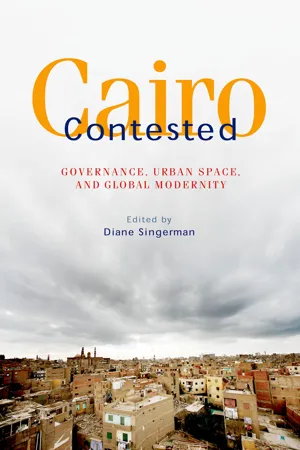
This cross-disciplinary, ethnographic, contextualized, and empirical volume explores the meaning and significance of urban space, and maps the spatial inscription of power on the mega-city of Cairo. Suspicious of collective life and averse to power-sharing, Egyptian governance structures weaken but do not stop the public's role in the remaking of their city. What happens to a city where neo-liberalism has scaled back public services and encouraged the privatization of public goods, while the vast majority cannot afford the effects of such policies? Who wins and loses in the "march to the modern and the global" as the government transforms urban spaces and markets in the name of growth, security, tourism, and modernity? How do Cairenes struggle with an ambiguous and vulnerable legal and bureaucratic environment when legality is a privilege affordable only to the few or the connected? This companion volume to Cairo Cosmopolitan (AUC Press, 2006) further develops the central insights of the Cairo School of Urban Studies.
Information
Subtopic
PoliticsIndex
Social Sciences
| 6 | Cairo’s City Government |
| The Crisis of Local Administration and the Refusal of Urban Citizenship |
In January 2004, fourteen people were killed when an apartment building in the middle-class, residential suburb of Madinat Nasr burned down. Among the dead were twelve firefighters and police officers, who were trying to extinguish the fire. The fire started in the basement, which contained flammable items, such as aerosol pumps and plastic utensils, used by a business that was leasing first-floor space from the landlord. Since the building’s construction in 1981, the landlord had added seven extra floors without government authorization. Deadly fires are frequent in Cairo, and, as this case shows, they do not only occur in poor and underdeveloped neighborhoods. But who is responsible for the neglect in regulation and enforcement, or persistence of corruption, that causes fires like this? The administration of the local district? The Cairo city government? The Egyptian central government? Certainly not the unlucky tenants in Madinat Nasr, who had already asked their landlord to ensure the safety of his renovations, particularly the newly added floors.
Their tragedy shows that the fundamental problems of this megalopolis stem from the inability of urban development, including the networks of municipal government, to keep up with Cairo’s massive demographic shifts since the 1970s. With more than 15 million inhabitants, over 20 percent of Egypt’s entire population, packed into an average of 380 residents per hectare, Cairo is one of the densest cities in the world (Séjourné 2002). The city’s strong concentration of political and economic power is the primary lure for its inhabitants. Greater Cairo has 43 percent of Egypt’s public sector jobs, 40 percent of its private sector jobs, and 49 percent of its industrial jobs, not counting the city’s universities and healthcare industries (El Kadi 2000, 527).
Meanwhile, even in Greater Cairo’s middle-class ‘heart,’ the Nile island of Zamalek, or the right-bank residential concentration of Muhandisin, one finds overpopulation, noise pollution, smog, traffic jams, poorly maintained buses, trains and buildings, and no green space. In the more working-class neighborhoods, most streets and alleys are unpaved and extremely narrow. These neighborhoods were farmland until the 1970s and 1980s, when governmental policies encouraged heavy urbanization, as well as the redistribution of the population into newly claimed desert outskirts. Now, the richest Cairenes live in new, gated enclave communities built by real-estate speculators on military-owned land in the desert outskirts of the capital. These compounds include the settlements of Sixth of October City, Dreamland, and Qattamiya, dotted with pools and golf courses (see Denis 2006). These new satellite cites, however economically and ecologically precarious, enjoy full political and administrative recognition by the state.
Meanwhile, the less privileged urban majority must find housing in selfmade settlements composed of illegally built-up structures, such as the one that burned down in Madinat Nasr. The working classes can choose to live in built-over farmlands with unpaved, narrow roads on the edges of Cairo, or in apartments constructed extra-legally on state-owned land. Although this form of spontaneous, informal urbanization is illegal, the state tolerates it because Egypt needs to house its expanding population to maintain, however temporarily, a certain social peace. Galila El Kadi considers the notion of “spontaneity” to dismiss the myth of a perfect and ordinary life, which contradicts another one that is anarchic and dangerous (1994). The adjective ‘spontaneous’ reflects a barbaric threat that besieges life.
State toleration is not the same as state recognition or formalization, however. The economic subsidies and legal preferences granted to the elite compounds, like the political freedoms, protections, and deferences granted to their inhabitants, are not afforded to the working-class neighborhoods. The central government’s attempt to both ignore and tolerate the proliferation of these ‘spontaneous’ working-class settlements finally ended in the late 1980s, when political and social violence enflamed these neighborhoods, which were built without an urban plan. The inhabitants of these quarters suffered from a lack of access to basic services such as water, electricity, sewers, sanitation, and schools. From 1994 on, the municipal and central governments started displacing large populations from their homes in order to renovate and upgrade buildings, especially in deteriorating areas in central Cairo, and made commitments to provide decent public services (see Dorman in this volume for further elaboration of the state’s ‘removal’ policies). These new policies, which were put in place slowly, are as lively, prolific, and tangled as are the patterns of new urban growth. Nonetheless, demographic pressures continue to override political efforts in both the margins and center of Cairo (Séjourné 2002).
Despite this mounting crisis in urban management, Cairo’s administrative powers are far weaker than they should be for a mega-city of such tremendous regional and global political influence and status. Unfortunately, this megalopolis is managed according to the general rules governing administration in Egypt. Municipal government in Egypt is sick, and the majority of the population suffers. This illness is actually a political-institutional crisis characterized by excessive centralization, lack of transparency, and communication failures between the administrative apparatus and citizens. Moreover, the enormity and the diversity of the city’s problems exponentially accentuate the dysfunction and the deficiency of local administration. The lost complaints of the tenants of the burned down building in Madinat Nasr reflect the ineffectuality of the local state of affairs and highlight the contradictions in models of hegemony and legitimacy that characterize Egypt’s political crisis today.
The point of this chapter is not to draw a complete and exhaustive picture of the administrative and political management of Cairo, but rather to highlight the political and administrative origins of this crisis of local government. I will show that the Egyptian government refuses to reform its local administration effectively because it refuses to accord political power to the local government and to allow for citizen participation. This refusal is part of a complex trend toward informal and apolitical decentralization. Egyptian sociologists and development consultants describe this process as al-majhud al-dhati, meaning self-help, self-reliance, or lifting oneself up by the bootstraps, without reliance on the state. The neoliberal norm of al-majhud al-dhati dictates that the inhabitants of working-class neighborhoods must pay both politically and financially for their own access to public services and resources, and perhaps eventually ‘buy’ formal administrative recognition from the state. Equally important, certain nongovernmental institutions (NGOs) have gained new power by taking over roles abandoned by the government, which is allowing unrestricted privatization of certain functions previously fulfilled by the state. This trend is a result of the ‘open door’ policy (Infitah) initiated by Anwar Sadat and continued under Husni Mubarak. This policy reduced the state’s social spending, especially with regard to health and education.
What are the effects of the Egyptian state’s refusal to let elected officials control municipal administration and the preference for privatization, informalization, and ‘NGO-ization’? Local officials, elected by neighborhoods to city council posts, are the most affected and frustrated by the ways that presidentially appointed national and city officials take policy decisions and distribute urban resources and services. My interviews of local elected officials in two peripheral quarters of Cairo show that the current political base suffers in such a situation and desires a larger role in the management of its neighborhoods and cities. This section will explore why the Egyptian state continues to privatize rather than ‘politicize’ local government, and the social unrest and administrative paralysis that arises from this trend. Then, using information from the Egyptian press, as well as interviews with heads of NGOs and local elected officials, I will expose the informal and apolitical decentralization that characterizes the new modes of responding to and channeling urban public needs in Greater Cairo.
The Administrative Sickness of Greater Cairo
To say that Cairenes do not have an institutional and formal hold on the management of their city and on the decisions that affect their daily lives is an understatement. It would be more proper to speak of an institutional impermeability between the administrative apparatus in charge of Cairo and those that live there. The administrative organization of Greater Cairo is so opaque that it is rare to find a Cairene who knows the name of the district administrator in charge of his or her own neighborhood. Just as rare is someone who actually knows which administrative and political authorities are responsible for solving local problems. This is because the administrative management of Greater Cairo is shared between three ‘governorates,’ each of which is divided into multiple districts.
Just as Greater Los Angeles includes Long Beach, Santa Monica, Orange County, and so forth, as well as the City of Los Angeles itself, Greater Cairo has grown beyond the technical limits of its original municipal boundaries. Greater Cairo includes the governorate of Cairo proper, historically identified with the urban concentration stretching from the east bank of the Nile west to the Muqattam Hills and the desert. The second governorate within the expanded urban region is Giza, situated along the west bank of the Nile. Giza is a zone of farms, deserts, villages, and pyramids that has become an increasingly important space for middle-class and working-class residential development since the Second World War and the Egyptian Revolution of 1952. The third governorate, Qalyubia, extends the Greater Cairo mass northward and includes the city of Shubra al-Khayma.
Because these three governorates share power over Greater Cairo, it is difficult to establish coordinated plans and policies for the megapolis as a whole. ‘Umbrella’ organizations created for planning Greater Cairo have no effective power, only the power to generate proposals. This is the case for the High Council for the Planning of Greater Cairo, created in 1965, and the High Committee for Regional Planning, created in 1979. Only the governorate of Cairo is fully within the boundaries of what is considered Greater Cairo, and its section of the larger urban region is currently divided into thirty urban districts.1
The governorate of Giza, meanwhile, has many villages and desert settlements to administer, which may or may not be considered within the Greater Cairo area. The city of Giza itself, which is certainly within the capital city’s radius, is led by a city government that is therefore in tension with both the larger governorate government of Giza and the central government and the planning councils of the broader urban region. Giza city is divided into seven districts.2 As for the governorate of Qalyubia, it is composed of four districts, which make up the city of Shubra al-Khayma.
The three governorates that share the management of Greater Cairo and the urban districts within each are considered autonomous administrative units. These provincial governorates are run and staffed by appointees and bureaucrats named by the central government. More than 70 percent of their resources flow from the coffers of the central government, and thus decisions about allocation and priorities come from the top down. The governor is the key relay-point in this system, and the presidents of urban districts subdividing the governorates work under him.
Governors and Presidents of the Quarters
The president of the republic directly appoints each governor, who holds the rank of a minister and is the representative of presidential power at the local/ provincial level. He—governors have always been male—supervises the application of general state policies in his governorate. He is directly responsible to the prime minister, who regularly organizes policymaking meetings between ministries and governors. Traditionally, since the Free Officers overthrew the monarchy in 1952, all governors have been high-ranking noncommissioned officers from the army and the police. An article published in the late 1990s shows that half of ministry-level municipal officials have been noncommissioned officers of the army and the police (Kharbush 1995).3 The selection of military personnel reflects the Egyptian president’s preoccupation with security, which overwhelms or comes to infuse all other municipal social or administrative issues. This preoccupation is also revealed in the appointment of certain presidents of local districts, particularly of working-class neighborhoods. This de facto requirement for the governor dates from the time of Nasser. The change during Mubarak’s era is the assignment of equal shares for officers from the army and the police to the positions of governor. The technocrats do not have any more visible access to politics.
The governor has at his disposal a cabinet responsible for administrative and financial questions, led by the governorate’s Council of Functionaries.4 This council is composed of presidents of the urban districts, governorate-level service directors, and directors of autonomous public services, such as those that distribute potable water, electricity, water drainage, sewage service, and gas, and those that maintain and inspect new public constructions like school buildings. These different bureaucratic bodies are organized in a hierarchy headed by the governor. Also included in the Council of Functionaries of the governorate are the members of the local district council, elected by vote of resident citizens in the neighborhoods. This council is supposed to represent district populations, convey their needs and grievances, and oversee the application of governorate-level state policies. Below the governorate level, at the district scale, a similar system exists, but as a more neatly disentangled bicameral system composed of the elected Popular Local Council (PLC) and the central government-appointed Council of Local Civil Servants (CLCS), which are presided over by the appointed district president.5
Local elections in Egypt are far less competitive than legislative elections because the local councils lack any real power. While the legislative elections witness an average of eight contenders per legislative seat, in the local elections in 2002, no more than 59,807 candidates ran for the 50,000 elected local seats, 80 percent of whom were the ruling National Democratic Party (NDP) candidates and 17.7 percent of whom were independents who could not secure a place on the NDP list. The rest of the candidates came from opposition parties. Regarding the profiles of the members of PLCs, there are no studies of their socioeconomic status. It is almost certain, however, that they are not social elites. The people who sit on the local council are simply civil servants from the decentralized services of the different ministries, such as the director of health, education, social affairs, habitat, and so on.
The Deficiencies of the System
This system of local representation and administration embeds conflicting urban regimes and reproduces several problems. First, each neighborhood has multiple bosses, with each chief having a different source of legitimacy, that is, a different authority to whom to report and from whom to seek approval for his actions. The PLC is supposed to be accountable to the people who elected it and is judged by levels of political popularity. The CLCS, whose members are judged by their level of technical efficiency, reports to the government, which guides and pays it. The governor, who reports to the president, must strive for political legitimacy, public popularity, and technical-admin...
Table of contents
- Cover
- Halftitle Page
- Title Page
- Copyright
- Dedication
- Content
- Contributors
- Acknowledgments
- Introduction
- Contested Space, Authority, Security, and Meaning
- Cairo’s Governance: Ambiguity, Legalities, Informality, and Mobilization
- Markets, Marketing, and Globalized Identities
Trusted by 375,005 students
Access to over 1.5 million titles for a fair monthly price.
Study more efficiently using our study tools.
Frequently asked questions
Yes, you can cancel anytime from the Subscription tab in your account settings on the Perlego website. Your subscription will stay active until the end of your current billing period. Learn how to cancel your subscription
No, books cannot be downloaded as external files, such as PDFs, for use outside of Perlego. However, you can download books within the Perlego app for offline reading on mobile or tablet. Learn how to download books offline
Perlego offers two plans: Essential and Complete
- Essential is ideal for learners and professionals who enjoy exploring a wide range of subjects. Access the Essential Library with 800,000+ trusted titles and best-sellers across business, personal growth, and the humanities. Includes unlimited reading time and Standard Read Aloud voice.
- Complete: Perfect for advanced learners and researchers needing full, unrestricted access. Unlock 1.5M+ books across hundreds of subjects, including academic and specialized titles. The Complete Plan also includes advanced features like Premium Read Aloud and Research Assistant.
We are an online textbook subscription service, where you can get access to an entire online library for less than the price of a single book per month. With over 1.5 million books across 990+ topics, we’ve got you covered! Learn about our mission
Look out for the read-aloud symbol on your next book to see if you can listen to it. The read-aloud tool reads text aloud for you, highlighting the text as it is being read. You can pause it, speed it up and slow it down. Learn more about Read Aloud
Yes! You can use the Perlego app on both iOS and Android devices to read anytime, anywhere — even offline. Perfect for commutes or when you’re on the go.
Please note we cannot support devices running on iOS 13 and Android 7 or earlier. Learn more about using the app
Please note we cannot support devices running on iOS 13 and Android 7 or earlier. Learn more about using the app
Yes, you can access Cairo Contested by Diane Singerman in PDF and/or ePUB format, as well as other popular books in Social Sciences & Politics. We have over 1.5 million books available in our catalogue for you to explore.