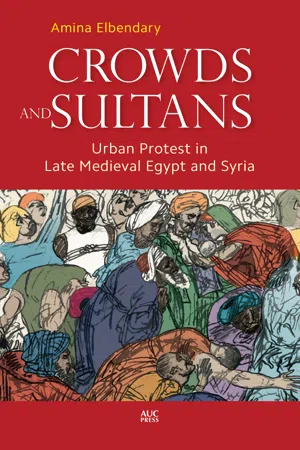
- English
- ePUB (mobile friendly)
- Available on iOS & Android
eBook - ePub
About this book
During the fifteenth century, the Mamluk sultanate that had ruled Egypt and Syria since 1249-50 faced a series of sustained economic and political challenges to its rule, from the effects of recurrent plagues to changes in international trade routes. Both these challenges and the policies and behaviors of rulers and subjects in response to them left profound impressions on Mamluk state and society, precipitating a degree of social mobility and resulting in new forms of cultural expression. These transformations were also reflected in the frequent reports of protests during this period, and led to a greater diffusion of power and the opening up of spaces for political participation by Mamluk subjects and negotiations of power between ruler and ruled.
Rather than tell the story of this tumultuous century solely from the point of view of the Mamluk dynasty, Crowds and Sultans places the protests within the framework of long-term transformations, arguing for a more nuanced and comprehensive narrative of Mamluk state and society in late medieval Egypt and Syria. Reports of urban protest and the ways in which alliances between different groups in Mamluk society were forged allow us glimpses into how some medieval Arab societies negotiated power, showing that rather than stoically endure autocratic governments, populations often resisted and renegotiated their positions in response to threats to their interests.
This rich and thought-provoking study will appeal to specialists in Mamluk history, Islamic studies, and Arab history, as well as to students and scholars of Middle East politics and government and modern history.
Information
Subtopic
Middle Eastern HistoryIndex
History1
INTRODUCTION: THE LONG FIFTEENTH CENTURY
Long-Term Transformations
Medieval as well as contemporary histories of the Mamluk period differ in their historiography and on many issues; they all agree, however, that the fifteenth century ushered in a new period for the regime. While many of these sources have understood these transformations in terms of a paradigm of decline—citing signs of the weakness and economic crisis the Mamluk regime was going through—this book will argue that things were more nuanced and complicated. Rather than straightforward and linear decline, I will argue that the fifteenth century witnessed crises that presented opportunities for various political and social groups, some of whom benefited and gained more power, while others suffered and were placed under increased stress. It will also show that the multiple crises were simultaneously the outward manifestations of deeper changes. These economic crises and political transformations led to changes and were themselves the outcome of changes in all of the domestic, regional, and international balances of power. Furthermore, while the changes led to distress in some areas, and for some groups at certain times, they also opened up opportunities for others, at other times. Rather than a linear regression, then, there was more dynamic change occurring, with ups and downs. This allowed some groups in society more access to power, and placed others under stress that led them to continually renegotiate their positions. On the whole, this social flux left non-elite urban populations in a position to negotiate power with rulers.
In order to better understand the deeper meanings of these crises, we need to look beyond dynastic history. Rather than narrate the history of this tumultuous fifteenth century solely from the point of view of the ruling dynasties, this book attempts to integrate into the total picture the point of view of the common people, especially the urban non-elites. And rather than presume that the non-elite took no part in those transformations and only stoically endured the oppression, it argues that the urban populations played various roles in those transformations. They were both the recipients of change and the agents of change in many cases. Their contributions are apparent and manifested in various ways, including the literary production of the time but also in references to urban protest.
Sources that refer to the fifteenth century include many references to incidents of protest, at rates that appear higher than those reported for other historical periods. These protests act as warning lights that point modern historians to areas of social and political tension. They also illuminate some of the ways in which power was negotiated and shared in medieval Egyptian and Syrian cities.
The Mamluk sultanate went through various economic crises. While it is difficult to give precise dates for the start of the crisis (indeed, in some modern narratives it seems as if the regime had barely been established when it began to decline economically), it is clear that by the beginning of the fifteenth century the regime was under much stress, and ruling sultans attempted to come up with various solutions to a long-term crisis. There would be times in which the crises reached a nadir as well as times of noticeable recovery throughout the century.
By reconsidering some of the interpretations of the fifteenth-century crisis, one must confront another issue: that of periodization. The issue of periodization is one that challenges many historians; medieval Islamicists are no exception. And while historians of the Arab-Muslim world have become reluctant to use the terminology of European historiography (‘late antique,’ ‘medieval,’ ‘early modern,’ etc.) to describe epochs of Arab-Muslim history, no standard alternative has been reached. Many scholars continue to date periods by referring to the contemporary ruling dynasties: thus Umayyad, Abbasid, Fatimid, Mamluk, Ottoman. I will use the terms ‘medieval’ and ‘late medieval’ with all the expected disclaimers. That is, it is important that the reader try to dissociate the European connotations of the Middle Ages when speaking of Islamic history. Instead I mean by ‘medieval’ the period and institutions that spread and characterized the Arab-Muslim region in the post-Abbasid, postclassical time, when the last semblance of a centralizing political entity gave way to multiple regional courts and military dynasties. By ‘late medieval’ I mean the tail end of this period, which is admittedly a blurred demarcation, but it includes early Ottoman rule of the Arab provinces. Similarly, I will concentrate on the fifteenth century, and I will argue that it was a long century for this part of the world. There is some merit in following the periodization of Mamluk historians, who saw the reign of Sultan Barquq (r. 1382–99 with a brief interruption) as the beginning of a new epoch. They based this largely on the racial shift in army recruits: Barquq’s reign is seen as the beginning of the Circassian period, characterized by the predominance of Circassian recruits in the army. I will argue that that shift itself was reflective of the long-term changes referred to earlier.
The fifteenth century ended with the fall of the Mamluk sultanate that had ruled Egypt and Syria since 1250. As is well known, the Mamluks were originally slave soldiers who were recruited for the armies by the last Ayyubid sultan al-Salih Najm al-Din Ayyub, hence the title ‘Mamluk,’ since they were ‘owned.’ Brought in as young slave boys from the Kipcak steppes, the Mamluks were educated in special military barracks. They were converted to Islam and taught basic literacy and skills as well as martial arts. Upon their graduation, the soldiers were manumitted and assigned to positions in the army. However, they continued to be referred to as Mamluks, even after their manumission. In the final months and years of Ayyubid rule over Egypt and Syria, and as the regime faced increasing military threats by the Crusaders directing attacks on Egypt, the Mamluk officers came to play greater roles in governance and rule, until ultimately they named one of their number as sultan. It is in the context of a crusade targeting Egypt in AH 647/1249–50 CE that they seized power. Not long after that, another invasion of Islamic lands, this time from the east, arrived on the scene. The Mongols reached Baghdad, until then the capital of the Abbasid Caliphate, under which the Ayyubids had at least nominally ruled. The fall of Baghdad in 1258 was a dramatic watershed in the history of medieval Islam. The Mongol advance threatened to expand and include all areas under Islamic rule in the eastern Mediterranean. The Mamluks’ victory against the Mongols at ‘Ayn Jalut in 1260 sealed their reputation as defenders of Islamic Egypt and Syria. It created a border between Iraq and Syria that was to be upheld for centuries. The Mamluks went on under al-Zahir Baybars (r. 1260–77) and al-Mansur Qalawun (r. 1279–90) to found a strong and stable military-feudal regime that was in many ways the epitome of postclassical medieval military regimes in the region.1
The Mongol invasions of the thirteenth century had put paid to the Seljuk network of regimes and subsidiary principalities in Iraq, Mesopotamia, and parts of Asia Minor. This vacuum allowed for the rise of new Turkish military regimes, one of which, the Ottoman principality, was to continue to grow and expand into a world empire that rivaled the Mamluks and others. By 1453 the Ottomans had taken over Constantinople, the historic capital of the Byzantines, thereby ending the centuries-old rule of the Eastern Roman Empire. The fifteenth century saw further consolidation of power by the Ottomans and their expansion in the east. It also witnessed the rise of the Safavid state in Iran and the Mongol successor states in parts of Iraq and Mesopotamia. By the sixteenth century, the balance of power between the Mamluks and the Ottomans had tipped in favor of the latter, resulting in final confrontation. The defeat of the Mamluks at the battles of Marj Dabiq (1516) and al-Raydaniya (1517) sealed the end of the Mamluk ruling regime, although Mamluk officers would continue to be important in Egyptian politics until the nineteenth century.
The battles between the last Mamluk sultans and the Ottoman armies in 1516–17 and the fall of the regime were in many ways the culmination of a long period of transformation that took place over at least a century. The economic and political transformations that Egypt and Syria witnessed during the long fifteenth century had tremendous effects on the populations and societies under Mamluk rule.
‘Decline and Fall’ Paradigm
Much of the modern literature on the late medieval period and late Mamluk rule is written within the paradigm of ‘decline and fall,’ which implicitly moves backward from the Ottoman conquests and explains the fifteenth century retrospectively. The rise of the Ottomans is understood firmly as a defeat of the Mamluks, thereby ignoring many of the similarities between the two regimes and many of the elements of historical continuity. One of the main signs and causes of the decline is implicitly the economic crisis. The decline is also thought to have permeated all aspects of society, so that cultural production of the period is looked upon with condescension and populations are imagined to have toiled, silently and stoically, under rampant corruption and injustice. This book tries to look at things sideways and bottom-up to read the signs of decline as signs of transformation and to hear the echoes of the non-elite through the surviving narratives.
Who are the non-elite? In addition to the challenges of periodization, social categorization is also a perennial issue for the modern historian. While it is important for us, writers and readers about the past, to be aware of the historical contexts in which terms such as ‘class’ have developed, we must also acknowledge the challenges in trying to understand and imagine how historical societies conceived and imagined social order in a pre-class context. The main divisions among people in the premodern Islamic world are usually imagined along the lines of rule and military power (rulers and ruled; sultans and subjects), religion (Muslims and non-Muslims), and gender (men and women). Economic privilege is of course understood to have played a role in people’s social position, although the rich as such do not seem to have constituted a visible social group on their own; rich people belonged to other apparently more dominant identities. They could be rich officers, rich ulama, rich merchants, and so on. The poor, on the other hand, sometimes appear in the sources as one undifferentiated block, usually in the contexts of certain crises, such as famine, for example. Such discursive references do not necessarily reflect social reality.
Then there are the elusive ‘amma. I tend to translate this term as ‘commoners,’ since the two words carry very similar connotations, or else as ‘non-elites.’ The ‘amma of the medieval Arabic sources are easier to define in negative terms: they are not Mamluks, for example; they are not even poor Mamluk soldiers. They are not necessarily uneducated, although some of the poorer members of the ulama class cannot have enjoyed much greater material benefits than the ‘amma, aside from education. They are not necessarily poor either; they could provide for themselves.
The difficulty of understanding medieval social distinctions in the spirit of their times is best understood by the terminology the contemporary sources themselves used. The Mamluk historian al-Maqrizi divided contemporary society into seven groups. The first were the rulers,
those who hold the reins of power. The second [is formed of] the rich merchants and the wealthy who lead a life of affluence. The third [encompasses] the retailers, who are merchants of average means, as are the cloth merchants. This also includes the small shopkeepers. The fourth category embraces the peasants, those who cultivate and plow the land. These are the inhabitants of the villages and of the countryside. The fifth category is made up of those who receive a stipend [al-fuqara’] and includes most legists, students of theology, and most of the ajnad al-halqah and the like. The sixth category [corresponds to] the artisans and the salaried persons who possess a skill. The seventh category [consists of] the needy and the paupers; and these are the beggars who live off the [charities of] others.2
Thus wealth alone was not the main marker of difference among groups of people in society, though al-Maqrizi does offer a quasi-hierarchical structure that begins with the rulers at the top and ends with beggars at the bottom. In the middle are various categories of people who are distinguished by their roles in society and the functions they performed.
Therefore, in discussing the roles of the non-ruling/non-Mamluk classes, including common people, I refer to them as the ‘non-elites.’ It is not an ideal term but it is meant to convey to the reader the sort of individuals who were not formally part of the ruling structure, who were not part of power, and who were not particularly wealthy or well connected, but who increasingly came to play roles in matters of power and politics, often through protest and negotiating power. They might have included craftsmen, artisans, and tradesmen of the Egyptian and Syrian cities, small-scale and local merchants. They might have included minor clerks and employees of ruling institutions, minor employees of educational institutions, katibs (scribes), janitors, muezzins, copyists. These members of society were traditionally marginalized in contemporary historiography, yet—as this book will argue—they made increasing appearances in the narratives of the late Mamluk period, which arguably reflects their changing social and political roles.
Economic crises
Contemporary and modern scholars agree that the Mamluk regime faced an economic crisis by the fifteenth century. Various reasons have been suggested for this, especially the long-term and cumulative effect of the waves of the plague, including the Black Death of 1348, that swept through the eastern Mediterranean. Contemporary historians recognized that something was amiss, prompting the famous Mamluk historian al-Maqrizi (d. 1442) to pen his treatise Ighathat al-umma bi kashf al-ghumma (Helping the community by revealing the causes of its distress). He and others placed the blame squarely on the shoulders of the rulers; the crises were a function of corrupt government. A similar argument is reflected in another treatise by Muhammad ibn Muhammad ibn Khalil al-Asadi (fl. 1450) titled al-Taysir wa-l-i‘tibar (The book of relieving hardship and learning lessons), in which the author called for administrative and fiscal reforms. The book analyzes the corruptions of the time and then describes the basic principles of sound administration and political practice that should be followed by Muslim rulers. According to al-Asadi there were four main reasons behind the disorder that Egypt suffered, all relating to matters of governance: the administration’s neglect of the land and irrigation; the state’s failure to quell rebellious Bedouin; the tyranny of government officials, especially inspectors, governors, and tax collectors; and the extortions levied by armed men and men close to the sultan.3
With the benefit of hindsight, we now recognize a number of economic challenges and difficulties that befell the Mamluk state simultaneously or else in close enough succession to be at times inseparable. A predominant factor must have been the successive waves of plague that decimated the population. That in turn had effects on both the workforce (i.e., the peasants) and the armies. Whole villages were reported to lie fallow as their dwindling populations fled to other areas, ultimately affecting agrarian production, especially in Egypt. When we keep in mind that Egypt was largely an agrarian society and that the land taxes did constitute a significant percentage of the state’s income, we can appreciate the compounded effects of decreased agrarian production on tax revenues. New military recruits were also severely affected by the epidemic; young and unaccustomed to the disease as they were, many perished during the plague epidemics. This meant that money, dearly obtained to buy young slaves for the army, was lost. Another economic challenge was that the Mamluk regime suffered from a cash crisis. Gold was difficult to obtain during the late Mamluk period, a situation clearly reported in surviving sources and reflected in the decreasing percentages of gold and silver in currencies. At the same time, the Mamluk state was increasingly facing new rival powers that threatened or cut off its control over certain trade routes and its supply of various materials including slaves, wood, and bullion. The rise of the Ottomans and the Safavids in Asia affected trade patterns. So did the increasing encroachment of the Portuguese into Red Sea trade.
In explaining the fifteenth-century crisis, modern historians fall roughly within two main schools. One school tends to explain it by stressing internal factors of decline. By looking within the Mamluk system, some historians have questioned not only its economic productivity, but also its politics. E. Ashtor, for example, considered government monopolies, taxes, corruption, and technological stagnation largely responsible for the collapse of Egyptian and Syrian industries such as the sugar and textile industries, and the ultimate triumph of European trade and commerce in the second half of the fifteenth century.4 Within this paradigm, the cruelty and greed of sultans such as Barsbay (r. 1422–38) led them to monopolize commodities and enterprises such as the spice trade and sugar production through various measures. The excessive taxes they levied from private, non-Mamluk producers and the system of tarh, or forced purchases, they imposed on traders in effect strangled competition and is the main reason, Ashtor argued, for the closing of many sugar factories. This led to both corruption in the management of surviving sugar factories and an aversion to technological innovation.5 Meanwhile, Europeans were developing more innovative techniques using horses instead of oxen, and a new sugar press was introduced by the mid-fifteenth century.6 Ultimately the Levantine products could not compete in price or quality with European sugar, especially after the introduction of New World plantations. While Ashtor did make allowance for demographic realities, mainly the depopulation of Egypt and Syria following the series of epidemics of the fourteenth and fifteenth centuries and the detrimental effects on the Syrian economy of Tamerlane’s invasion at the dawn of the fifteenth century, his analysis stresses the effect of the structure and organization of medieval Mamluk government itself, in addition to the decrees of particular rulers.7 Similarly, though he disagrees with some of the arguments of Ashtor, Sato Tsugitaka sees political corruption and natural disasters—rather than technological stagnation—as the main causes for the decline of sugar production in late Mamluk Egypt.8
Carl Petry has focused on studying the politics ...
Table of contents
- Cover
- Half Title Page
- Title Page
- Copyright
- Dedication
- Contents
- Note on Transliteration
- Preface
- 1 INTRODUCTION: THE LONG FIFTEENTH CENTURY
- 2 THE MAMLUK STATE TRANSFORMED
- 3 A SOCIETY IN FLUX
- 4 POPULARIZATION OF CULTURE AND THE BOURGEOIS TREND
- 5 BETWEEN RIOTS AND NEGOTIATIONS: POPULAR POLITICS AND PROTEST
- 6 PROTEST AND THE MEDIEVAL SOCIAL IMAGINATION
- 7 CONCLUSION
- Notes
- Bibliography
Trusted by 375,005 students
Access to over 1.5 million titles for a fair monthly price.
Study more efficiently using our study tools.
Frequently asked questions
Yes, you can cancel anytime from the Subscription tab in your account settings on the Perlego website. Your subscription will stay active until the end of your current billing period. Learn how to cancel your subscription
No, books cannot be downloaded as external files, such as PDFs, for use outside of Perlego. However, you can download books within the Perlego app for offline reading on mobile or tablet. Learn how to download books offline
We are an online textbook subscription service, where you can get access to an entire online library for less than the price of a single book per month. With over 1.5 million books across 990+ topics, we’ve got you covered! Learn about our mission
Look out for the read-aloud symbol on your next book to see if you can listen to it. The read-aloud tool reads text aloud for you, highlighting the text as it is being read. You can pause it, speed it up and slow it down. Learn more about Read Aloud
Yes! You can use the Perlego app on both iOS and Android devices to read anytime, anywhere — even offline. Perfect for commutes or when you’re on the go.
Please note we cannot support devices running on iOS 13 and Android 7 or earlier. Learn more about using the app
Please note we cannot support devices running on iOS 13 and Android 7 or earlier. Learn more about using the app
Yes, you can access Crowds and Sultans by Amina Elbendary in PDF and/or ePUB format, as well as other popular books in History & Middle Eastern History. We have over 1.5 million books available in our catalogue for you to explore.