- English
- ePUB (mobile friendly)
- Available on iOS & Android
eBook - ePub
About this book
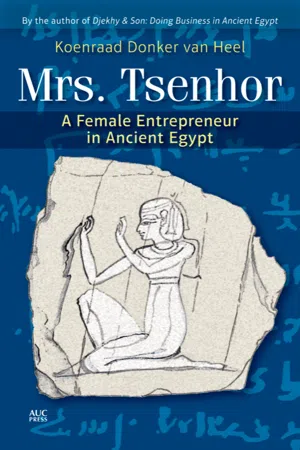
Tsenhor was born about 550 BCE in the city of Thebes (Karnak). She died some sixty years later, having lived through the reigns of Amasis II, Psamtik III, Cambyses II, Darius I and perhaps even Psamtik IV. By carefully retracing the events of her life as they are recorded in papyri now kept in museums in London, Paris, Turin, and Vienna, the author creates the image of a proud and independent businesswoman who made her own decisions in life.
If Tsenhor were alive today she would be wearing jeans, drive a pick-up, and enjoy a beer with the boys. She clearly was her own boss, and one assumes that this happened with the full support of her second husband Psenese, who fathered two of her children. She married him when she was in her mid-thirties.
Tsenhor--who was probably named after her father's most important client--was a working wife. Like her father and husband, she could be hired to bring offerings to the dead in the necropolis on the west bank of the Nile. For a fee of course, and that is how her family acquired high-quality farm land on more than one occasion. But Tsenhor also did other business on her own, such as buying a slave and co-financing the reconstruction of a house that she owned together with Psenese.
When Tsenhor decided to divide her inheritance, her son and daughter each received an equal share. Even the papyri proving her children's rights to her inheritance were cut to equal size, as if to underline that in her household boys and girls had exactly the same rights. Tsenhor seems in many ways to have been a liberated woman, some 2,500 years before the concept was invented.
Embedded in the history of the first Persian occupation of Egypt, and using many sources dealing with ordinary women from the Old Kingdom up to and including the Coptic era, this book aims to for ever change the general view on women in ancient Egypt, that is far too often based on the lives of Nefertiti, Hatshepsut, and Cleopatra.
Trusted by 375,005 students
Access to over 1.5 million titles for a fair monthly price.
Study more efficiently using our study tools.
Information
Subtopic
Social Science BiographiesIndex
History1
People
The Family
If Tsenhor were alive today, she would be wearing jeans, driving a pickup, and enjoying a beer with the boys. Instead she was born around 550 BCE in the city of Thebes (Karnak), in the deep south of Egypt. From the papers she left behind—now kept in the Bibliothèque Nationale (Paris), the British Museum, the Louvre, the Museo Egizio (Turin), and the Kunsthistorisches Museum (Vienna)—a picture emerges of a woman who had firm control over her own life. One assumes that this happened with the full support of her second husband, Psenese, who fathered two of her children. Just like Djekhy and Iturech—the main characters in Djekhy & Son: Doing Business in Ancient Egypt (Cairo: American University in Cairo Press, 2012)—Tsenhor was a choachyte, a funerary service provider who was hired to bring offerings to the deceased who were buried in the necropolis on the west bank of the Nile. By this we mean that Tsenhor did the work herself. In P. Turin 2127 from 491 BCE her eldest (half-)brother Nesamunhotep allots to her one-quarter of the income of a choachyte in return for her funerary services, presumably because she was a partner in the family business together with Nesamunhotep and two of her other (half-)brothers, Inaros and Burekhef. By that time, Tsenhor may already have been sixty years old, which was ancient in Late Period Egypt.
To you (Tsenhor) belongs a quarter of the bread of the choachyte and any other things that will be given to us as an offering for the mouth of the kalasirian (policeman) of the nome Nespaser son of Teos and his children. You will perform the service of a choachyte for its quarter in accordance with their needs at any time.
If it had not been for P. Turin 2125, in which the same man allots a part of their father’s house to Tsenhor, we probably would never have known that they were related. In this contract from 506 BCE Nesamunhotep refers to himself as “son of Petemin, whose mother is Tays,” while addressing his sister as “Mrs. Tsenhor daughter of Nesmin, whose mother is Ruru.” It is only in the first line of the actual contract that their relationship becomes clear: “I have given to you a large space of the house of Nesmin, our father.”
Ten years earlier, in P. Bibl. Nat. 217 from March 517 BCE, Tsenhor allots half of her inheritance to her baby daughter Ruru, who was named after her grandmother (this was a popular custom), showing that she herself owned part of the income of a choachyte established by her father Petemin (or Nesmin):
To you (Ruru) belongs half of what I (Tsenhor) own in the field, the temple, and the city, namely houses, field, slaves, silver, copper, clothing, it grain, emmer, ox, donkey, tomb in the mountain, and anything else on earth, as well as half of my share that comes to me in the name of the choachyte of the valley Nesmin son of Khausenwesir, my father, and (in the name of) Mrs. Ruru daughter of the choachyte of the valley Petemin, whose mother is Taydy, my mother. To you belongs half of my share that comes to me in the names of my mother and father mentioned above and in the names of their father and mother. To you belongs (half of) what is rightfully mine, in their name.
Ruru eventually followed in her mother’s footsteps. In September or October 497 BCE she herself closed a deal with a high official from the temple of Amun in Karnak to provide funerary offerings to a Mrs. Tadyipwer in return for four aruras of land, which was slightly over a hectare (P. Louvre E 3231A).
The other papyri left by Tsenhor also show that she was a business woman in her own right. In 516 BCE she bought a slave (P. Bibl. Nat. 223), and in 512 BCE, together with her second husband Psenese, she acquired a house or building site in the Theban necropolis (P. Turin 2123). Above, it was seen how Tsenhor (in P. Turin 2127 from 491 BCE) was appointed as a choachyte for one-quarter of the income connected with the funerary services to be performed for the family of a policeman. Since she had three brothers, dividing their parental home into equal parts in 506 BCE (P. Turin 2125), it seems that the four siblings may have continued the funerary services business of their father Petemin as a single company. Although the members of the family were mere choachytes, belonging to the lower middle class, in some of the contracts—maybe because they were standing in a notary office (not an everyday experience)—they call themselves “choachyte of the valley (the Assasif),” “choachyte of the necropolis of Djeme,” and “choachyte of the west of Thebes,” as if to underline the solemnity of the occasion. Most Egyptians would probably never have owned a written contract in their entire lives.
Then there was the land, eleven aruras that we know of, almost three hectares. These had been acquired by Tsenhor’s father in 556 BCE (P. Louvre E 10935) in return for his funerary services for a woman also called Tsenhor. The papers collected by ‘our’ Tsenhor tell us that she and her brothers were also engaged in the cultivation of this land. In P. Turin 2124 from 507 BCE we see her (half-)brother Burekhef (‘He does not know’) pay another man for the use of the cow he had leased for plowing the land. In view of the Turin inventory number—P. Turin 2122 up to and including 2128 are all papers connected to Tsenhor—we may be certain that this contract made out for Burekhef was originally part of Tsenhor’s archive. In 487 BCE we see Tsenhor’s son Ituru exchange cows with a cattle-keeper (P. Turin 2128). If Tsenhor was still alive at this time, she would have been sixty-three.
To the eleven aruras of family land we can add the four aruras acquired by her daughter in 497 BCE (P. Louvre E 3231A). If both her father and her daughter acquired land in return for their services, it is hardly likely that a keen businesswoman such as Tsenhor would not have acquired land on her own, so the family probably owned more land than we know of (she did have two husbands). Some believe that the eleven aruras acquired by Tsenhor’s father were owned by her exclusively, but she could actually have co-owned and cultivated these fields together with her three (half-)brothers.
But where did Tsenhor come from? Her father Petemin (‘Whom Min has given’) was also called Nesmin (‘Belonging to Min’) and married at least twice in his life. His first wife was an otherwise unknown Mrs. Tays, who bore him a son called Nesamunhotep, or Amunhotep for short. Petemin was to have two more sons who survived childhood, playing a minor role in some of the papers left by Tsenhor. They were called Inaros and Burekhef, but we do not know their mother’s name.

The names of the women are in italics.
Petemin’s second marriage was to a choachyte’s daughter called Ituru, or Ruru for short, who gave birth to our Tsenhor (‘The sister of Horus’) around 550 BCE. She was probably named after Petemin’s best-paying customer, the deceased Mrs. Tsenhor, whose son had endowed the family with eleven aruras of fields. It is difficult to believe that Tsenhor would have been the only surviving girl in this household, but the sources are silent on this point.

If we assume that Petemin (Nesmin) was in his early twenties when he concluded this deal about the eleven aruras in 556 BCE, he may have lived well into his seventies. Only in 506 BCE did Tsenhor and her (half-) brothers divide the house he once owned (P. Turin 2125), although it is equally possible that Petemin died much earlier and that the eldest brother Nesamunhotep managed the estate for some years before the formal decision was made to split up the house. This would include the writing of at least three new title deeds for Tsenhor and her (half-) brothers Inaros and Burekhef and maybe even three more in which the siblings promise their eldest brother not to claim some other part of the house in the future. In any case, as the ancient Egyptians were a very practical people, when the siblings divided the house, the scribe—no doubt wise through experience—specifically mentioned that the staircase would remain in communal use. The clause about the right of way was not a standard clause, although it does occur more often going into the Coptic period.
Perhaps in 535 BCE Tsenhor married for the first time, to a Mr. Inaros, presumably also a choachyte. They had one son that we know of, Peteamunhotep. In March 517 BCE Tsenhor, now about thirty-three years old, allotted half of her parental inheritance to her son (P. Bibl. Nat. 216). The other half went to Peteamunhotep’s baby half-sister Ruru from Tsenhor’s second marriage, in a contract that was drawn up the same day (P. Bibl. Nat. 217). After this, nothing is heard about Peteamunhotep again, and some Egyptologists believe that he died in his early youth.

This day in March 517 BCE was to be a special day in Tsenhor’s life. Apart from the division of her inheritance between Peteamunhotep and Ruru, she also concluded a marital property arrangement with her second husband, the choachyte Psenese son of Heryrem (P. BM EA 10120A). On the same day, in a separate contract, the latter also formally recognized the rights of his daughter Ruru to his inheritance (P. BM EA 10120B). This is strange, because normally the husband would designate his heirs in the marital property arrangement itself, thus guaranteeing his wife that the children from their marriage would be the future heirs to his property. We do not know what happened to Tsenhor’s first husband Inaros. He may have died, but the couple could equally well have divorced, which was a rather simple and common procedure in Late Period Egypt. A man could khâa, ‘repudiate,’ his wife and compensate her financially if she had been a faithful wife, and a woman could just as easily decide to shem, ‘go away,’ as long as the obligations laid down in a written marital property arrangement, or dictated by customary law, were observed and the wife had not been unfaithful.
As will be seen later, adultery by men was not exactly approved of, although the reasons for this seem to have been practical rather than ethical. For women, adultery was a much bigger problem. There is, for instance, P. BM EA 10416, also known as P. Salt 1821/131, which is dated to the late Twentieth Dynasty, about 550 years before Tsenhor was born. This text of 23.5 x 22 cm, with eleven lines on the recto (front) and thirteen on the verso (back), is a letter that clearly deals with an affair between a married man and an unmarried woman, which was not exactly approved of by some immediate relatives. The text was published by the famous Deir al-Medina expert Jac J. “Jack” Janssen, my first and most beloved teacher in Egyptology, at a time when his own marriage had gone wrong and people were pointing fingers at him for no reason. P. BM EA 10416 was an intelligent reply, at the same time showing that the maxims about adultery that we encounter in, for instance, the demotic teachings of Ankhsheshonqy (about which we will hear more below) are often mistaken by mainstream Egyptology for ‘the’ Egyptian outlook on life—which of course they were not. This could happen in real life and it probably was not an accident:
Your people were on the move, their old and young, both men and women, in the evening. They left saying: “We will beat her up together with her people.” [It] was the steward who told them: “But why are you going [to the house] of my scribe to beat up my people? She will not be there.” And he withstood them and told them: “Is it your man who will be found there? My envoy told me: ‘Him whom we will find we will beat up.’ So please tell me.” This he said to them, and they answered back at him: “He has been sleeping with that woman for eight full months until this day, although he is not (her) husband. Were he her husband, would he not have sworn this oath about this (?) woman?”
Since this is a letter the content is, as ever, rather obscure, but it seems clear that the brave steward managed to repel an angry mob intent on blood, preferably the blood of the woman having an affair. It continues with a piece of advice that could have been given yesterday: “Why did you receive him to sleep with him repeatedly? [Are you] looking for partners to argue with? ( … ) If the heart of that man is after you, then let [him] enter the court together with his wife and let [him] swear an oath and return to your house.” Apparently, if the adulterous man were to file for divorce in the qenbet (local court of law) and then wrap things up financially, things would calm down almost immediately. If not, village justice would be theirs.
In ancient Egyptian marriage there were three kinds of property, although further subdivisions were possible (see “When Old Age Sets In” below): the property of the husband, the property of the wife (which was often at least partly managed by the husband during their marriage), and the property the couple acquired together during their marriage. If they divorced, the wife stood to receive the ...
Table of contents
- Cover
- Half Title Page
- Title Page
- Copyright Page
- Contents
- List of Illustrations
- List of Tables
- The Tsenhor Papyri
- Preface
- Acknowledgments
- Chronology
- 1. People
- 2. Earth and Water: Nesmin, 556 BCE
- 3. Love and Death: Psenese, Tsenhor, Ruru, and Peteamunhotep, 530–517 BCE
- 4. Slave: Tsenhor, 517 BCE
- 5. Bricks: Tsenhor, Psenese, and Nesamunhotep, 512–506 BCE
- 6. Cattle: Burekhef and Ituru, 507–487 BCE
- 7. Love and Death: Tsenhor, Psenese, Ituru, and Ruru, 498–494 BCE
- 8. Earth and Water: Tsenhor, Ruru, and Nesamunhotep, 497–491 BCE
- Notes
- Index
Frequently asked questions
Yes, you can cancel anytime from the Subscription tab in your account settings on the Perlego website. Your subscription will stay active until the end of your current billing period. Learn how to cancel your subscription
No, books cannot be downloaded as external files, such as PDFs, for use outside of Perlego. However, you can download books within the Perlego app for offline reading on mobile or tablet. Learn how to download books offline
Perlego offers two plans: Essential and Complete
- Essential is ideal for learners and professionals who enjoy exploring a wide range of subjects. Access the Essential Library with 800,000+ trusted titles and best-sellers across business, personal growth, and the humanities. Includes unlimited reading time and Standard Read Aloud voice.
- Complete: Perfect for advanced learners and researchers needing full, unrestricted access. Unlock 1.5M+ books across hundreds of subjects, including academic and specialized titles. The Complete Plan also includes advanced features like Premium Read Aloud and Research Assistant.
We are an online textbook subscription service, where you can get access to an entire online library for less than the price of a single book per month. With over 1.5 million books across 990+ topics, we’ve got you covered! Learn about our mission
Look out for the read-aloud symbol on your next book to see if you can listen to it. The read-aloud tool reads text aloud for you, highlighting the text as it is being read. You can pause it, speed it up and slow it down. Learn more about Read Aloud
Yes! You can use the Perlego app on both iOS and Android devices to read anytime, anywhere — even offline. Perfect for commutes or when you’re on the go.
Please note we cannot support devices running on iOS 13 and Android 7 or earlier. Learn more about using the app
Please note we cannot support devices running on iOS 13 and Android 7 or earlier. Learn more about using the app
Yes, you can access Mrs. Tsenhor by Koenraad Donker van Heel in PDF and/or ePUB format, as well as other popular books in History & Social Science Biographies. We have over 1.5 million books available in our catalogue for you to explore.