- English
- ePUB (mobile friendly)
- Available on iOS & Android
eBook - ePub
About this book
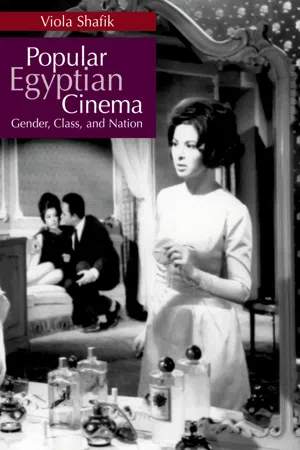
In this groundbreaking work, film scholar Viola Shafik examines popular and commercial movies from Egypt's film industry, including a number of the biggest box-office hits widely distributed in Egypt and the Arab world. Turning a critical eye on a major player in Egyptian cultural life, Shafik examines these films against the backdrop of the country's overall socio-political development, from the emergence of the film industry in the 1930s, through the Nasser and Sadat eras, up to the era of globalization.
In unearthing the largely contradictory meanings conveyed by different films, Popular Egyptian Cinema examines a broad array of themes, from gender relations to feminism, Islamism and popular ideas about sexuality and morality. Focusing on representations of religious and ethnic minorities primarily Copts, Jews, and Nubians Shafik draws out issues such as the formation of the Egyptian nation, cinematic stereotyping, and political and social taboos. Shafik also considers pivotal genres, such as melodrama, realism, and action film, in relation to public debates over highbrow and lowbrow culture and in light of local and international film criticism.
Information
Subtopic
Film & VideoPART I
Nation
CHAPTER 1
The Other
The most horrible grievances of the twentieth century, such as social unrest, ethnic cleansing, and forced migration have been commonly linked to the process of modern nation formation that was combined in the so-called Third World with the movement of colonization and decolonization, something that has doubtless left its traces on the art and culture of the affected peoples and made Homi Bhabha state that “The nation fills the void left in the uprooting of communities and kin, and turns that loss into the language of metaphor” (Bhabha 1990, 291). This certainly holds true for people under foreign occupation like the Palestinians, but is it also the case for a country like Egypt, based on an ancient and relatively stable territorial entity? Moreover as Eric Hobsbawm, who investigated the development of nationalism on the international arena since 1789, insisted, “Frictions between ethnic groups and conflicts, often bloody ones, between them, are older than the political programme of nationalism, and will survive it” (Hobsbawm 1992, 164).
Unlike what Anderson claims for quite a number of formerly colonized peoples, it cannot be established that it was colonial census-taking and mapping alone that engendered disparate ‘identities’ (cf. Anderson 1991, 164) in the Middle East in general and in Egypt in particular. Religious affiliation was a means by which the millet system of the Ottoman Empire—intact until 1914—differentiated juridically between Muslims and non-Muslim religious communities protected by the state. This resulted in communitarist identities within the borders of a multi-ethnic and multi-confessional empire. One of its features was a “high level of toleration, communal autonomy, and cultural symbiosis among Muslims, Christians, and Jews” (Beinin 1998, 36).
Yet colonialism and the spread of modern nationalism in the territories of the Ottoman Empire were accompanied by often futile or incomplete attempts to create secular non-religious citizenship on the one hand, while old forms of ethnic and religious schisms and differentiations resulted in hitherto unprecedented sorts of injustice and oppression on the other. Turkish and Iraqi Assyrians suffered displacement. Most of the Arab Jews left, willingly or by force, their countries of origin; many Christian and Muslim Palestinians still live in refugee camps or under occupation, suffering daily humiliation and deadly assaults. The Egyptian and Sudanese Nubians were forced to migrate while the waters of Lake Nasser drowned most of their original homeland.
As states and nationalities do not necessarily coincide (Hobsbawm 1992, 134), nationalism(s) exit in various interrelated or conflicting versions, economic, territorial, and linguistic. In the case of the Arab world it was particularly the language factor that had a strong interregional impact. Even though Arab nationalism at first developed two seemingly competing trends—one of them had a pan-Islamic orientation first expressed by Muslim scholars, while the second tended to be more secular, dissociating nationalism from religion—they were united in their reliance on the Arabic language and later reconciled by state practice. Thus, after an initial liberal phase and in spite of their seemingly secular orientation, the region’s most dominant nationalisms, be they in Algeria, Egypt, Syria, or Iraq, chose primarily Islam as the state religion and the Arabic language and Arab culture as unifying factors at the expense of all other religions and languages, marginalizing minorities in the official and to a large extent in the unofficial media.
With independence, regimes like that of Egypt inherited colonial bureaucracy and its ethnic–religious spatial and racial categorizations (mappings), and developed structures close to what Anderson has described for nineteenth-century official nationalism in Europe. The latter’s “policy levers” were “compulsory state-controlled primary education, state-organized propaganda, official re-writing of history, militarism . . . and endless affirmations of the identity of dynasty and nation” (Anderson 1991, 101). But immense differences in practice and theory remain between what people can identify with and what leaderships and spokesmen propose, for unlike what official or dominant unitary ideologies aim at, “collective identity is a set of interlocking elements in strife and tension, a set periodically scrambled, reorganized, blocked, and gridlocked by contingencies from within and without” (Connolly 2002, 204). In other words, the process of imagining one’s own community was not as coherent and unequivocal as official or dominant rhetoric and discourses suggested, for it may be suspected that what Eric Hobsbawm stated for the colonial period became true also of present-day situations, namely that “pro-national identifications, ethnic, religious or otherwise, among the common people, they were, as yet, obstacles rather than contributions to national consciousness” (Hobsbawm 1992, 137).
This means that any metaphor of the nation will always find itself contested, first because it is the project of constant negotiation between those who are (or are not) admitted to it and second, because of the “Janus-faced discourse of the nation. This turns the familiar two-faced god into a figure of prodigious doubling that investigates the nation-space in the process of articulation of elements: where meanings may be partial because they are in medias res; and history may be half-made because it is in the process of being made” (Bhabha 1990, 3). This is also what inspired Homi Bhabha to go further and ask, “If the ambivalent figure of the nation is a problem of its transitional history, its conceptual indeterminacy, its wavering between vocabularies, then what effect does this have on narratives and discourses that signify a sense of ‘nationness’: the heimlich pleasures of the hearth, the unheimlich terror of the space or race of the Other; the comfort of social belonging, the hidden injuries of class; the customs of taste, the powers of political affiliation; the sense of social order, the sensibility of sexuality” (Bhabha 1990, 2). This question is indeed a thread that leads through this and following chapters.
(En-)Countering the Other
Black-British scholar Stuart Hall clarified that the notions of difference and the ‘Other’ are widely considered constitutive on the linguistic, social, cultural, and the psychic level, something that renders the term ‘difference’ highly ambivalent. “It can be both positive and negative. It is necessary for the production of meaning, the formation of language and culture, for social identities and a subjective sense of the self as a sexed subject—and at the same time, it is threatening, a site of danger, of negative feelings, of splitting, hostility and aggression toward the ‘Other’” (Hall 1997, 238).
As difference is constitutive to meaning, the process of ‘Othering’ can hardly be contested, unless a conscious decoding, a ‘contest from within’ that does not avoid the stereotype but acknowledges that meaning can never be finally fixed, gets applied. Or to take up Jackie Stacey’s interpretation of Roland Barthes’ ideas, “It might be better, as Barthes suggests, neither to destroy difference, nor to valorize it, but to multiply and disperse differences, to move towards a world where differences would not be synonymous with exclusion” (Stacey 1992, 248).
Hall’s view implies also that difference does not simply exist by nature but is also a cultural product. Therefore it is constantly regenerated and reflected in different media formats and is coded often in a very subtle way, even in its positive approach, as has been demonstrated by U.S. cinema. Even though the sympathetic well-cultured African-American cop for instance has conquered the screen, the reversing of stereotype for the sake of political correctness is not enough to recode his binary racialized representation (Hall 1997, 271). Drawing on Edward Said’s groundbreaking study Orientalism, Hall has therefore occupied himself with unpacking stereotyping as representational practice particularly regarding race and sexuality. In analyzing the most recurrent mechanisms that govern the process of ‘Othering’ at work in the mass-mediated spectacles of the ‘Other,’ he has shown to what extent they are caught up in the social and political power structures. Essentialism, reductionism, naturalization, and the creation of binary oppositions are in his view the more conscious strategies of ‘Othering,’ while the more subtle, subconscious ones crystallize in fantasy, fetishism, and disavowal.
In Hall’s eyes “[s]tereotyped” means “reduced to a few essentials, fixed in Nature by a few, simplified characteristics” (Hall 1997, 249). Those few outstanding traits are then declared part of the Other’s unchanging natural essence. This may not only be achieved by overtly negative demonizing but also through glorification and/or fetishizing, as can be seen among others in the sexualized representation of black Africans starting with Leni Riefenstahl’s Nubians and ending with modern sports photography, a strategy that appears to be positive only at first sight (Hall 1997, 264).
The problem with cinematic representation is its potentially naturalizing or ‘real-ization’ effect, which helps viewers to mistake cinematic discourses on reality for real-life itself, and that works even better in the absence of alternative representations and balanced information. Local and concrete circumstances are likely to be obliterated. In this respect stereotypes may play an important role in shaping or confirming certain perceptions. Yet Robert Stam and Ella Shohat have warned against isolating stereotypes without looking at the overall cinematic context, for not every stereotype is damaging. Instead they have asked for a “comprehensive analysis of the institutions that generate and distribute mass-mediated texts as well as of the audience that receives them in order to understand the dynamics of stereotyping” (Shohat and Stam 1994, 184). Furthermore, it goes without saying that the Othering effect cannot be generalized, as it depends, as does the perception of realism, on the standpoint of the reader, his/her state of knowledge and experience regarding what is represented.
Toward a ‘National’ Film Industry
In Egypt the process of nationalist unification and purification has been reflected in film stories and film plots but also became evident in the changing composition of the country’s early film industry. Post-independence film historiography in the years following independence underscored national achievements at the expense of cineastes who were later not considered native Egyptians. In fact, this was a more complex issue than it seems to be at first sight (and also torments some European nations today who have a large immigrant population). For what is it that defines nationality: blood, birth, language, or culture, or all of them?
In Egypt, where the population was not only composed of a majority of Arabic speaking Muslims and Copts, but also of other tiny Christian Arab communities, Middle Eastern Jews, Sephardim, Ashkenazim, non-Arabic speaking Muslim Nubians, Arab–Muslim Bedouin tribes, Turks and Circassians, Armenians, and a range of Levantine communities such as Greeks and Italians who were partially Egyptianized (mutamassirun), the issue gained more importance in 1929 with the introduction of the nationality law and subsequent attempts to Egyptianize the economy. It seems that not all who were entitled to hold Egyptian nationality were indeed able to acquire it. It is reported that many members of the mutamassirun, but also of the poorer Arabized Jewish communities, were confronted with bureaucratic obstacles when applying for Egyptian nationality (Beinin 1998, 38). On the other hand, some ‘native’ minorities such as Syrian Christians and Jews had acquired earlier foreign nationalities profiting from the Capitulations, that is, the special legal rights for Europeans. This placed them under the protection of European powers who in turn considered them useful local helpmeets.
With national sentiments on the rise, the identification of the first really native ‘Egyptian’ films gained increasing importance for Egyptian postindependence film historiographers. Local critics, and accordingly many Western writers, mostly named Layla/Layla, which was produced and codirected by the actress ‘Aziza Amir in 1927, as the first Egyptian full-length feature film. Ironically, Layla may not be regarded as a purely national production as well, for it was the Turkish director Wedad Orfi who persuaded ‘Aziza Amir to produce the film. Later, after Orfi and Amir disagreed, Stéphane Rosti, an Italian-Austrian born in Egypt, was in charge of codirection. Subsequently he became a popular actor.
However, as Ahmad al-Hadari unearthed in 1989, the first full-length film produced in Egypt was In Tut Ankh Amon’s Country/Fi bilad Tut ‘Ankh Amun by Victor Rositto, shot in 1923. Its existence was at first obliterated, probably because of insufficient promotion and its focus on ancient Egypt, or because its director was not considered an ethnic Egyptian. The same applies to the full-length feature film A Kiss in the Desert/Qubla fi-l-sahra’, directed by the Chilean-Lebanese (or Palestinian) (cf. Bahgat 2005, 118) Ibrahim Lama, whose film appeared almost at the same time as Layla.
Ibrahim Lama and his brother Badr (their real names were Pietro and Abraham Lamas), who arrived in Alexandria in 1926, produced, directed, and acted in several full-length feature films. The Christian Lebanese actress Assia Daghir also settled in Egypt in 1922. Her first production The Young Lady from the Desert/Ghadat al-sahra’ was screened in 1929 and starred herself and her niece Mary Queeny. Several other ‘foreigners’ were involved in directing too, most notably Togo Mizrahi, a Jew who was born in Egypt but carried Italian nationality, and the German Fritz Kramp.
This is not to say that so-called native Egyptians did not contribute to the creation of a local film industry. Actors and actresses including Yusuf Wahbi, ‘Aziza Amir, Amin ‘Atallah, and Fatima Rushdi soon discovered the media and joined in to shape it. They did not only act, but directed, produced, and even constructed studios as early as the late 1920s. Others, for example Muhammad Bayumi, who started shooting short films in the early 1920s and worked then as a professional director and cameraman (el-Kalioubi 1995, 44) and Muhammad Karim, who became one of the most distinguished directors during the 1930s and had started working in 1918 as an actor for an Italian production company, had no prior relation to the theater.
The majority of screen performers during this period were ‘native’ Egyptians from different religious backgrounds: Christians such as popular comedian Nagib al-Rihani, but also Bishara Wakim, who often embodied the character of a funny Lebanese and appeared first in 1923 in Bayumi’s short fiction Master Barsum is Looking for a Job/al-Mu‘allim Barsum yabhath ‘an wazifa and Mary Munib, who started her career in cinema during the late 1920s and became a very popular comedian. The most famous Jewish artist was Layla Murad, who remained one of the most acclaimed singers of Egyptian cinema. She made her first appearance in 1938 in Muhammad Karim’s Long Live Love/Yahya al-hubb, converted to Islam in 1946, and remained in Egypt until her death in 1995. Others who became involved from the 1940s onward—to name just a few—were the Jewish actresses Raqya Ibrahim, Camelia, and most importantly Nigma Ibrahim, who often embodied a gangster woman (Raya and Sakina/Raya wa Sakina, 1953), Greek actor Jorgos (Georges) Jordanidis, and Greek dancer Kitty.
Greek businessmen played a decisive role too. Two Greeks, Evangelos Avramusis and Paris Plenes,1 founded in 1944 the Studio al-Ahram that presented ten films until 1948 (Khiryanudi 2003, 10). Several Egyptian directors, most notably Togo Mizrahi, directed films meant to be distributed exclusively in Greece or made two versions, in Arabic and Greek, of one and the same film. During the 1950s and until the nationalization of the Egyptian film industry in 1963, 80 percent of all movie theaters were Greek-owned, something that changed of course with the subsequent disintegration of the Greek community (Khiryanudi 2003, 11). Kitty, who starred in, among others, Isma‘il Yasin’s Ghost/‘Afritat Isma‘il Yasin (1954) is said to have left Egypt in the 1960s (Khiryanudi 2003, 13).
Although early Egyptian cineastes came from such diverse ethnic and religious backgrounds, they were unified, first, by the cosmopolitan and francophone elitist culture of the two Egyptian metropolises Alexandria and Cairo and, second, by the needs and rules of the local market, or in other words, by the preferences of the Egyptian audience. Thus, the subjects of Egyptian cinema were not as international or alienated as the origins of their producers may suggest. The love stories, for example, that were presented at that time were not always set in the surroundings of the Europeanized elite but also included local lower-class characters or were projected back into a glorious Arab Muslim past. The majority of comedies starring popular comedians, such as Nagib al-Rihani and ‘Ali al-Kassar, had a strong popular orientation. In particular during the 1930s, these comedians presented rather stereotypical roles that they had previously played in theater, such as Nagib al-Rihani’s Kish Kish Bek and Kassar’s Nubian ‘Uthman ‘Abd al-Basit. Similar to the lesser known Jew, Shalom, these characters represented poor natives living in traditional surroundings who often landed in trouble, mainly because of their bad economic situation.
It ...
Table of contents
- Cover
- Halftitle Page
- Title Page
- Copyright
- Contents
- Acknowledgments
- Introduction
- Part 1: Nation
- Part 2: Gender
- Part 3: Class
- Notes
- Bibliography
- Index of Names
- Index of Film Titles
- Photographic Credits
Trusted by 375,005 students
Access to over 1.5 million titles for a fair monthly price.
Study more efficiently using our study tools.
Frequently asked questions
Yes, you can cancel anytime from the Subscription tab in your account settings on the Perlego website. Your subscription will stay active until the end of your current billing period. Learn how to cancel your subscription
No, books cannot be downloaded as external files, such as PDFs, for use outside of Perlego. However, you can download books within the Perlego app for offline reading on mobile or tablet. Learn how to download books offline
Perlego offers two plans: Essential and Complete
- Essential is ideal for learners and professionals who enjoy exploring a wide range of subjects. Access the Essential Library with 800,000+ trusted titles and best-sellers across business, personal growth, and the humanities. Includes unlimited reading time and Standard Read Aloud voice.
- Complete: Perfect for advanced learners and researchers needing full, unrestricted access. Unlock 1.5M+ books across hundreds of subjects, including academic and specialized titles. The Complete Plan also includes advanced features like Premium Read Aloud and Research Assistant.
We are an online textbook subscription service, where you can get access to an entire online library for less than the price of a single book per month. With over 1.5 million books across 990+ topics, we’ve got you covered! Learn about our mission
Look out for the read-aloud symbol on your next book to see if you can listen to it. The read-aloud tool reads text aloud for you, highlighting the text as it is being read. You can pause it, speed it up and slow it down. Learn more about Read Aloud
Yes! You can use the Perlego app on both iOS and Android devices to read anytime, anywhere — even offline. Perfect for commutes or when you’re on the go.
Please note we cannot support devices running on iOS 13 and Android 7 or earlier. Learn more about using the app
Please note we cannot support devices running on iOS 13 and Android 7 or earlier. Learn more about using the app
Yes, you can access Popular Egyptian Cinema by Viola Shafik in PDF and/or ePUB format, as well as other popular books in Media & Performing Arts & Film & Video. We have over 1.5 million books available in our catalogue for you to explore.