- English
- ePUB (mobile friendly)
- Available on iOS & Android
eBook - ePub
About this book
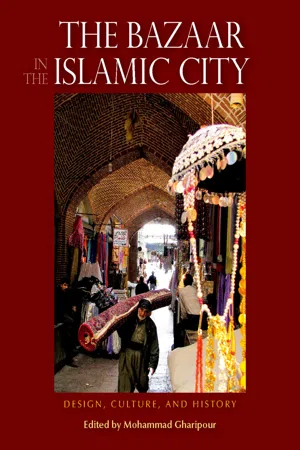
The Middle Eastern bazaar is much more than a context for commerce: the studies in this book illustrate that markets, regardless of their location, scale, and permanency, have also played important cultural roles within their societies, reflecting historical evolution, industrial development, social and political conditions, urban morphology, and architectural functions. This interdisciplinary volume explores the dynamics of the bazaar with a number of case studies from Cairo, Damascus, Aleppo, Nablus, Bursa, Istanbul, Sana'a, Kabul, Tehran, and Yazd. Although they share some contextual and functional characteristics, each bazaar has its own unique and fascinating history, traditions, cultural practices, and structure. One of the most intriguing aspects revealed in this volume is the thread of continuity from past to present exhibited by the bazaar as a forum where a society meets and intermingles in the practice of goods exchange-a social and cultural ritual that is as old as human history.
Information
Subtopic
Middle Eastern HistoryIndex
History| Introduction | |
| 1 | The Culture and Politics of Commerce |
| Bazaars in the Islamic World |
Mohammad Gharipour
Contemporary debates on Islamic cities emerged from the classic nineteenth-century orientalist model. The Islamic City, praised as an ideal and undiscovered realm by orientalists such as Albert Hourani and Gustave von Grunebaum in the 1960s, served as the subject of paintings, literature, and even music in Europe. The Europeans’ view of the orient was based on an exotic interest in the ‘other,’ the unknown world described in the story of One Thousand and One Nights, in the portrayal of Timur’s court by Ruy Gunzales Clavijo, in Johann Strauss II’s “Egyptian March,” and in David Roberts’ sketches of Jordan and the Holy Land. This view either rejected categorizing the construct as a city because it did not follow western models of ‘organized’ cities where the local government or municipality ruled, or considered the Islamic city as a construct, or as a structure including elements that differentiated it from European medieval cities, such as mosques and bazaars. Later, the involvement of revisionist scholars and researchers brought an insider’s view, emphasizing process over form, and context over content. These scholars tried to explain the reasons behind what orientalists described as chaos or disorder in Islamic cities, by emphasizing the sociopolitical factors behind urban development. Arguing that westerners’ ignorance originated in a Eurocentric approach, they clarified that the ‘chaotic’ or ‘disorganized’ form of cities was not the consequence of lack of governance. The form of these cities was the reflection of the functionality of the concept of umma and Muslim community on macro and micro levels. As AlSayyad claimed,1 the medievalizing Islamic city would reveal different layers of change, each of which illustrates vibrant complexes of politics, economy, and culture. This view not only analyzed and appreciated the pre-Islamic roots of Islamic cities, but also attempted an answer to the question “Is there such a thing as an Islamic city?” in the sense of a city shaped by Muslims, a city that protects its own ethnic or religious minorities, that may be the reflection of heaven on earth, or—as the Muslim philosopher al-Ghazali claims—a place where all the sins of the world run riot!
These diverse definitions all consider the bazaar as a unique element or quality of the Islamic city. For orientalists, the bazaar was the main distinguishing feature between cities in the Islamic and European worlds, while in recent theoretical frameworks the bazaar is considered as part of the development process, a quality rather than a physical realm. The bazaar has the potential to narrate the history of development, change, and even revolution within society. The latest instance is that of Tarek al-Tayyib Muhammad Bouazizi, the Tunisian street vendor who set himself on fire in a makeshift market in Sidi Bouzid, a small town in Tunisia, on December 17, 2010, after being harassed by a municipal official. This event ignited local uprisings in Tunisia that later spread to Egypt, Yemen, Bahrain, and other Arab countries, and are currently reshaping the politics of the whole region.
For centuries, people around the world have gathered to trade, buy, and sell goods in their communal and commercial centers. These marketplaces often served as an integral part of the community and were called by many names, with meanings specific to their respective cultures. Bazaar means a marketplace or assemblage of shops where miscellaneous goods and services are bought and sold. The word bazaar has roots in Middle Persian (wazar) and Armenian (vačar). In the course of economic interactions, the word spread to Arab countries, Ottoman Turkey, Europe, India, and even China. ‘Bazaar’ has acquired three different meanings: the market as a whole, a market day, and the marketplace.2 It could also refer to one part of the bazaar, such as a street belonging to a specific guild. Borrowing from the Aramaic word shuka, bazaar equates with the Arabic word ‘suq,’ which denotes the commercial exchange of goods or services as well as the place in which this exchange is normally conducted.3 While bazaar and suq are used in most Islamic countries, other relevant terms (such as khan, badistan,4 qaysariya, and sarai) may be misleading because they have diverse regional denotations, or focus on various structures within the commercial complex of the bazaar. Even a single term can refer to several different structures with various functions.5
The bazaar has played a key role in the economic, cultural, and even political transformation of cities throughout the Islamic world. Such a central role has made it an integral part of the city, often the generator of urban form and the definer of urban elements. The synergistic interaction between the bazaar and the city can be seen in different growth patterns of the bazaar (planned or organic); it has also had the capacity to reinforce or restrict urban growth. Decline or enhancement of the economic and political function of the bazaar, as well as its integration in the local, national, and global economies, can affect the development of a city. Moreover, the flexibility of the bazaar as a temporary or permanent setting for social and political assemblies or religious ceremonies has made it the core of most cities in the Islamic world. Its spatial and symbolic connection to major components of the city such as religious, residential, or administrative quarters has brought the bazaar to prominence, not only in the built city, but also in the political realm. By controlling economy and commerce the bazaar is able to establish a strong relationship, sometimes an alliance, with the forces of power. Moreover, the dynamics of the bazaar in terms of order and control represent and reflect the power of government. The historical role of bazaars in international trade had a major effect on the international role of cities in the entire Islamic world. Because of the bazaar’s key role in Near Eastern cities, its study is of interest to scholars in a variety of fields; and yet, despite its significance in the study of urbanism and architecture, the concept of the bazaar in the Islamic world has not yet received a comprehensive analysis.6
Origins and Development
Population growth in early human settlements in the Near East led to increased production, advancement of trade, and accumulation of wealth, which necessitated the creation of trade centers.7 Trade was the main connecting factor between separate civilizations, but it also fostered the division of labor and encouraged the diffusion of technological innovations, writing and other methods of intercultural communication, and political and economic management, as well as techniques of farming and industrial production.8 As Will Durant says, “Trade was the great distributor of the primitive world.”9 Primitive forms of shops and trade centers existed in early civilizations such as Sialk Hills in Kashan (6000 BCE), Catal Huyuk (7500 BCE–5700 BCE), Jericho (2600 BCE), and Susa (from 4000 BCE).10Evidence proves that between the sixth and second millennia BCE, pottery was exported from Tepe Yahya, an early civilization in southwestern Iran, to remote villages in Mesopotamia, and scattered sites in Syria, the Indus Valley, and modern-day Uzbekistan. Similarly, pearls from Bahrain, jasper from Armenia, beryl from India, and perfume from Egypt were found in distant villages. Their dispersal proves the evolution of a commercial trade network among these early civilizations.11
Starting in the fourth millennium BCE, the population grew and villages gradually joined together to shape new cities, resulting in trade, even with remote areas. The site plans of the “Burnt City” (3000 BCE) in southeastern Iran show it divided into a number of zones, one of which was intended for commercial exchange). Around the same age, Egyptian civilization developed a 880-kilometer commercial thoroughfare along the Nile River in order to facilitate the export of grain to the Mediterranean and the importing of gold, ebony, and spices.12 Such international trade could not have been possible without trade centers, even if we have no archaeological evidence for them. In the case of Mesopotamian civilizations, archaeological remains prove the existence of mixed-purpose houses and warehouses in residential districts. Elizabeth Stone, the excavator of a Babylonian city called Mashkan-shapir, found that residences, workshops, and commercial areas were intermixed. While excavations of Mesopotamian cities do not reveal shopping streets, they suggest the integration of compatible crafts in certain areas, for instance carpenters living next to coppersmiths. Stone also found that shops in Mashkan-shapir were not located on specific streets but concentrated at crossroads.13 This is implicit evidence that Mesopotamian cities included commercial areas, which were not restricted to one district. The mass of Elamite cuneiform evidence points to undoubted mercantile seafaring and overland trade, especially in the period ca. 2400–1750 BCE, for both precious goods (such as tin, carnelian, lapis lazuli, silver, and gold) and products (notably textiles). The written evidence is also unequivocal for trade between Sumer and South Asia via Elam (Iran) and by sea, intermediated by Persian Gulf entrepôts; and for an extremely sophisticated overland caravan trade between Assyria and Anatolia, especially in the nineteenth and eighteenth centuries BCE. There is nothing primitive about these contacts: they had insurance, contracts, credi...
Table of contents
- Cover
- Halftitle Page
- Title Page
- Copyright Page
- Contents
- Tables
- Illustrations
- Contributors
- Acknowledgments
- Introduction
- Ideal-type and Urban History
- The Making of the Old City
- Commerce in the Emerging Empire
- The Continuity of Social Space
- The Suqs of Sanaa
- Crafts and Trade
- From Pre-industrial to Industrial Kabul
- Politics and Patronage
- A Caravanserai on the Route to Modernity
- Form and Function
- New Trinkets in Old Spaces
Trusted by 375,005 students
Access to over 1.5 million titles for a fair monthly price.
Study more efficiently using our study tools.
Frequently asked questions
Yes, you can cancel anytime from the Subscription tab in your account settings on the Perlego website. Your subscription will stay active until the end of your current billing period. Learn how to cancel your subscription
No, books cannot be downloaded as external files, such as PDFs, for use outside of Perlego. However, you can download books within the Perlego app for offline reading on mobile or tablet. Learn how to download books offline
Perlego offers two plans: Essential and Complete
- Essential is ideal for learners and professionals who enjoy exploring a wide range of subjects. Access the Essential Library with 800,000+ trusted titles and best-sellers across business, personal growth, and the humanities. Includes unlimited reading time and Standard Read Aloud voice.
- Complete: Perfect for advanced learners and researchers needing full, unrestricted access. Unlock 1.5M+ books across hundreds of subjects, including academic and specialized titles. The Complete Plan also includes advanced features like Premium Read Aloud and Research Assistant.
We are an online textbook subscription service, where you can get access to an entire online library for less than the price of a single book per month. With over 1.5 million books across 990+ topics, we’ve got you covered! Learn about our mission
Look out for the read-aloud symbol on your next book to see if you can listen to it. The read-aloud tool reads text aloud for you, highlighting the text as it is being read. You can pause it, speed it up and slow it down. Learn more about Read Aloud
Yes! You can use the Perlego app on both iOS and Android devices to read anytime, anywhere — even offline. Perfect for commutes or when you’re on the go.
Please note we cannot support devices running on iOS 13 and Android 7 or earlier. Learn more about using the app
Please note we cannot support devices running on iOS 13 and Android 7 or earlier. Learn more about using the app
Yes, you can access The Bazaar in the Islamic City by Mohammad Gharipour in PDF and/or ePUB format, as well as other popular books in History & Middle Eastern History. We have over 1.5 million books available in our catalogue for you to explore.