- English
- ePUB (mobile friendly)
- Available on iOS & Android
eBook - ePub
About this book
This unique interdisciplinary collective project is the culmination of research and translation work conducted by American University in Cairo students of different cultural and linguistic backgrounds who continue to witness Egypt's ongoing revolution. This historic event has produced an unprecedented proliferation of political and cultural documents and materials, whether written, oral, or visual. Given their range, different linguistic registers, and referential worlds, these documents present a great challenge to any translator.
The contributors to this volume have selectively translated chants, banners, jokes, poems, and interviews, as well as presidential speeches and military communiqués. Their practical translation work is informed by the cultural turn in translation studies and the nuanced role of the translator as negotiator between texts and cultures. The chapters focus on the relationship between translation and semiotics, issues of fidelity and equivalence, creative transformation and rewriting, and the issue of target readership. This mature collective project is in many ways a reenactment of the new infectious revolutionary spirit in Egypt today.
1
Mulid al-Tahrir:
Semiotics of a Revolution
Mulid al-Tahrir:
Semiotics of a Revolution
Sahar Keraitim and Samia Mehrez
Friday, January 28, 2011 marked a crucial turning point in the history and narrative of the Egyptian Revolution, which began on January 25, 2011 with massive demonstrations in several major Egyptian cities to demand the end of the corrupt Mubarak regime that had ruled Egypt for thirty years.1 January 28, 2011 was the Friday of Rage (Gum‘at al-ghadab); hundreds of marches took place nationwide in protest of the violent confrontations between the Central Security Forces and peaceful demonstrators. Those clashes, which occurred during the first couple days of the uprising, led to the fall of the first martyrs in the city of Suez on January 26, 2011 as well as the arrest and detention of hundreds of protesters and activists.2 The Friday of Rage came the morning after the former Mubarak regime had interrupted Internet and cell-phone service nationwide. Prior to the blackout, Egyptians were able to view and compare news reports broadcast by state-sponsored media and dozens of other regional and international satellite channels that had been covering the violent confrontations between protesters and Central Security Forces in more than one major Egyptian city. Through such comparisons many Egyptians became dissatisfied with the state-sponsored media and when faced with the blackout, more people took to the street to remain informed.
In Cairo, as in all major cities whose demonstrators congregated in and tried to cordon off major public squares and spaces, protesters came from various areas and neighborhoods with one focal point as their destination: Midan al-Tahrir, the well-guarded navel of the capital whose seizure from armed Central Security Forces was to become one of the revolution’s epic battles. The entire world has watched, over and over again, the legendary day-long scenes of valor, perseverance, and courage that took place on Qasr al-Nil Bridge and several other vital entry points to the midan—such as Abdel Moneim Riyad Square, Talaat Harb Street, Qasr al-Aini Street, Muhammad Mahmud Street, and Sheikh Rihan Street, among others—as thousands of Egyptians of all ages and from all walks of life won a dramatic and costly battle, in terms of the number of lives lost, against the Central Security Forces and took over Tahrir.3
Exhausted and outnumbered, the embattled Central Security Forces received orders to retreat, leaving the well-protected bastion, and prize of the Cairo uprising, empty to be reclaimed by the people who would, from this moment onward, make it their own. This moment marked the beginning of a new historic and symbolic life for Midan al-Tahrir, which became the site for the initial eighteen days of unprecedented revolutionary energy that continues to inspire the successive massive sit-ins and demonstrations in Tahrir. Friday, January 28, 2011 marked the crossing of the bridge of fear, of oppression, of class and social hierarchies, of gender divide and religious affiliation, of ideological orientations and political sympathies and agendas. A crossing over to the agency and empowerment of the people (al-sha‘b) and their will (irada), which was articulated and immediately engraved on one of the largest permanent banners present throughout the historic eighteen days in Tahrir for the entire world to see: “al-Sha‘b yurid isqat al-nizam” (‘The people demand the removal of the regime’). This slogan and chant was inspired by the Tunisian Revolution and it continues to resound in all the Arab uprisings.
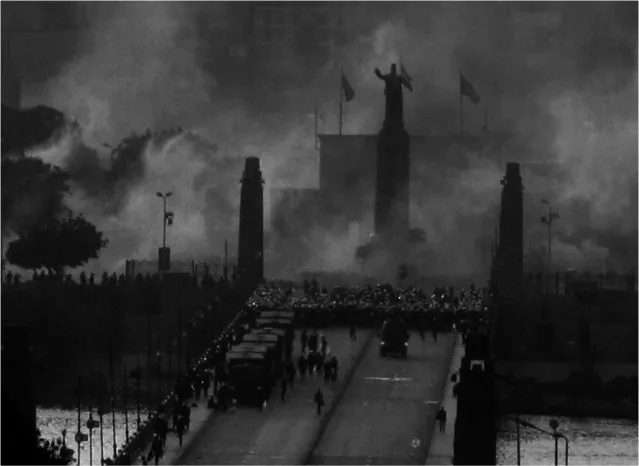
The Battle of Qasr al-Nil Bridge, January 28, 2011. Photograph by Islam Azzazy (Messages from Tahrir, pp. 18–19)
It is precisely this will of a whole people to bring down the regime and to bring about the basic demands of the revolution—change, freedom, and social justice (taghyir, Huriya,‘adala igtima‘iya)—that needed to be sustained, protected, nourished, and enabled during and beyond the historic day of January 28, when Midan al-Tahrir was reclaimed and became the barometer for a nationwide uprising. This challenge was met through concerted organizational planning and strategizing on the part of a growing spectrum of civic and political groups and other actors, which included youth activist groups and coalitions, syndicates, NGOs, political parties, and popular movements. Despite their competing ideological differences, they came together to sustain the unique energy in Tahrir—which was both unifying and edifying—for the first eighteen days of the uprising. The midan was thereby transformed into what came to be called “The Independent Republic of Tahrir.”4 Together, protesters set up the new boundaries surrounding Tahrir: checkpoints that ensured the safety of those within the square, forms of political and cultural expression and mobilization that animated it, and the sustenance of daily life for the massive sit-in of thousands of protesters camped in the midan.5 These arrangements included speaker podiums, ‘Tahrir radio’ broadcasts of patriotic songs and important announcements, makeshift clinics for the injured, the construction of restrooms for the protesters, a nursery for the children who accompanied their parents, a lost and found area, a prison set up inside the entrance to metro stations in Tahrir for the ‘thugs’ who tried to enter the midan to attack the protesters, an artist and caricature corner, a reading wall for media updates, a map of the midan to facilitate a daily head count of protesters, food and drinks to be delivered to protesters, and much more.
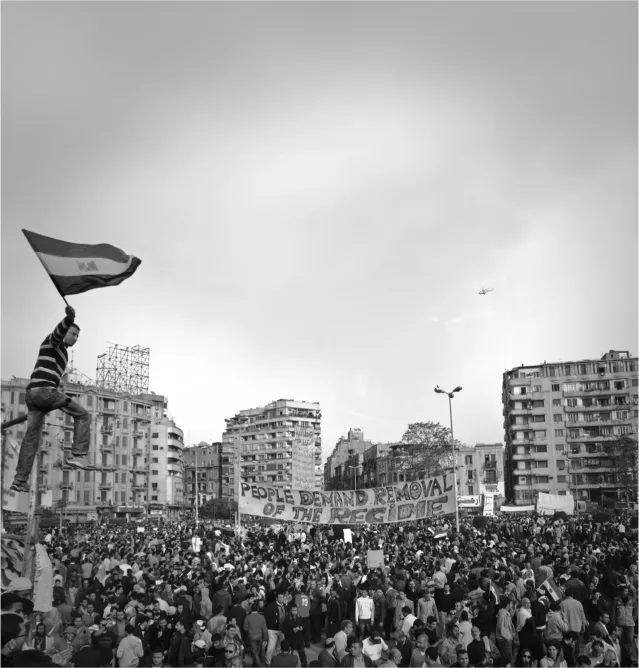
The People Demand the Removal of the Regime. Photograph by Ahmad Saad Bahig (Messages from Tahrir, p. 61)
Since deposed president Hosni Mubarak finally stepped down on February 11, 2011, Midan al-Tahrir has continued to embrace demonstrations every Friday as well as the sustained and perseverant sit-ins, which finally led to his public trial on August 3, 2011.6 Over the past several months, millions of Egyptians have responded to political activists and coalition groups’ calls for protest and have flocked to the midan to press on with the demands of the revolution and to keep the spirits high whenever problems occurred, and they have been many. Despite repeated violent confrontations with the Military Police, Central Security Forces, and ‘thugs’ who have on more than one occasion attempted to disband the protesters and clear the midan, Tahrir has acquired a symbolic life of its own that has become the sign and language of an ongoing revolution. Tahrir continued to breathe that new symbolic life even after August 1, 2011, when protesters endured the more recent of such violent attacks to disband the longest sit-in, which started on July 8, 2011, when the State Security Forces and Military Police destroyed the ‘tent city’ in the midan. That sit-in was made up of the families of the martyrs along with activists joined in solidarity and demanded a public trial of police officers involved in the killings of the protesters who had been camping out.7
In fact, the inversion of the politics of space in Tahrir since the August 1, 2011 attack further confirmed the revolutionary connotations and significations of the midan, where the central garden of the roundabout, the stronghold of the protesters, became the contested icon of the revolution itself. The Central Security Forces and Military Police occupied the garden in what looked like a drawn-out sit-in throughout the month of August and beyond while protesters, who had been beaten and chased out of their tents, besieged them from the side streets leading into Tahrir. Official discourse from both the ruling Supreme Council of the Armed Forces (SCAF) and the interim government over the past several months had accused protesters in Tahrir of “obstructing the wheel of production,” hence the need, according to the SCAF, to clear the square of the sit-ins—even if this was done violently. In the aftermath of the August 1, 2011 attack, after witnessing the ironic inverted ‘sit-in’ by the Central Security Forces and the Military Police in the roundabout, the going joke among Egyptians was that the people demand the removal of the Central Security Forces from the midan because they are “obstructing the wheel of the revolution!”
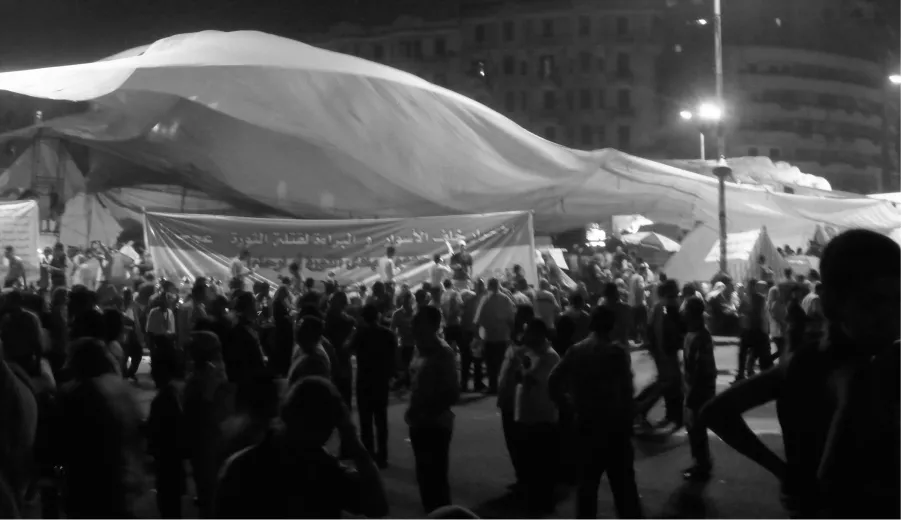
Tent city in Tahrir during the July 8–August 1 sit-in. Photograph by Samia Mehrez
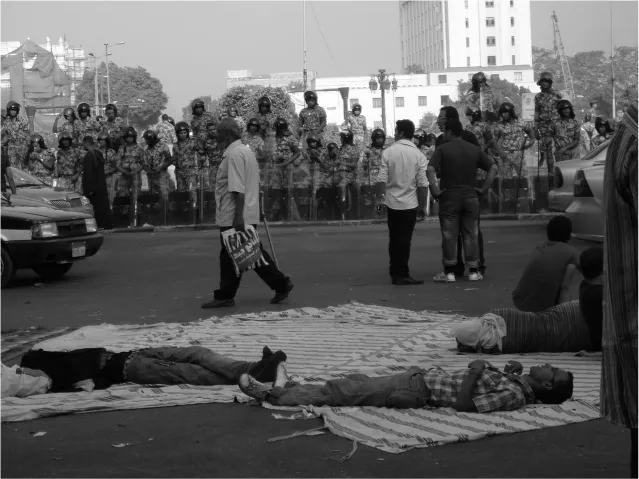
Military and police forces occupy Tahrir’s central garden, August 2, 2011. Photograph by Huda Lutfi
But despite the ongoing violence, Tahrir has become a familiar space of pilgrimage with its own rituals and its own signs and language(s). Anyone who has been in Tahrir during the initial memorable eighteen days and later throughout the following months will no doubt have noted the festive, creative, uplifting ambience that has dominated the midan. They will also have noted how the general dispositions of the actors in the midan bore many traces of the mulid celebration, a popular form of carnivalesque festivities that has been celebrated in Egypt for hundreds of years and whose rituals, enacted by multitudes of demonstrators, were marshaled, politicized, and revolutionized during the massive protests and sit-ins to sustain and transform the impetus and impact of revolt.
This chapter will argue that one of the vital inspirational and organizational sources for the tactics and strategies of life in Midan al-Tahrir during the initial days of the revolution, and well beyond, was precisely this historic familiarity of the millions of people who came to the midan with the extended and elaborate rituals and festivities of the popular mulid celebrations. We are by no means claiming that this is the only way to read and translate what happened and continues to take place in Tahrir. Nor do we wish to diminish the complex political convergences of events, forces, leaders, and movements which led to this historic uprising, including regional and global factors external to Egypt, all of which continue to partake in the performativity of Egypt’s revolution (see chapters 2 and 3).8 On the contrary, once the protesters achieved a critical point of strength and mass density and support within the reclaimed midan, it needed to be sustained over an extended period of time; the experience and legacy of the mulid in Egyptian culture and history became a very salient and useful one.
In fact, one could argue that the mulid-like festivities in Tahrir were instrumental in attracting thousands of enti...
Table of contents
- Cover
- Halftitle Page
- Title Page
- Copyright Page
- Note on the Contributors
- Note on Transliteration
- Acknowledgments
- Introduction: Translating Revolution: An Open Text: Samia Mehrez
- 1. Mulid al-Tahrir: Semiotics of a Revolution: Sahar Keraitim and Samia Mehrez
- 2. Of Drama and Performance: Transformative Discourses of the Revolution: Amira Taha and Christopher Combs
- 3. Signs and Signifiers: Visual Translations of Revolt: Laura Gribbon and Sarah Hawas
- 4. Reclaiming the City: Street Art of the Revolution: Lewis Sanders IV
- 5. al-Thawra al-DaHika: The Challenges of Translating Revolutionary Humor: Heba Salem and Kantaro Taira
- 6. The Soul of Tahrir: Poetics of a Revolution: Lewis Sanders IV and Mark Visonà
- 7. The People and the Army Are One Hand: Myths and Their Translations: Menna Khalil
- 8. Global Translations and Translating the Global: Discursive Regimes of Revolt: Sarah Hawas
- Appendix 1
- Appendix 2
- Appendix 3
Trusted by 375,005 students
Access to over 1.5 million titles for a fair monthly price.
Study more efficiently using our study tools.
Frequently asked questions
Yes, you can cancel anytime from the Subscription tab in your account settings on the Perlego website. Your subscription will stay active until the end of your current billing period. Learn how to cancel your subscription
No, books cannot be downloaded as external files, such as PDFs, for use outside of Perlego. However, you can download books within the Perlego app for offline reading on mobile or tablet. Learn how to download books offline
Perlego offers two plans: Essential and Complete
- Essential is ideal for learners and professionals who enjoy exploring a wide range of subjects. Access the Essential Library with 800,000+ trusted titles and best-sellers across business, personal growth, and the humanities. Includes unlimited reading time and Standard Read Aloud voice.
- Complete: Perfect for advanced learners and researchers needing full, unrestricted access. Unlock 1.5M+ books across hundreds of subjects, including academic and specialized titles. The Complete Plan also includes advanced features like Premium Read Aloud and Research Assistant.
We are an online textbook subscription service, where you can get access to an entire online library for less than the price of a single book per month. With over 1.5 million books across 990+ topics, we’ve got you covered! Learn about our mission
Look out for the read-aloud symbol on your next book to see if you can listen to it. The read-aloud tool reads text aloud for you, highlighting the text as it is being read. You can pause it, speed it up and slow it down. Learn more about Read Aloud
Yes! You can use the Perlego app on both iOS and Android devices to read anytime, anywhere — even offline. Perfect for commutes or when you’re on the go.
Please note we cannot support devices running on iOS 13 and Android 7 or earlier. Learn more about using the app
Please note we cannot support devices running on iOS 13 and Android 7 or earlier. Learn more about using the app
Yes, you can access Translating Egypt's Revolution by Samia Mehrez in PDF and/or ePUB format, as well as other popular books in Politics & International Relations & Politics. We have over 1.5 million books available in our catalogue for you to explore.