eBook - ePub
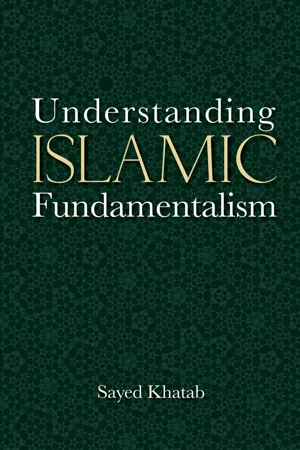
Understanding Islamic Fundamentalism
The Theological and Ideological Basis of al-Qa'ida's Political Tactics
- English
- ePUB (mobile friendly)
- Available on iOS & Android
eBook - ePub
Understanding Islamic Fundamentalism
The Theological and Ideological Basis of al-Qa'ida's Political Tactics
About this book
Beginning with an examination of medieval Islamic fundamentalist movements such as Kharjism, Ibadism, Hanbalism, and Wahhabism, Sayed Khatab looks at the similarities and differences between them and present organizations such as al-Qa'ida. It may be surprising that many of the radical narratives embraced by modern groups have not emerged recently. Identifying these roots can lead to a better understanding of al-Qa'ida's theological and intellectual narratives, and how they effectively indoctrinate youths and attract many of them to violent acts of terrorism.
The book then focuses on al-Qa'ida's theology, ideology, and tactics; the geographic contours and implications of al-Qa'ida's political strategy in relation to the western and eastern countries which are considered enemy states; the impending clash of cultures; and the ideological war within al-Qa'ida.
Innovative in its concept, examining political Islamic thought from a historical to a contemporary perspective, Islamic Fundamentalism generates new understanding of the many complexities of political Islam, and the role of violence and terrorism.
Information
Year
2011eBook ISBN
9781617973840
1
Islamic Fundamentalism
Fundamentalism is a word, like many words in both Arabic and European languages, that has a range of meanings across cultures. This is relevant to the task at hand. In the science of politics, for example, the concept of ‘the Left’ in western literature traditionally refers to workers, laborers, the lower classes, and needy and unfortunate people.1 However, in Arab-Islamic literature, ‘the Left’ refers to the aristocrats, to wealthy people who lead a comfortable life. Likewise, the concept of ‘the Right’ in western literature refers to aristocrats, the owners and controllers of capital, the upper classes, and those who do not desire change but seek to influence government through their connections as an elite, and so the term also tends to refer to rigid and reactionary people. In Arab-Islamic literature, however, ‘the Right’ refers to the righteous who do good deeds.2 Therefore, Muslims might seek membership of ‘the Left’ in this world, but may wish to be among ‘the Right’ in the next.3
Modernization is another example of a word that gives rise to potentially misleading interpretations, because it can be mistakenly equated with westernization. However, the latter means no more than the adoption of certain alien (western) social and cultural habits that may not be inherently superior or more advanced, although this is often implied. For example, the Ottoman Sultan Mahmud II (who ruled from 1808 to 1839) considered modernity to be the imitation of the west in terms of lifestyle and even fashions. He replaced the turban with the Roman fez4 and issued a decree that declared European dress as the official dress of the State’s workforce, whether military or civil. The Ottomans underwent many forms of borrowing from western cultures, but none of this saved the caliphate, and Turkey was not, in any notable way, more advanced than a country like Egypt, whose revolution took place more than a century later, whose development was arrested by not inconsiderable colonial rule and numerous wars, and who did not have to deny her own culture as Turkey did.
Secularism is another western notion, and secularization has very much been a part of modernization in the western context. Its history is rooted in the domination of the Church over the State through the Church’s control of ‘learning’ and ‘capital,’ and the clergy’s interference in scientific, sociopolitical, and economic matters. Secularism, however, has no parallel in the history of Islam, because Islam has no Church and no clergy in the sense of an elaborate ecclesiastical hierarchy.
Likewise, the term fundamentalism in western society has been widely used since the 1960s to characterize those Muslim individuals and groups who have been involved in Islamic revivalism in Egypt and other Muslim countries. This period has also been filled with many events that have been attributed to Islamic revivalism. These include: the Arab–Israeli wars of 1967 and 1973, and the subsequent tragic conflicts between Sadat and the Islamists in Egypt; the civil war in Lebanon, which broke out in 1975; the Sudanese Islamic Republican Brotherhood’s relationship with President Numayri reaching an intolerable impasse; Ayatullah Khomeini’s Islamic Revolution in 1979, which brought Islamic clerics to power in Iran; the hostage crisis at the U.S. Embassy in Tehran in 1979–80; the coming to power of Saddam Hussein in Iraq in 1979, and the start of his attacks on Iraqi Kurds; the Iraq–Iran war; Saddam’s opposition to President Sadat’s peace process between Egypt and Israel in 1979 under the banner of the ‘Rejectionist Front’; the assassination of Sadat in 1981, which brought Islamists to the verge of revolution in Egypt; and, more generally, the threat of Islamic terrorism to western interests. All these events have become a source of increasing and ever-present concern.
It is within this complex historico-political context that the term fundamentalism has been applied to Muslims. Thus, the term ‘Islamic fundamentalism’ is seen by many people in the west through the prism of the above-cited and similar crises that took place in the Middle East. The application of the term fundamentalism to Muslims, as James Barr has emphasized, is, however, far from precise.5 The term assumed, through this use, a wider spectrum of meaning, as almost all Islamic revivalist movements were tagged with fundamentalist labels connoting extremism, radicalism, and other, similar terms that carry the force and intent of violence and terrorism. Such application, however, should not be taken at face value or as a rigid and mutually exclusive classification of cultures and thought. Fundamentalism does not necessarily equate to or engender extremism, radicalism, or terrorism. From an Islamic perspective, terrorism is terrorism, and fundamentalism is fundamentalism. The impact of the term is obvious, as its application can carry a certain weight.
Before the term fundamentalism was used to brand Muslims, it was and still is being used by certain Christian denominations. Some of them, in the view of many scholars, are radicals and take pride in being called fundamentalists. A great number of individuals and groups around the world, ranging from Protestant and Catholic churches to governments, have also being tagged with the fundamentalist label.6
Historically, the term was used to denote the literal, yet creative, interpretation of the Bible. Indeed, a history of Christian fundamentalism was written in 1931 by Stewart Grant Cole, and another account published in 1954 by Norman Furniss. Many authorities date fundamentalism from the time of the Holy Book Conference, which convened in the U.S. in 1902.7 This conference led to the publication of a series of radical Protestant booklets, entitled “The Fundamentals,” in the U.S. between 1910 and 1915. It was on the basis of this title and the contents of these booklets that the term fundamentalism was derived to characterize those “doing battle royal for the Fundamentals.”8
Consequently, fundamentalism has been defined as a U.S. Protestant movement, guided by the doctrine of complete faith in the fundamentals of the inerrancy of the Bible; the virgin birth and divinity of Jesus Christ; the vicarious and atoning character of his death; his bodily resurrection; and his second coming. These fundamentals, in the Protestant view, constitute the irreducible minimum of authentic Christianity. This minimum is rooted in what is known as the fourteen-point creed of the Niagara Bible Conference of 1878 and later in the five-point statement of the Presbyterian General Assembly of 1910.9
During the period spanning the 1970s through to the 1990s, fundamentalism resurfaced to again become an influential force in the U.S. Promoted by popular television evangelists and represented by such groups as the Moral Majority, the new politically oriented ‘religious right’ opposed the influence of liberalism and secularism on U.S. life. This movement has adopted the term ‘fundamentalism’ as originally used to refer to a specific Christian experience in the U.S. in the early years of the twentieth century.10
Further, the assumption underpinning the use of the term fundamentalism in the western context is that modernism and fundamentalism are inherently opposed. Some others consider fundamentalism a negative tendency that counters the processes of modernization and rationalism.11 Thus, the application of the term fundamentalism carries the implication of a dramatic conflict between fundamentalists and modernization, the former seeking to divorce themselves from modern life, rejecting new scientific discoveries, and refraining from interacting with the reality of the modern epoch. In this sense, the term fundamentalism has no Arabic source or Islamic reference.12
In other words, the term fundamentalism, born of unique historical circumstances, does not exist in Arabic and Islamic literature. For this reason, Joachim Wach emphasized that many observers, Muslims and non-Muslims alike, have stipulated that the term fundamentalism should not be applied to Islamic movements.13 Muslims, especially those of the Islamic resurgence for example, reject the use of the term fundamentalism to characterize Islamism, which takes the teaching of the Qur’an and faith seriously; and if that were the criteria, then all Muslims would indeed be ‘fundamentalists,’ but the term would cease to be of any use.14
Etymologically, the term fundamentalism in Arabic translates to usuliya. This is an abstract noun of quality derived from the Arabic root (a-s-l), the substantive asl (root, origin, foundation, or basis of a thing) being the basic word from which the trilateral verb asula is derived. The present participle or the nomen agentis is usuli (fundamentalist, singular) and the plural is usuliyyun and usuliyyin (fundamentalists). Thus, the singular substantive asl or the plural usul means root(s), origin(s), foundation(s), fundamental(s) or principle(s) of a human being or of anything else, in general, including ideology(s), idea(s), or concept(s).15
The Qur’an uses the term ‘fundamental(s)’ as in the following: Whatsoever palm-trees ye cut down or left standing on their roots [usul], it was by God’s leave (Qur’an 59:5); Lo! it is a tree that springs out of the base [asl] of hell (Qur’an 37:64); and Have you not considered how God sets forth a parable of a good word (being) like a good tree, whose root [asl] is firm and whose branches are in heaven? (Qur’an 14:24). Thus, the word ‘fundamentalism’ as known in western literature is not found in Arabic.
Further, all of the contemporary major political or social systems have their own fundamentals (usul: origins, foundations, or bases) upon which they have been established and which distinguishes them from each other. In other words, capitalism, socialism, communism, democracy, and Islam are each based on their own distinct fundamentals. Thus, neither the capitalist nor democratic systems can be called communist systems.16 Likewise, the Islamic system cannot be called a communist system or even democratic in western terms. This does not, however, mean that the Islamic system is theocratic or autocratic, or anything but Islamic. Islam is a broader sociopolitical system than democracy, and accommodates the substance and values of democracy within it. The phrase ‘democracy in Islam’17 means that Islam is bigger than democracy, and when Islam incorporates contemporary democracy within it, there still remains more space within which to encompass more permutations of democracy with no change to the inherent Islamic identity of the system.
Although the existence of democracy in Islam is clearly evident, those who are called fundamentalists do not appreciate any view that erases the name of Islam in favor of a label of democracy. They argue that Islam is adequately equipped and that its system has the characteristics and qualities necessary to give that system all the rights to retain its name ‘Islam.’ In their view, Islam will gain nothing by being called democracy. In other words, democracy is democracy, socialism is socialism, and Islam is Islam.18 Each of these systems, in the fundamentalist view, has its own historically based origins, principles, and fundamentals, which define the nature of the system and distinguish one system from the other. Thus, ‘Islamic fundamentalism’ or ‘fundamentalism in Islam’ signifies searching for the fundamentals and Islamic authority, rather than referring to a specific political or religious movement.19
Searching for the fundamentals of Islam and its authority is the meaning preserved in Arabic literature, as in the sciences of the fundamentals (‘ulum al-usul). For example, among the academic institutions of al-Azhar University in Cairo, there is the Faculty of the Fundamentals of Religion. The title indicates the subject core and the objectives of the teachings in this faculty. Further, among the Arabic and Islamic disciplines are the science of the fundamentals of religion (‘ilm usul al-din), the science of the fundamentals of Islamic jurisprudence (‘ilm usul al-fiqh), the science of the fundamentals of Arabic language (‘ilm usul al-lugha), and the science of the fundamentals of Hadith (‘ilm usul al-Hadith). Nothing within these disciplines has any parallel to the western concept of fundamentalism.20
Historically, Muslim scholars who specialized in any of the sciences of the fundamentals were honored with the title ‘fundamentalists’ (usuliyyun). Among the celebrated fundamentalist scholars in the medieval epoch were, for example, Imam Ahmad Ibn Hanbal (780–855), Imam Ibn Taymiya (1263–1327), Imam ‘Abd al-Jabbar Ibn Ahmad (946–1036), and Imam Abu al-Hasan al-Bisri (d. 436/1057), the author of Sharh al-‘umad (The Natural Hearing), a commentary on Aristotle’s book of physics.21 Hence, the title ‘fundamentalist’ in Islamic terms denotes the force and intent of the concepts of honor, fame, and celebrity.
Fundamentalism is also explained alongside the concept of Salafism (traditional or ancestral). In an oft-quoted statement, Hasan al-Banna (d. 1949) defined his Muslim Brotherhood organization, founded in 1928, as an ‘Islamic society’ on a ‘Salafi’ mission that follows the Qur’an, the Sunna (tradition of the Prophet), and the conduct of the Muslim ancestors (salaf).22
The term salaf, as a noun, refers to the venerable Muslim ancestors, while the term khalaf refers to the succeeding generations.23 Muslims are overwhelmingly agreed that the salaf are better in their application of Islam than are the khalaf. This also applies to all Abrahamic religions, as mentioned in the Qur’an. The Qur’an refers to God’s messengers (that is, Abraham, Isaac, Jacob, Moses, Aaron, Isma‘il, Idris, Jesus, Zakariya, and John), their immediate followers (salaf), and the succeeding generations (khalaf) with an emphasis on their application of faith as follows:
These are they unto whom God showed favor from among the Prophets, of the seed of Adam and of those whom We carried (in the ship) with Noah, and of the seed of Abraham and Israel Jacob], and among those whom We guided and chose. When the revelations of the Beneficent were recited unto them, they [salaf] fell down, adoring and weeping. Now there hath succeeded them a later generation [khalaf] who have ruined worship and have followed lust. But they will meet deception. Save him who shall repent and believe and do right. Such will enter the Garden, and they will not be wronged in aught. (Qur’an 19:57–59).24
The words and language indicate that the immediate followers (salaf) of the messengers were more successful in their application of their faith than were the succeeding generations (khalaf). This passage also suggests that after the immediate generation of the messengers, selfishness and godlessness at times gained the upper hand among some of the succeeding generations (khalaf). Hence, there are always those who see the failures in the applic...
Table of contents
- Cover Page
- Halftitle Page
- Title Page
- Copyright Page
- Contents
- Introduction
- 1. Islamic Fundamentalism
- 2. The Origins of Fundamentalism
- 3. From Fundamentalism to Neo-jihadism
- 4. Al-Qa‘ida
- 5. Ideology
- 6. Al-Qa‘ida’s Tactics
- 7. Inside al-Qa‘ida: The Ideological War
- Conclusion
- Notes
- Bibliography
- Index
Trusted by 375,005 students
Access to over 1.5 million titles for a fair monthly price.
Study more efficiently using our study tools.
Frequently asked questions
Yes, you can cancel anytime from the Subscription tab in your account settings on the Perlego website. Your subscription will stay active until the end of your current billing period. Learn how to cancel your subscription
No, books cannot be downloaded as external files, such as PDFs, for use outside of Perlego. However, you can download books within the Perlego app for offline reading on mobile or tablet. Learn how to download books offline
Perlego offers two plans: Essential and Complete
- Essential is ideal for learners and professionals who enjoy exploring a wide range of subjects. Access the Essential Library with 800,000+ trusted titles and best-sellers across business, personal growth, and the humanities. Includes unlimited reading time and Standard Read Aloud voice.
- Complete: Perfect for advanced learners and researchers needing full, unrestricted access. Unlock 1.5M+ books across hundreds of subjects, including academic and specialized titles. The Complete Plan also includes advanced features like Premium Read Aloud and Research Assistant.
We are an online textbook subscription service, where you can get access to an entire online library for less than the price of a single book per month. With over 1.5 million books across 990+ topics, we’ve got you covered! Learn about our mission
Look out for the read-aloud symbol on your next book to see if you can listen to it. The read-aloud tool reads text aloud for you, highlighting the text as it is being read. You can pause it, speed it up and slow it down. Learn more about Read Aloud
Yes! You can use the Perlego app on both iOS and Android devices to read anytime, anywhere — even offline. Perfect for commutes or when you’re on the go.
Please note we cannot support devices running on iOS 13 and Android 7 or earlier. Learn more about using the app
Please note we cannot support devices running on iOS 13 and Android 7 or earlier. Learn more about using the app
Yes, you can access Understanding Islamic Fundamentalism by Sayed Khatab in PDF and/or ePUB format, as well as other popular books in Politics & International Relations & Political Ideologies. We have over 1.5 million books available in our catalogue for you to explore.