eBook - ePub
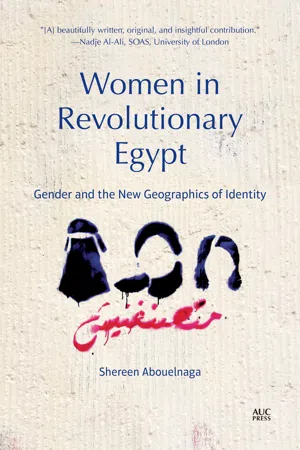
Women in Revolutionary Egypt
Gender and the New Geographics of Identity
- English
- ePUB (mobile friendly)
- Available on iOS & Android
eBook - ePub
About this book
The 25 January 2011 uprising and the unprecedented dissent and discord to which it gave rise shattered the notion of homogeneity that had characterized state representations of Egypt and Egyptians since 1952. It allowed for the eruption of identities along multiple lines, including class, ideology, culture, and religion, long suppressed by state control. Concomitantly a profusion of women's voices arose to further challenge the state-managed feminism that had sought to define and carefully circumscribe women's social and civic roles in Egypt.
Women in Revolutionary Egypt takes the uprising as the point of departure for an exploration of how gender in post-Mubarak Egypt came to be rethought, reimagined, and contested. It examines key areas of tension between national and gender identities, including gender empowerment through art and literature, particularly graffiti and poetry, the disciplining of the body, and the politics of history and memory.
Shereen Abouelnaga argues that this new cartography of women's struggle has to be read in a context that takes into consideration the micropolitics of everyday life as well as the larger processes that work to separate the personal from the political. She shows how a new generation of women is resisting, both discursively and visually, the notion of a fixed or 'authentic' notion of Egyptian womanhood in spite of prevailing social structures and in face of all gendered politics of imagined nation.
Information
Subtopic
Political FreedomIndex
Social Sciences1 Is There Gender in This Revolution?
The Road to 2011
On 20 March 2003, the antiwar movement, specifically against Egypt’s involvement in Iraq, escalated, and protesters took to Tahrir Square. For two days, the generation of the 1970s (Students’ Movement) recalled several memories related to their movement through songs and chants, while a new generation was being chased by the security forces. Among the latter, women were the main actors. On 15 March 2005, Nafisa al-Marakbi (thirty-eight years old), a farmer from Sarando, a remote village in the Delta, died while defending her land against the capitalist tycoons. The whole village was besieged by police, and she was among those arrested, was beaten brutally in the police station, and died shortly after her release. On 21 March, the general prosecutor declared that al-Marakbi had died from natural causes and not because of physical torture. This story was repeated toward the end of 2010 when a young man, Khaled Said, died in a police station in Alexandria due to brutal physical torture. This time, the general prosecutor declared that he had died because he swallowed a marijuana joint. What was alarming in the latter incident was that Said was arrested, or rather abducted, on the grounds of a civil charge, not a political one. Between the two incidents of al-Marakbi and Said, anger had been escalating, and gender was an essential factor in the amalgam of protesting voices. In December 2006, Wedad al-Demerdash, a worker in Ghazl al-Mahalla Textile Factory, started a strike, along with three other women, demanding profit bonuses. Three days later, the men joined the strike. Hossam el-Hamalawy, a member of the Revolutionary Socialist Party, reported that “three thousand women garment workers struck and marched into the company compound demanding their male colleagues join their strike. The factory was brought to a complete halt, and for three days the area was the scene of marches and demonstrations.”1 Among the demands of al-Demerdash and her colleagues was equality of wages with men. These examples, and there are hundreds of similar ones, prove that gender has always played a role in inciting and sometimes leading protests in the political scene. Gender was not the possession of feminist nongovernmental organizations (NGOs) and, thus, was not confined to the narrow definition of ‘rights’ as advanced by educated, middle-class women. However, of importance is how gender conflates with other factors: class, ideology, and religion. That both al-Marakbi and Said died as a result of brutal torture is a fact that, ironically and sadly, testifies to the concept of equality in injustice. It also functions as a reminder of one of the precursors of the 2011 Revolution in the form of Asmaa Mahfouz’s call to action in her blog.2 These examples are not inclusive by any means; but they illustrate the point that women have been politically active since long before the Revolution. We must, therefore, sharpen the discourse about women’s participation in the 2011 Revolution.
During the famous eighteen days (25 January to 11 February), Tahrir Square and the other squares across Egypt were the focus of, and were zoomed in on by, international television channels. The presence of women was evident and needed no further proof, whether watching events on TV or being present as an eyewitness—it was a simple fact that they were there. Yet, Arab and foreign media—and, of course, analysts and observers—dealt with this presence as a totally novel and unprecedented phenomenon. The role of women in the Revolution became a cliché that, surprisingly, was met with no objection. The unsaid in this cliché implies that Egyptian women have always been absent from the sociopolitical scene of the country, and, therefore, their presence deserves to be studied and understood. Many feminist activists and scholars have been asked to comment on the role of Egyptian women in the Revolution, either in the media or in conferences and public events. Moreover, the obsession of the Western media with the conspicuous presence of women in the Revolution and its aftermath has salvaged a rubric from the 1980s and 1990s; it is that of Middle Eastern women and Muslim women. Needless to say, the events of 2011 and 2012 in the Arab World consolidated the latter label. In an eye-opening conversation between Lila Abu-Lughod and Rabab El-Mahdi, the problem of the discourse adopted by the Western media toward the participation of women in the Revolution was one of the main issues. El-Mahdi explains that this obsession obliterated the real presence of women in the sociopolitical scene long before the 2011 Revolution. She says:
It dismisses the role that female workers have played in the wave of labor mobilization since 2006, the role of female activists in the pro-democracy and anti-war movements since 2003, and their constant presence in the student movement, just to name a few. Second, it assumes a level of gender-specificity that I am uncomfortable with; it is expecting that “women” are a homogenous group that would have a specific role in the revolution, disregarding the fact that different groups of women might participate differently depending on their locations (both geographic and class-based).3
El-Mahdi’s strong logic could be easily discerned by any scholar or activist in the field. This makes the question more persistent: Why was it taken for granted by the media that women’s participation is something new? The answer to this question must grapple with the policy of the ex-regime in dealing with women’s issues and rights. To render all Egyptian people as a homogenous group was one of the goals of the Mubarak regime, since such a rendition increased control and produced a specific image of stability, not to mention the fact that it hid the major issues that needed to be addressed. In other words, Egypt merited only a fantasy of diversity, propagated by state policies, especially those related to the positioning of women. As a typical Third World regime, the authoritarian elites4 vehemently deployed the ill-famed essential rhetoric about homogenous communities that provides positive images in order to construct a specific image of the nation. This nonexisting homogeneity allowed the regime to exercise more power and control. Yet, subverting this constructed image was an ongoing process. Therefore, as McClintock says, nations are not “simply phantasmagoria of the mind,” but “they are historical practices through which social difference is both invented and performed.” Among these differences, gender stands as one of the main constituents of identity, and this explains why the ex-regime was so concerned with controlling and legitimizing a certain system of gender as the dominant cultural representation; that is, it “amounted to the sanctioned institutionalization of gender difference” by enforcing state feminism.5
State Feminism: What Is It Good For?
That state feminism, led by ex-first lady Suzanne Mubarak, co-opted the concept of ‘women’s rights’ is not without its consequences. Women’s rights became part of the Mubarak regime; in fact, the ‘woman question’ has since become part and parcel of any regime. This is because the Personal Status Law has always been ordained and modified by the state; the modifications, however, never mirrored the actual progress of the feminist movement. Yet, any modification has always been discerned by society as a legacy of the state. Thus, we hear of “Suzanne’s Laws” and “Gihan [Sadat]’s Laws”; that is, any modifications have always been tied to the name of the first lady, a fact that facilitated the crackdown on the law later. The situation becomes complicated when we realize that the state has always used women’s rights—especially the Personal Status Law—as a terrain for bargaining. The law was used as a tool for propagating women’s rights, insofar as it pertained to the project of modernism, and, at the same time, it was used to enforce patriarchal conservative values that allowed for more social control.
Since women’s rights have always been linked to the project of building the modern state, they have never achieved legitimacy on the ground. At the same time, the work of activists was appropriated and manipulated by ‘official’ representatives. If we add to all the above how the ex-regime homogenized women (and men as well) to propagate an unreal image of the country, we can understand the extreme hostility toward women and their rights in the period that followed the ousting of Mubarak. The first shocking and hostile reaction to the woman question took place on 8 March 2011. A demonstration celebrating International Women’s Day was attacked and harassed verbally by the crowds. Again, the media was obsessed with the way the demonstration turned ugly, and the headlines described what happened as a shocking blow. It was shocking and it took a while to understand the reason behind such hostility and aggression. Women’s rights, simply, had been tied to the name of Suzanne Mubarak and the ex-regime. In a telling interview, Hoda Elsadda states that one of the main obstacles women’s rights activists are bound to encounter is
a prevalent public perception that associates women’s rights activists and activities with the ex-First Lady, Suzanne Mubarak and her entourage, that is with corrupt regime politics. This public perception is already being politically manipulated to rescind laws and legislative procedures that were passed in the last ten years to improve the legal position of women, particularly within Personal Status Laws (PSL). These laws are deliberately being discredited as “Suzanne’s laws.”6
What happened on 8 March is interpreted differently by El-Mahdi. Her different approach reflects her ideology that takes issue with the whole project of the concept of women’s rights. In answer to a question posed by Abu-Lughod about what the various groups of women are doing politically in the light of the “NGO-ization of women’s rights work,” El-Mahdi replies:
Unlike those who would like to interpret this low turnout as revealing a lack of support for women’s rights, I found this lack of response very telling about the extent to which these organizations and individuals are detached from society. Even the symbolism of choosing the date (March 8th), which has no significance for most Egyptian women, and the call for a march that made no specific demands except the “rights of women,” is revealing. It is as if there is a set of rights that one can demand, devoid of context and position. This non-specificity made “women’s rights” vulnerable to attack as “Western” or foreign.7
The problem with the above analysis is that it refuses categorically any link to the global politics of feminism, despite that transnational feminism is a strong form of solidarity and of founding common ground without losing specificity. At the same time, this utter dismissal of any global coloring negates the idea of multiplicity El-Mahdi defends throughout the conversation.
The fragile position of women’s rights in Egypt stems from the strategies of the state, as practiced by the ex-regime of Mubarak. They are strategies that alienated society toward the concept itself and brought it down to a reductionist definition of gender equality. The main concern of the ex-regime was to deny the existence of any problems that might tarnish the image of Egyptian women. Violence against women, in both the private and public spheres, was utterly denied, and when it became part of the agenda as set by international concerns, the regime had to change its discourse, though naïvely. The official representatives resorted to reminding the audience of Islam’s teachings and bringing up examples of violence against women that took place in the United States to prove that it was a universal phenomenon.
The obsession of the ex-regime (and the ones before) with producing a homogenous, positive image of women resulted in excluding all the dissenting, different feminist voices, along with their supporters and labeling them as the ‘other.’ That is to say, they are classified as those who are trying to deform the image of the nation and sabotage the national project. Deniz Kandiyoti has called this process of inclusion and exclusion “utopian populism”; that is, social unity is achieved on the grounds of agreeing on the position of women, as the cornerstone of cultural authenticity. The politics of authenticity are usually very complicated, where the West is presented as the Other. Yet, Kandiyoti perceives the problem as a much broader one, since the representations of that Other take very different forms. She explains that
anti-imperialistic pronouncements about the West are often a thinly disguised metaphor to articulate disquiet about more proximate causes for disunity. These include the existence of indigenous social classes with different cultural orientations and conflicting interests, and the coexistence of religiously and ethnically diverse collectivities in the very bosom of the nation. Discourses on women’s authenticity are therefore at the heart of a utopian populism which attempts to obliterate such divisions by demarcating the boundaries of the ‘true’ community and excluding the ‘Other within.’8
Utopian populism, heavily and systematically exercised by the ex-regime in relation to activists’ work and voices (and also other things), rendered the conflation between women’s rights and a discredited regime inevitable. This is one of the main reasons that endowed post-Revolution Egypt with a paradox that subverts the paradigm of democracy. State policies, especially those related to women’s positioning, propagated a fantasy of diversity by denying the charge of exclusion. As a typical Third World regime, the authoritarian elites have vehemently deployed the ill-famed essential rhetoric about homogenous national communities (reminiscent of Benedict Anderson’s “imagined communities”9) and positive images in order to construct a specific image of the nation. That popular unity was one of the reasons that led to suppressing the different forms of the subject’s agency. On the road to the 2011 Revolution, women’s rights became a marker of a corrupt authoritarian regime.
Thus, the hostility that started from March 2011 can be understood. The main problem is that women’s rights and the woman question, in their various transformations, have always been tied to the politics of nationalism.
The Marriage of Nationalism and Gender
The long historical entanglement of women’s rights issues in ideological, national, and political struggles is the foundation of all the ensuing politics that supported or discredited the citizenship of women. In her book that focuses on the Egyptian women’s movement, Nadje Al-Ali states that
feminist projects in anti-colonial struggles have often been sacrificed to the cause of national liberation and, in the aftermath of independence, women have been relegated to their former ‘domestic’ roles. However, there were points of convergence between nationalist and feminist struggles, especially when the nation was envisioned as ‘modern.’10
The most flagrant example we have seen in the Arab World is what happened to Algerian women. Once independence was obtained, all the women were ordered to go back home to perform their sacred duties. The public sphere came under the possession of men. It was the time of building the nation, and women’s rights were not a priority, since there were more urgent issues. Leila Abouzeid has dealt with this issue in depth in her novel Year of the Elephant. In Abouzeid’s book, Zahra, who supported the Revolution and worked undercover instead of her husband so as to protect him from being arrested, was immediately thrown onto the street after independence, because her husband replaced her with a ‘modern’ woman who could cope with the new era. He had simply sat down and said to her, “‘Your papers will be sent to you along with whatever the law provides.’ My papers? How worthless a woman is if she can be returned with a paper receipt like some store-bought object! How utterly worthless!”11
Kumari Jayawardena’s seminal book Feminism and Nationalism in the Third World12 has detailed the entanglement of both concepts in the nineteenth and early twentieth centuries. The book has served as one of the essential and necessary references in documenting and analyzing women’s movements in the Third World. Despite the fact that the book has become a classic by now, its importance stems from the fact that it debunks the idea that feminism was imported from the West. However, it also reveals the fact that feminism started with national struggles to build a modern nation. That is, feminism has always been contoured and controlled by the ebbs and flows of political struggles and trajectories—hence, the limitations of nationalism. The women’s movement in Egypt stands at the heart of this paradigm, where the woman question was born with the 1919 Revolution. And, ever since that time, women’s rights have never managed to stand independent of the competing discourses of the state, Islamists, and nationalists. The history of the Egyptian women’s movement could be read in the history of modern Egypt and, of course, vice versa. Many valuable studies have dealt with this history that usually takes the end of nineteenth century as its point of departure, that is, with the publication of Qasim Amin’s debut books The Liberation of Women (1899), followed by The New Woman (1900). Kandiyoti, Beth Baron, Mervat Hatem, Nadje Al-Ali, and Leila Ahmed,13 to name but a few, have rendered detailed analyses of the history and trajectory of the Egyptian women’s movement and the interaction of feminism with nationalism and Islamism.
From the very beginning, although beginnings are hard to find, the woman question was among the markers of identity. Put differently, from very early on, it was at the mercy of identity politics. Although the invitation that Huda Shaarawi received to attend the conference of the International Women’s Union in Rome incited her to call for the formation of the Association of the Egyptian Women’s Union in March 1923, the constitution of 1923 came out in April without any trace of women’s demands in its 170 articles. Hala Kamal notes that
when the post-revolution constitution was issued in 1923, women’s demands were not met. Article 3 of the 19...
Table of contents
- Cover Page
- Half Title Page
- Title Page
- Copyright
- Contents
- Preface
- Introduction: Whose Spring?
- 1. Is There Gender in This Revolution?
- 2. Gender and the New Text
- 3. The New Subversive Poetic Voices
- 4. Multiple Patriarchies and One Body
- 5. The Politics of Memory
- Notes
Trusted by 375,005 students
Access to over 1.5 million titles for a fair monthly price.
Study more efficiently using our study tools.
Frequently asked questions
Yes, you can cancel anytime from the Subscription tab in your account settings on the Perlego website. Your subscription will stay active until the end of your current billing period. Learn how to cancel your subscription
No, books cannot be downloaded as external files, such as PDFs, for use outside of Perlego. However, you can download books within the Perlego app for offline reading on mobile or tablet. Learn how to download books offline
Perlego offers two plans: Essential and Complete
- Essential is ideal for learners and professionals who enjoy exploring a wide range of subjects. Access the Essential Library with 800,000+ trusted titles and best-sellers across business, personal growth, and the humanities. Includes unlimited reading time and Standard Read Aloud voice.
- Complete: Perfect for advanced learners and researchers needing full, unrestricted access. Unlock 1.5M+ books across hundreds of subjects, including academic and specialized titles. The Complete Plan also includes advanced features like Premium Read Aloud and Research Assistant.
We are an online textbook subscription service, where you can get access to an entire online library for less than the price of a single book per month. With over 1.5 million books across 990+ topics, we’ve got you covered! Learn about our mission
Look out for the read-aloud symbol on your next book to see if you can listen to it. The read-aloud tool reads text aloud for you, highlighting the text as it is being read. You can pause it, speed it up and slow it down. Learn more about Read Aloud
Yes! You can use the Perlego app on both iOS and Android devices to read anytime, anywhere — even offline. Perfect for commutes or when you’re on the go.
Please note we cannot support devices running on iOS 13 and Android 7 or earlier. Learn more about using the app
Please note we cannot support devices running on iOS 13 and Android 7 or earlier. Learn more about using the app
Yes, you can access Women in Revolutionary Egypt by Shereen Abouelnaga in PDF and/or ePUB format, as well as other popular books in Social Sciences & Political Freedom. We have over 1.5 million books available in our catalogue for you to explore.