- English
- ePUB (mobile friendly)
- Available on iOS & Android
eBook - ePub
About this book
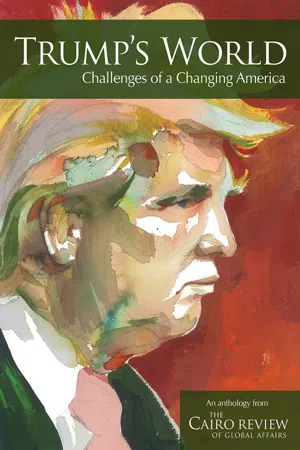
An anthology from the pages of the Cairo Review of Global Affairs brings together experts from the Middle East and around the world for a penetrating insight into how maverick tycoon Donald Trump captured the White House and a comprehensive survey of the new America president's domestic and international challenges. This is a must-read collection of serious writing for everyone concerned about superpower relations, Middle East peace, migration and immigration, climate change, and other hot-button issues in the Trump Era. Among the anthology's 32 essays: "The Meaning of Trump" by Donald T. Critchlow; "American Poverty" by Bernie Sanders, "Islamophobes" by Moustafa Bayoumi; "The United States and Palestine" by Rashid Khalidi; "Struggle of the Middle East Refugees" by António Guterres; "How ISIS Will End" by Mark Juergensmeyer; "Failings of Political Islam" by Tarek Osman," "Unraveling in the Kremlin" by Lilia Shevtsova, and "After the Paris Agreement" by Hoda Baraka and Payal Parekh. With an introduction by former Egyptian Foreign Minister Nabil Fahmy.
Information
Year
2017eBook ISBN
9781617978128
Challenges at Home
The Year of Living Dangerously
Trump’s Victory and the Brexit Vote in 2016 Highlight the Crisis of Democracy and the Need for Reform
Brexit. Trump. In Britain, the country’s membership in the European Union is rejected in a referendum. In America, a maverick anti-establishment political outsider wins the presidency.
These results are monumental political upheavals in the two countries, with consequences that reach beyond their shores and throughout the world. Toward the end of 2016, the French president announced that he would not be seeking a second term, citing the pressure of extremist forces, and the Italian government was dispatched in a “populist” referendum. In Austria, the extreme anti-establishment attempt at the presidency failed, but the establishment candidates had already been dismissed before the final test. History will see 2016 as a watershed, the year of reaction.
Britain and America are the world’s core democracies. These countries have been bearers of a political–economic venture that has come to define the meaning of modern democracy. In 2016, to the surprise of winners and losers alike, the modern idea of modernity—“the liberal inheritance” that the philosopher John Gray described as the belief that the future is liberal and the arc of history, in the words of Martin Luther King, Jr., “bends towards justice”—has suffered a defeat from which it may not soon recover. What was lost in these tests was finally a set of ideas.
To be clear, firstly: The results in both countries were eminently democratic. In Britain, it was the verdict of a referendum mandated by Parliament. In America, it was the outcome of the regular vote. In both countries, no voters could be in doubt that they were given radically different options to choose between. In both countries, the choice was between establishment and anti-establishment positions, with huge constituencies of angry voters rallying behind the policies and candidates of discontent.

As often in democracies, the results were messy. The winning margins were tight, with about the same electoral strength behind losers and winners. In Britain, there is (probably) a majority in the population in favor of continued membership in the European Union (EU), but because of low voter participation among the young, that majority did not prevail in the referendum. In America, the losing candidate won the majority of the popular vote, but not in enough states to carry the election as constitutionally required. In both countries, the campaigns were distressingly ugly, the blame for which has to be shared between the perpetrators of ugliness and those unable to lift the battles above it.
But to be clear, secondly: The purpose of democracy is not to be democratic. Democracy is a method. The purpose is a social order of equality in which all citizens enjoy security and inclusion, and adequate governance to maintain and improve that order—in the American constitution: “to form a more perfect Union.” We subscribe to democracy because we believe that such a system, being under popular control, is likely to protect citizens against oppression and, being governance by consent, is likely to be effective in delivery. There has been a vision of liberty, inclusiveness, tolerance, and internationalism, and of trust in the democratic method for the advancement of these ideas. The tenability of this vision is now in question.
What is distressing in both Brexit and the Donald Trump victory is not that complacent establishments were rejected—nothing could be more pleasing to the democratic mind—but that it was done on terms that negate both the ideas of purpose that underpin the democratic enterprise and the huge advances that have been made in safeguarding democratic values after the defeat of fascism in the world, the fall of communism in Europe, and the end of legal racial and other segregation. In both countries, ugly campaigns embraced and encouraged sundry voices of xenophobia, fear of the other, racism, and divisiveness which we until the fateful year of 2016 had thought had been marginalized to the dark and dusty corners of the house of modernity. In both countries, the unexpected victories of reaction were followed by a new assertiveness of hate-speak and hate-crime.
There are lessons to be learned for those of us who are concerned for the standing of democracy in the world. We have for some time been used to thinking that “the crisis of democracy” is located in the democratic fringes where democracy has struggled to take hold and cope, such as in Russia and North Africa. There are clearly cases of democratic failure, but by and large democracy is doing well in the world. The proposition that democracy as such is in crisis has been tested empirically and rejected, for example by the German political scientist Wolfgang Merkel. Democratic weakness, it is now clear to see, is not confined to the fringe. We therefore need to give renewed and critical attention to the core democracies and how they are performing. If democracy falters in Europe and America, it falters generally. Democracy theorists have also been used to thinking—usually with reference to their rightly admired Tocqueville—that democracy is something it is difficult to become but easier to be. Another lesson of 2016 is that democracy, even in the old democracies, remains something that is persistently difficult to be. To understand the democratic predicament, the “crisis” if you will, we should pay renewed and critical attention to the social conditions of democracy.
Failure of Leadership
What happened in Britain and America? Briefly, the establishment projects were rejected. In Britain, the government side and in America the Democratic Party represented the alternatives of continuity. It turned out they were hapless, but they were right. They were on the side of progress but were unable to stand up to the challenge of reaction. They had the wind of history behind them but were defeated by assaults of anti-politics. What came under attack was not just this or that candidate or party but the very venture of modernity as it has come to be understood in the age of liberty.
However, thus describing what happened, even in stark terms, is not to explain it. Why establishments that had history and the logic of progress on their side were overthrown by foes that were all but impressive and attractive, if not atrocious, is something that evades easy explanation.
In both cases, what the establishment sides brought to the party failed to inspire. In Britain, the government and its many allies fought for a continuation of EU membership, but never articulated any vision or idea to give life to their line. With stunning strategic incompetence, they fell back on patronizing scaremongering, which could not fail to alienate voters they needed to attract. In America, Hillary Clinton failed, from the primaries and on, to present herself as an attractive candidate with a program of purpose. With equal strategic incompetence, her campaign took swaths of voters, whose votes they just felt entitled to, for granted.
Already at this elementary level of explanation, we meet a factor that is recurrent from whatever angle we look at it: the failure of leadership. In Britain, Prime Minister David Cameron’s Conservative government failed to present its case as believable. In America, Clinton and the other Democratic leaders failed to present themselves as worthy of taking over the mantle. These tests were lost more than they were won. The sides that should have won failed to rise to the occasion and were given short shrift.
In my book Nation of Devils: Democratic Leadership and the Problem of Obedience, I argue that democratic order depends strongly on good leaders who are able to exercise good and persuasive leadership. In both the British and American campaigns there was an absence of good and an abundance of bad leadership. That goes to both sides. Not only did the establishment sides fail to make their case, the challenger sides disdained the responsibility of leadership. One would have hoped, in mature democracies, that those who aspire to leadership accept that with ambition comes responsibility. That includes to behave with civility, to argue honestly, to respect the truth, to refrain from extreme demagoguery, to not stimulate base motives. The reason they should accept such responsibility is that if they do not, short-term opportunism strikes back in the form of long-term damage to respect for public service and governance and to rational deliberation and decision-making.
In these two cases, that responsibility failed utterly. It failed in particular (but not only) on the side of the challengers. In the Brexit campaign, the “leave” side built their challenge around known untruths about the economic costs of membership in the European Union. In America, the Trump campaign was simply a parade of untruths, as uncovered by fact-checkers among campaign observers. That was in both cases shocking, but equally shocking was that the establishment sides proved themselves to be without the authority to discredit utterly disreputable politicking. In both countries, the campaigns exposed weaknesses of political culture and a debilitating absence of cohesion between leaders and people which have rendered their respective systems dysfunctional.
The result of leadership failure was that the establishment sides were unable to mobilize their voters. In Britain, the young, who are overwhelmingly in favor of EU membership and who are the beneficiaries of the lifestyles of internationalism that come with European integration and therefore had much at stake in the referendum, were not mobilized. In America, the Democrats failed to mobilize not only the young but also women and minority voters, again groups that had much at stake in the election and in the defeat of the challenger. Astonishingly, those whose interests the government in Britain and the Democrats in America were promoting failed to rally behind those they should have seen as their champions. The campaigns did spiral down into distortion, but something so counterintuitive as these results cannot be explained by campaign tactics alone. We need to dig deeper.
The 2016 clashes of progress and reaction took place in an environment of post-economic crisis and extremes of inequality and rising inequality. In 2008, America and Britain, and gradually the rest of the world, plunged into an economic crash of a ferocity comparable only to that of 1929.
The fallout was, firstly, a collapse in standards of living. Many workers and families experienced the loss of jobs, the loss of savings, the loss of homes, and degradation in other ways. In Britain, real wages and working age incomes have been stagnant since the crash, and for some groups of workers in decline, and are not expected to reach pre-crash levels again until at least 2021. Poverty rates have soared. It is not that people have felt abandoned, it is that they were abandoned. It was not that their anger was the result of simple-mindedness or lack of sophistication, or that those who were rising up in revolt were, in Hillary Clinton’s words, “a basket of deplorables.” They may not all have been articulate (by educated middle-class standards) but they were angry because they had good reasons to be angry.
Secondly, the economic crisis followed through not only to deprivation but also to a loss of confidence in prevailing models and custodianship of the political economy. During the pre-2008 years of steady economic growth, mainstream economic thinking had been infested by hubris to such a degree that ministers of finance, central bankers, and high-visibility economists were promising a steady march of growth into the heavens of prosperity. As late as June 2007, as world capitalism was about to implode, the British chancellor of the exchequer, Gordon Brown, in the formal setting of his annual Mansion House speech, heaped praise on the financial industry and congratulated “the City of London on these remarkable achievements, and on an era that history will record as the beginning of a new golden age in which a new world order was created.” Then came the crash. A year later, testifying before the House of Representatives Oversight Committee, the former U.S. Federal Reserve Chairman Alan Greenspan described himself as in “shock” at having to face up to his free-market ideology, which he had been going by for forty years or more—“the model that I perceived is a critical functioning structure that defines how the world works”—being “flawed.” In the upheavals and the reaction to them, confidence in “the experts” died. This was to haunt the Brexit campaign in Britain. Near to unanimous warnings from official and independent economists that Brexit would come at a cost to the wallet had no traction, while the dismissal of these warnings for coming from “the experts” found an easy audience.
Long before the sudden economic crash, advanced economies, the American and British ones in particular, had entered into a period of ever-widening inequalities in income and wealth. In Britain, the turning point was around 1975, when a previous trend toward less inequality was broken for a new trend of rising inequality. In America, the share of pre-tax national income to the bottom half of earners had fallen to 12 percent in 2014, from 20 percent in 1980. Of children born in 1940, almost all would obtain a higher standard of living than their parents. Of children born in 1980, only a half can count on achieving that betterment.
Gradually, inequalities grew obscene, with most of the fruits of economic growth falling to a minority of the rich and super-rich, and with the majority of the population enjoying only moderate, if any, improvement in wages and real standards of living, except such improvements as were secured by more work through longer hours and two family incomes. (This has all been documented in great detail by, in particular, Thomas Piketty in Capital in the Twenty-First Century.)
Nevertheless, as long as there was steady economic growth, inequalities were in some way tolerable since there was, or seemed to be, at least some improvement, and a great deal of hope, also for many. The economic crisis caused that to change in two ways. The excesses of ever-widening i...
Table of contents
- Cover
- Title Page
- Copyright
- Contents
- Introduction Nabil Fahmy
- PART 1: Challenges at Home
- PART 2: Challenges Abroad
- CONTRIBUTORS
- ACKNOWLEDGEMENTS
Trusted by 375,005 students
Access to over 1.5 million titles for a fair monthly price.
Study more efficiently using our study tools.
Frequently asked questions
Yes, you can cancel anytime from the Subscription tab in your account settings on the Perlego website. Your subscription will stay active until the end of your current billing period. Learn how to cancel your subscription
No, books cannot be downloaded as external files, such as PDFs, for use outside of Perlego. However, you can download books within the Perlego app for offline reading on mobile or tablet. Learn how to download books offline
We are an online textbook subscription service, where you can get access to an entire online library for less than the price of a single book per month. With over 1.5 million books across 990+ topics, we’ve got you covered! Learn about our mission
Look out for the read-aloud symbol on your next book to see if you can listen to it. The read-aloud tool reads text aloud for you, highlighting the text as it is being read. You can pause it, speed it up and slow it down. Learn more about Read Aloud
Yes! You can use the Perlego app on both iOS and Android devices to read anytime, anywhere — even offline. Perfect for commutes or when you’re on the go.
Please note we cannot support devices running on iOS 13 and Android 7 or earlier. Learn more about using the app
Please note we cannot support devices running on iOS 13 and Android 7 or earlier. Learn more about using the app
Yes, you can access Trump's World by in PDF and/or ePUB format, as well as other popular books in Politics & International Relations & North American History. We have over 1.5 million books available in our catalogue for you to explore.