A fascinating account of football culture in Egypt through its ultras groups
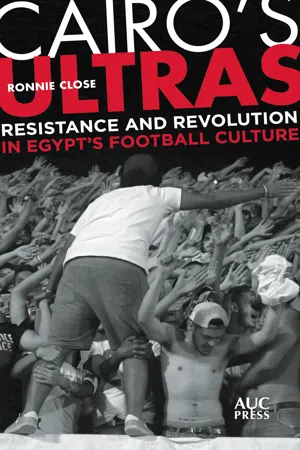
The history of Cairo's football fans is one of the most poignant narratives of the 25 January 2011 Egyptian uprising. The Ultras Al-Ahly and the Ultras White Knights fans, belonging to the two main teams, Al-Ahly F.C. and Zamalek F.C respectively, became embroiled in the street protests that brought down the Mubarak regime. In the violent turmoil since, the Ultras have been locked in a bitter conflict with the Egyptian security state. Tracing these social movements to explore their role in the uprising and the political dimension of soccer in Egypt, Ronnie Close provides a vivid, intimate sense of the Ultras' unique subculture.
Cairo's Ultras: Resistance and Revolution in Egypt's Football Culture explores how football communities offer ways of belonging and instill meaning in everyday life. Close asks us to rethink the labels 'fans' or 'hooligans' and what such terms might really mean. He argues that the role of the body is essential to understanding the cultural practices of the Cairo Ultras, and that the physicality of the stadium rituals and acerbic chants were key expressions that resonated with many Egyptians. Along the way, the book skewers media clichés and retraces revolutionary politics and social networks to consider the capacity of sport to emancipate through performances on the football terraces.
- English
- ePUB (mobile friendly)
- Available on iOS & Android
eBook - ePub
About this book
Information
1
FOOTBALL, NATIONALISM, AND SPECTACLE
Egypt continued to suppress political dissent in 2009. The Emergency Law (Law No. 162 of 1958) remained in force, providing a basis for arbitrary detention and unfair trials. The government has never confirmed the number of those detained; Egyptian human rights organizations estimate that between 5,000 and 10,000 people are held without charge (Human Rights Watch Annual Report 2010, 34).
Among the key street agitators in the 2011 ousting of Egyptian president Hosni Mubarak were the Ultras football fan groups. Although affiliated to different teams in the domestic league, they often joined forces in street protests in the capital that eventually brought down the bankrupt rule of the National Democratic Party (NDP) and its towering leader of over thirty years. The subsequent tragic Port Said incident a year later, on 1 February 2012, when seventy-two al-Ahly Ultras died in a violent attack at a football game in the Suez Canal city, projected the Ultras back onto the political stage, but this time as revolutionary martyrs. There have been speculations that this coordinated attack—allegedly with the involvement of remnants of the Mubarak regime—may have been a vendetta, or pay back for the key role some of the Ultras played in the protest movements of 2011. However, the long-lasting effect of the Port Said violence diminished with the revolutionary impulse of activists and opposition groups, as they reformulated their demands for political and social change. Moreover, the panic caused in the public sphere by such a violent incident led many Egyptians to believe more firmly in the military narrative to reestablish stability in the uncertain post-2011 vacuum. This tragic football incident came a year after another infamous attack on protesters in Tahrir Square in 2011, when armed henchmen on horses and camels attacked the peaceful anti-Mubarak protesters with swords and knives, in a direct attempt at suppressing the widespread calls for Mubarak to step down. Both of these human rights violations, set apart by a year, were designed to undermine the emergent Egyptian spirit of resistance, and to normalize a level of state violence that displaced the demands of democratic street politics.
The remarkable appeal of the Ultras football groups lies in the social and economic stagnation that pervaded Egyptian society. Human Rights Watch (HRW), Amnesty International, and other rights-based organizations, have documented the lack of democratic values in Egypt—including freedom of expression—and criticized the level of state neglect.1
Successive regimes have well understood the role football can play in unifying people and maintaining social order and political stability. The president’s youngest son Gamal addressed the National Democratic Party Conference in 2006, advocating for the need to promote Egyptian football. In the same year, the Africa Cup of Nations was held in Egypt, and Mubarak renovated the impressive Cairo International Stadium to encourage people to attend matches. Ahead of this tournament, the perception of a ‘good fan’ was manufactured with the support of a compliant media industry, which depicted images of upper middle-class fans of mixed genders, celebrating together in first- or second-class seating. This intentionally excluded the newly-formed Ultras fans in talta shimal (third on the left) seating, who were considered loutish and offensive by the regime. The FIFA World Cup fixtures between Egypt and Algeria in 2009 were played in Cairo and Khartoum as part of the African qualifying rounds of the competition. Mubarak’s two sons, Alaa and Gamal, attended both games; a gesture many perceived as a popularity stunt within an intention to bequeath the rule of Egypt from father to son. Such moves demonstrate the manipulation tactics employed by the Mubarak regime to harness the popularity of football, and to diffuse public frustrations by fusing support for the national team with an attempt to prop up the class of the political establishment.
In the general election held in December 2010, Mubarak’s personal political tool—the National Democratic Party—secured 420 of the 508 seats in the country’s lower house of parliament, Majlis al-Sha‘b (People’s Assembly). This parody of an electoral process eliminated most other representative voices, including the highly-popular Muslim Brotherhood representatives, from the political process and public debate. Social issues, like the commonplace police brutality, unemployment, and low-paid jobs, were rarely addressed in public, as pervasive media censorship added to the sense of deep-rooted societal frustration felt most severely by Egyptian youth. In this taut hiatus, the emergence of an angry football-based youth movement such as the Ultras, operating with a clear horizontal organizing philosophy, was highly appealing to many. The Egyptian Ultras blended the ‘hooligan’ mentality with opposition to the status quo, offering a badly needed escape inside a pressurized social environment. These Ultras organizations were quickly seen as being subversive to the Egyptian state, because they declared a form of social autonomy and deviance from military rule that characterized the foundation of the Arab Republic of Egypt. The Ultras “politics of fun” helped destabilize Mubarak’s authority and the police apparatus through civil disobedience within a football context (El-Sherif 2012, 21).
As the Ultras groups expanded across the nation and attracted legions of young supporters, the state retaliated to their perceived threat by tightening up control of football stadiums and public spaces. Police targeted the newly-formed Ultras fans in particular, and, starting in 2008 and increasing in 2009, the authorities set about confiscating Ultras’ regalia, such as banners, megaphones, and flares at stadium entrances—although many Ultras members were able to smuggle in such items regardless. Such state suspicion was not unique to this time, as it emerged from a distinctive political history and culture of football in Egypt. A rich sporting legacy was bound up with the establishment of the game as a nationalist movement against colonial rule.
The first official Ultras group to appear was the Ultras Ahlawy, also known as UA07, who are affiliated with the country’s most successful club al-Ahly S.C. Egypt. Al-Ahly means ‘national’ in Arabic, and the team was established in April 1907 by Amin Samy, after Omar Lotfi initiated the idea of a football club open to local membership—preexisting clubs at the time prohibited Egyptians from joining as members. The club’s name, the ‘National Club,’ and its popularity coalesced in a period of anticolonial struggle. Ahl in Arabic also means ‘people,’ and Ahly at the end of the word is the pronoun ‘my’—to become ‘my people’s club.’ Nationalist student unions self-organized within football crowds to conceal political debate and mobilize activism.2 In 1919, this nonviolent movement for full independence emerged from university student unions to agitate against British occupation and the colonial administration of Egypt, following the forced exile of proindependence leaders. Organized at a grassroots level and using the tactics of civil disobedience, nationalist leaders such as Sa‘d Zaghlul of the Wafd Party enjoyed massive support among the Egyptian populace. Wafd Party emissaries went into towns and villages to collect signatures authorizing the movement’s leaders to petition for the complete independence of the country.
Moreover, Zaghlul was selected to be honorary president at the inaugural general assembly of al-Ahly Football Club. Somewhat incongruously, the first chairman of al-Ahly was an Englishman, Mitchell Ince, who facilitated the foundation of the club, and helped obtain planning permission to establish grounds in the center of Cairo. In order to curtail this nationalist sentiment and the popularity of football, the pro-colonial forces founded their own club, King Faruq Club (later renamed Zamalek Club) in January 1911, on Gezira Island in the middle of the Nile and under the British protectorate. In time, the popular revolt movement against British rule eventually resulted in conditional sovereignty for the imperial power, along with the formation of limited independence for Egypt on 28 February 1922. The Wafd Party drafted a new constitution in 1923, based on a parliamentary representative system, but Egyptian independence at this stage was nominal, since British forces continued to be physically present in the country and to control national resources.
Zaghlul became the first popularly elected prime minister of Egypt in 1924. However, Britain retained several key areas under its supervision, and during this period King Fuad was installed as monarch, against the popular will of many Egyptians. Relations between the unelected monarch and Zaghlul deteriorated after his son Faruq succeeded his father to the throne. A new quiescent treaty, signed in 1936 between the king and the British, further alienated the Wafd Party, and in 1928 Hassan al-Banna founded the Muslim Brotherhood organization. Two dominant visions of self-determination (among others) took shape in Egypt—through the religious conservatism of the Muslim Brotherhood and the secular direction adopted by the military institutions and its officers.
Al-Ahly’s Arab nationalism embraced both versions of sovereignty, and was validated by the success of the team, who went on to dominate the Egyptian football scene. The political orientation of the team is evident in the stance taken by team captain Mahmud Mukhtar al-Titsh in 1943, when he accepted an invitation from the Palestinian nationalist leadership to play a short match tournament in support of the Palestinian independence cause against the British Mandate in the region. The colonial administration in Egypt attempted to prevent al-Ahly team from participating in this football solidarity tour, and demanded that al-Titsh, as captain, persuade his team players not to travel. Despite this pressure, the team and club asserted its right to play in the tournament in Palestine. In retaliation, Egyptian Football Association President Muhammad Haidar Pasha was instructed to intervene and revoke players’ passports. At the last minute, with the assistance of Fuad Sirag al-Din, then minister of interior, al-Ahly were issued new passports in time to travel to Palestine. The short visit was extended to three weeks, and al-Ahly played five games in defiance of colonial rulers in both countries.
Soon after, al-Ahly team was scheduled to return to play a game against their archrivals and pro-British administration team, King Faruq Club, in the King Faruq Cup (later the Egyptian Cup Championship). The Palestinian trip had deeply angered a football obsessed King Faruq, who blamed Egyptian Football Association (EFA) president Haidar Pasha for the situation. Such pressure led the football association to issue a decree suspending al-Ahly from all sporting activities for ten months. Fans protested outside Abdin Palace in Cairo, chanting against King Faruq, British imperialism, and the Egyptian Football Association. Before long, the National Party president Mustafa Kamel intervened to resolve the problem and the king was forced to rescind the order and reschedule the fixture between the clubs. However, Haidar Pasha insisted on a personal apology from al-Ahly’s team captain al-Titsh over the Palestinian tour. Al-Titsh responded to the request with what became a famous letter, parts of which are still remembered by al-Ahly Ultras. He wrote, “If nationalism requires an apology, I am not honored to be a football player in the Egyptian Football Association that you [Haidar Pasha] are the head of” (Ibrahim 2015, 33).
As these examples demonstrate the development of a football league in Egypt throughout the twentieth century was interwoven with nationalist movements against British colonial rule and the forces of the monarchy. The fusion of football and politics was personified by the al-Ahly S.C. organization. The inaugural Egyptian League Championship was founded on a national standing in 1948–49, and al-Ahly won the competition—the first of nine successive national championship titles—laying nationalist foundations for the autonomous Arab Republic of Egypt. On 22 October 1948, eleven teams from Cairo, Alexandria, and the Suez Canal region competed for the new national football title. The teams were: al-Ahly, King Faruq (Zamalek), al-Sikka al-Hadid, Tersana, Ismailiya (Ismailiya), al-Masry (Port Said), Port Fuad, Olympic and al-Ittihad (Alexandria), Tiram and Yunan.
Following the popular overthrow of King Faruq in the military-led revolution in 1952, al-Ahly appointed Egypt’s new ruler, Gamal Abd al-Nasser, as club president. Both Cairo-based teams—Zamalek (formerly King Faruq) and al-Ahly—moved into the iconic, 75,000 capacity Cairo International Stadium as a shared home ground, and both continue to this day to use the venue for football fixtures. The stadium was designed by German architect Werner March, who also designed the Olympic Stadium in Berlin for the Olympic Games in 1936. Nasser inaugurated the new mega stadium in 1960, on the eighth anniversary of the 1952 military-led revolution, and the space has since hosted presidential ceremonies and other related political rallies, in addition to sports events. Notable visitors to the stadium include Soviet Union President Nikita Khrushchev in 1964, and the Muslim Brotherhood-backed President Muhammad Morsi. In June 2013, Morsi severed Egypt’s diplomatic ties with Syria during a controversial conference in the stadium, just a few weeks before his ouster in another military-led coup by his defense minister General Sisi. Through such events, Egyptian presidents have appropriated the sporting spectacle, and utilized the architectural and cultural capital of the vast stadium space in order to consolidate and project the appearance of power, thereby fusing sports with politics.
The evolution of the domestic league in the 1960s, under the influence of the Nasserist government, at times exposed tensions in the social formation of the new Egyptian state. Some animosity was regional in nature. As Cairo expanded, it tended to absorb the limited economic resources over the smaller, regional cities or the rural hinterlands. Such tensions were also evident in football at the time. For example, when in 1962 star player Rida Sika moved from the southern Suez Canal city of Ismailiya to al-Ahly in Cairo. However, under immense pressure from local fan communities in Ismailiya, where protests extended to setting fire to the player’s family house, he shortly returned to the Suez Canal city club. To smooth over social tensions, al-Ahly President Salah Shishtawy personally chauffeured the young football star back to his hometown club. Others animosities and disturbances were evident between the Suez Canal city clubs of Port Said and Ismailiya, and the metropolis teams of Cairo. The distinctive nationalist history of the canal region, and its sense of autonomy and unique identity was present in the intense football rivalries against the dominant role of the two major Cairo-based clubs, Zamalek and al-Ahly. Frequently, these defining incidents were infused with the politics of the time. Popular Cairene perceptions of Port Said and Ismailiya residents were strongly influenced by the displacement that occurred during the War of Attrition with Israel in 1967–70, which led to a mass civilian exodus from the Suez Canal region to Cairo. Many people from Port Said and Ismailiya lived transitory lives of impoverishment and unemployment in the capital, existing on the margins of the megacity. A popular myth exists that al-Ahly refused to host Ismailiya training sessions and home games after the forced displacement from the Suez Canal area in the war with Israel. While the majority of hardcore Ismailiya S.C. fans acknowledge that this legend is inaccurate, the myth is still able to antagonize intercity fan rivalry.
The origin of the Ultras movement is often disputed in the Middle East and North Africa (MENA) region, but evidence exists of nascent fan groups in Morocco, Tunisia, Libya, and Algeria in the first decade of the twenty-first century. The transformation in the perception of Egyptian football fans, from that of the boisterous supporter—known as terso—to the Ultras subculture, occurred during this period of time. A forerunner to the Ultras phenomenon, terso emerges from the Italian word for ‘third,’ in reference to the enthusiastic fans commonly occupying third-class tickets in football stadiums. Nonetheless, in the Egyptian context, the first self-defining Ultras group was noted in 2007, with the formation of the Ultras Ahlawy, or UA07 of al-Ahly S.C. Another al-Ahly support group, Ultras Devils, was formed soon afterward in the Mediterranean coastal city of Alexandria, and intercity rivals of Zamalek S.C. established the Ultras White Knights (UWK) in the same year. The Ultras phenomenon was adopted in rapid succession, with strongholds in the major regional clubs across Egypt, in particular, the Suez Canal cities established the notorious Ultras Green Eagles of the al-Masry team in Port Said, and the Ultras Blue Dragons of Ismailiya S.C. in Ismailiya. The third most supported team in Egypt, Alexandria’s al-Ittihad club, is supported by the Green Magic Ultras organization. Given al-Ahly’s popular nationalist role historically in Egypt, dating from the foundation of the club and its role in supporting sovereignty, the UA07 membership remained only a minority of the total fan-base, but was able to establish a network of Ultras squadrons across the vast country; the al-Ahly club is estimated to have a supporter base of millions around the world.
The founding narrative of the Ultras Ahlawy in Egypt is a contested story, although one plausible hypothesis emerged from an interview with one of its founders and leaders, Assad, as part of the documentary film project, More Out Of Curiosity.3 Assad is from a privileged, upper-class Egyptian background, and was a university student studying abroad in Bologna University, Italy, when he started attending local games in the Italian league. After his study abroad program concluded, he returned to Cairo with an idea, modeled on his experiences in Italy, to form a small group of young, passionate and militant fans among the existing al-Ahly Terso organization. In general, the Ultras movement began to recruit supporters via young fans on social media networks on the Internet, operating within different football fan forums. This new Ultras football fan entity in Egypt differed in attitude from the typical Terso fan, and the nascent group first raised their banner at a match on 13 April 2007. Soon, this new Ultras-styled group drew attention from fellow al-Ahly fans and caught the attention of other supporters in the domestic league. Early Ultras members have commented on how the atmosphere at domestic football league games was often monotonous, lacking flair on the pitch, and the stadium space felt lackluster in feeling or collective spirit, unlike many European football cultures. Although this militant football fan behavior was essentially a mimetic form of other Ultras groups, mostly in Spain and Italy, the Egyptian authorities misread the youthful expression as a political threat toward the state, and tended to react aggressively toward this use of ritualized, choreographed choral group identity.
The UA07 and other Ultras in Egypt adapted the core components of similar international football groups. They upheld raucous attitudes that are antiauthoritarian, collectivist, and opposed the commodification of sport. This fusion of bravado posturing and antagonistic displays was an explosive combination within a tightly-controlled political state like Egypt, as the Ultras commanded the football terrace space through their visceral display of collective power. Mubarak’s police system regime perceived this new brash and youthful attitude as a subversive threat to state power. Enduring animosity between the police and the Ultras escalated in the early years. In one key incident, thirty-eight members of the Ultras Devils, an offshoot of the UA07 based in Alexandria, were arrested at a protest outside the courthouse in Shibin al-Kom in the Nile Delta, accused of ‘belonging to an illegal group.’
Over time, Ultras fans were regularly arrested, harassed, or tortured in Egypt’s infamous police stations; thereby intimidated and harassed for emulating the Italian form of Ultras-style behavior. As a consequence of such oppressive obstacles and restrictions, the Ultras’ appeal expanded across the Egyptian football league, as rival groups in other cities evolved cultural activities of fanatical football behavior. Soon there were, in total, twelve recognized Ultras groups in Egypt, some affiliated to the same team—such as in the case of al-Ahly—with the majority of their fans drawn from the lower social classes.
Ex-Ultra Muhammad Gamal Bashir’s book, Kitab al-Ultras (The Ultras’ Book), published in Arabic in November 2011, offers a unique first-person narrative of this new social phenomenon at the time, and details an incipient political awareness in the lead up to 2011. Bashir describes how many Ultras became more politically aware and active, and began to display banners about political causes, such as the Israeli military invasion of Gaza in 2008. Despite their own rhetorical disclaimer of ‘just being fans,’ the majority of members were increasingly antagonistic toward the Mubarak government, both within and outside the stadium performance space. Beyond football issues, the Egyptian authorities also arrested Ultras at political protests, forcing them to operate within highly-controlled, shifting parameters in public space. In one case, Zamalek’s UWK, of which Bashir was a member, demonstrated in support of the second Palestinian Intifada. The Egyptian police responded by arresting members and imprisoning fans for a couple of days. Rather th...
Table of contents
- Cover
- Half Title Page
- Title Page
- Copyright
- Contents
- Acknowledge
- Introduction
- 1 Football, Nationalism, and Spectacle
- 2 The Catastrophe Apparatus
- 3 Hooligan Days of Sporting Dissensus
- 4 The Aesthetic Economy of Revolution
- 5 Ultras Utopia, Bodies of Possibility
- 6 Errant Futures (#trash_ahlawy)
- Notes
- Glossary
- Bibliography
Trusted by 375,005 students
Access to over 1.5 million titles for a fair monthly price.
Study more efficiently using our study tools.
Frequently asked questions
Yes, you can cancel anytime from the Subscription tab in your account settings on the Perlego website. Your subscription will stay active until the end of your current billing period. Learn how to cancel your subscription
No, books cannot be downloaded as external files, such as PDFs, for use outside of Perlego. However, you can download books within the Perlego app for offline reading on mobile or tablet. Learn how to download books offline
Perlego offers two plans: Essential and Complete
- Essential is ideal for learners and professionals who enjoy exploring a wide range of subjects. Access the Essential Library with 800,000+ trusted titles and best-sellers across business, personal growth, and the humanities. Includes unlimited reading time and Standard Read Aloud voice.
- Complete: Perfect for advanced learners and researchers needing full, unrestricted access. Unlock 1.5M+ books across hundreds of subjects, including academic and specialized titles. The Complete Plan also includes advanced features like Premium Read Aloud and Research Assistant.
We are an online textbook subscription service, where you can get access to an entire online library for less than the price of a single book per month. With over 1.5 million books across 990+ topics, we’ve got you covered! Learn about our mission
Look out for the read-aloud symbol on your next book to see if you can listen to it. The read-aloud tool reads text aloud for you, highlighting the text as it is being read. You can pause it, speed it up and slow it down. Learn more about Read Aloud
Yes! You can use the Perlego app on both iOS and Android devices to read anytime, anywhere — even offline. Perfect for commutes or when you’re on the go.
Please note we cannot support devices running on iOS 13 and Android 7 or earlier. Learn more about using the app
Please note we cannot support devices running on iOS 13 and Android 7 or earlier. Learn more about using the app
Yes, you can access Cairo's Ultras by Ronnie Close in PDF and/or ePUB format, as well as other popular books in History & Middle Eastern History. We have over 1.5 million books available in our catalogue for you to explore.