eBook - ePub
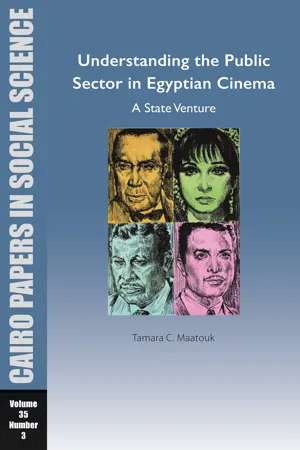
Understanding the Public Sector in Egyptian Cinema: A State Venture
Cairo Papers in Social Science Vol. 35, No. 3
- English
- ePUB (mobile friendly)
- Available on iOS & Android
eBook - ePub
Understanding the Public Sector in Egyptian Cinema: A State Venture
Cairo Papers in Social Science Vol. 35, No. 3
About this book
In 1957 the public sector in Egyptian cinema was established, followed shortly by the emergence of public-sector film production in 1960, only to end eleven years later, in 1971. Assailed with negativity since its demise, if not earlier, this state adventure in film production was dismissed as a complete failure, financially, administratively and, most importantly, artistically. Although some scholars have sporadically commented on the role played by this sector, it has not been the object of serious academic research aimed at providing a balanced, nuanced general assessment of its overall impact. This issue of Cairo Papers hopes to address this gap in the literature on Egyptian cinema. After discussion of the role played by the public sector in trying to alleviate the financial crisis that threatened the film industry, this study investigates whether there was a real change in the general perception of the cinema, and the government's attitude toward it, following the June 1967 Arab–Israeli war.
Information
CHAPTER 1
Introduction
Between an inevitable birth and a predestined death, historical inaccuracies and deterministic analyses prevail in the study of the public sector in Egyptian cinema, the outcome of which is none other than general confusion. Over four decades have passed since the dissolution of the General Egyptian Institution for the Cinema (al-Mu’assassa al-misriya al-‘amma li-l-sinima) led to the unceremonious, perhaps premature, demise of public-sector film production in Egypt. Since that time, the Egyptian state’s short-lived adventure in film production has sparked heated debate, attracting either mordant criticism or uncritical praise. Although a considerable volume of academic literature dealing with the Egyptian cinema has been published, little research has studied in depth the story of the public film sector in Egypt.1 The first intention of this study is to fill this lacuna by shedding some light on the multilayered circumstances under which this sector emerged, expanded, and was eventually brought to an end.
What has been written about this sector takes the form of a few teleological interpretations, all yielding the same incomplete and somewhat distorted narrative that starts and ends with the assumption of inevitability. To many historians and film critics, the establishment of this sector was a foregone conclusion in a society experiencing an overall drift to socialism, and they attribute its emergence mostly to a premeditated set of ideological elements.2 The collapse of this sector, however, is strongly assumed by some scholars to have been predetermined by birth defects, namely, the absence of a clear ideological agenda.3 From this frequently repeated narrative of the rise and fall of the public sector in Egyptian cinema, the sociopolitical and economic implications of contingent events, such as the Tripartite Aggression in 1956, the political tension between Egypt and some Arab countries from the late 1950s onward, the defeat of 1967, Nasser’s death in 1970, and Sadat’s Corrective Revolution, are typically excluded.4 To propose a comprehensive and more accurate account of the public sector is, therefore, the second intention of this study, with a view to incorporating previously underplayed, seemingly unrelated influences into the analysis of the public sector’s attitude toward the cinema.
This partial narrative is fueled by the political stances and backgrounds of the film critics concerned (al-Tilimsani 1995:70; Murad 1991:210). Writing in conformity with their times, which, more probably than not, were affected by the anti-Nasserist movement that ultimately aimed at “delegitimiz[ing] and demoniz[ing]” the Nasserist experiment,5 critics were more inclined to assail the experience of the public sector in Egyptian cinema than to evaluate it. For most of them, the state’s venture into film production is considered “the beginning of the ‘setback’ of Egyptian cinema” (Fayid in Gordon 2002:207) and they pejoratively brand this period “cinema of fear” (Sharaffudin in Gordon 2002:209). Moreover, they held the public sector accountable for the decline of Egyptian cinema, grounding their criticism in the manifold reorganizations that the public film companies underwent (Sharaffudin 2002:71; Mumtaz 1985:181). What these critics failed to see is what this study intends, in part at least, to highlight. Hence, the third and last main goal of this study is to suggest an alternative perspective, which, in lieu of dismissing these continuous structural organizations as weaknesses and failings, showcases them as an apparent indication of the state’s resolve to reform and, in the process, rescue an industry in jeopardy.
This study also aims at rectifying the shortcomings in the existing literature. The constant lamenting of the public sector in Egyptian cinema automatically results in the dismissal of its films. Overwhelmed by preconceived notions, critics tend to overlook the great artistic value of some publicly produced films. A fact such as the Film Foundation’s designation of The Mummy6 (al-Mummya’, 1975) as “a gem of Egyptian cinema,” and its subsequent selection to be restored, preserved, and screened at the Lumière 2015–Grand Lyon Film Festival goes unnoticed.7 So does the fact that among the top 100 Arab films listed in Cinema for Passion, a book published by the Dubai International Film Festival in 2013, nine were produced by the public sector, with The Mummy ranking first and The Land (al-Ard, 1970) ranking fourth.8 Even more, it seems as if the results of the referendum of 1995 conducted by the Cairo International Film Festival, which registered 30 public films among the top 101 Egyptian films produced between 1923 and 1995, are completely ignored by this scholarship, with the exception of the work of ‘Ali Abu Shadi and Amal al-Gamal (Bahgat 1996:9–12). In light of this, the importance of this study lies in the fact that it lays the foundation for an unprejudiced, more nuanced assessment of the public film sector. In so doing, the latter’s role in introducing the possibility of “an alternative national cinema” (al-Tilimsani 1995:70) and as an incubator to “a new generation of talented filmmakers” (Gordon 2002:207) becomes evident.
The main body of this manuscript is divided into five chapters including the conclusion. Chapter two provides an introductory summary of the state involvement in Egyptian film industry from its inception in the early twentieth century until the Tripartite Aggression in 1956. The rest of the chapter examines the various factors that led to the emergence of the public sector in Egyptian cinema in 1957 and public-sector film production in 1960. The story continues in chapter three to tell how the ideological and economic repercussions of the sociopolitical transformations that Egypt witnessed between 1961 and 1962 drove the state to expand the public sector to encompass a considerable volume of film assets, without resorting to comprehensive nationalization. As a result, the state’s film policy evolved from supervision and sponsorship to direct film production. Though this intervention succeeded in reviving a threatened film industry, rising difficulties necessitated a different film policy. The downsizing policy is, therefore, expansively discussed in chapter four, which also sheds light on the cinematic situation following the 1967 defeat. It is the author’s contention that this policy, coupled with a new cinematic perception on the part of both the post-1967 government and the cineastes,9 paved the way for the possibility of an alternative, critical national cinema, one that is politically charged and highly acclaimed. The story of the public sector ends shortly after the launching of the Corrective Movement in 1971, which caused the sudden end of this brief state adventure in film production.
In addition to a long list of secondary sources, this study relies heavily on several main sources. The official gazettes, al-Garida al-rasmiya and al-Waqa’i‘ al-misriya, proved essential in tracking the evolution and expansion of the public sector in Egyptian cinema, as they include all the presidential and ministerial decrees concerning cinema affairs. Another important source is the report of the Public Prosecution Office (al-Niyaba al-‘amma) regarding the decade-long legal proceedings of the public film sector, which is absent from much of the existing literature. The National Charter of 1962, Nasser’s speeches, and the 1968 Manifesto are also beneficial in constructing the historical context of the time period in which the public sector existed. The memoirs of Tharwat Okasha, which also include his correspondence and reports as the minister of culture, are consulted with the intention of viewing the story of this sector through the eyes of the state. Last but not least, the popular Rose al-Yusuf and the ideologically bound al-Tali‘a are two contemporary periodicals that stand out as being of great value, including in their pages a wealth of information dealing with this sector as well as critical discussions of the role of the cinema.
This study focuses on the history of the public sector in Egyptian cinema as a state institution, and therefore intentionally avoids being caught up in the study of sociopolitical and cultural representations in Egyptian cinema. Viola Shafik’s Popular Egyptian Cinema: Gender, Class, and Nation, Joel Gordon’s Revolutionary Melodrama: Popular Film and Civic Identity in Nasser’s Egypt, and Marisa Farugia’s “The Plight of Women in Egyptian Cinema, 1940s–1960s” are only a few examples of the huge body of scholarship that deals with representations in Egyptian cinema. Film censorship is another topic that this study does not lengthily engage with, for censorship came in a variety of forms and agencies, not all of which operated under the purview of the public film sector.10 The third trope that this study carefully avoids is the confusion between cinema matters and other communication media, particularly television and radio.11 Except for a short period when all three media operated under the control of the same government authority, the public film sector was always regarded as a separate entity that had its own administration, budget, and policy.
A point should be made here: ‘cinema’ and ‘film industry’ are often used interchangeably when referring to the various institutions and subsectors of filmmaking. The unit of analysis in this study is the public sector in the Egyptian cinema/film industry, which comprises governmental film organizations and state-owned companies that were involved in producing, distributing, and screening films. Also, it should be stated plainly here that establishing a public sector in cinema is different from launching a public-sector film production. Whereas the former entails the establishment of a state body charged to support (financially or technically), manage, and aid the cinema sector, the latter denotes the state’s direct involvement in the film industry as a producer, distributor, and theater owner.
1 A few exceptions include studies relating to the relationship between politics and cinema in Egypt in general, which more often than not devote a chapter or a section to the public sector in Egyptian cinema. Among these exceptions are Sharaffudin 2002; al-Nahas 2010; Abu Shadi 2000a; al-Tilimsani 1994.
2 To mention only two: Hisham al-Nahas suggests that the state’s decision to nationalize the Egyptian film industry came as a logical continuation of a decade-long wave of reforms, al-Nahas 1994:22–23; Ella Shohat explains how the creation of the public sector in cinema “was merely a continuation of the process of bureaucratically reshaping the state sectors along the lines of what was described as ‘Arab Socialism,’” Shohat 1983:29.
3 Walter Armbrust and Fuad Mursi shed light on the issue of undercapitalization in Armbrust 1995 and Mursi, “al-Qita‘ al-‘amm wa-l-istithmar al-khas,” al-Tali‘a 2 (February 1974):17. On bureaucracy and absence of a clear program see Gaffney 1987:59; Sharaffudin 2002:39, 71; and Muhammad Kamil al-Qalyubi, “al-Sinima al-misriya, da’irat al-hisar wa rihlat al-khurug,” al-Thaqafa al-Gadida, 15 (1 January 1980):61.
4 Andrew Flibbert underlined this point in a personal correspondence with the author. Flibbert is an associate professor of political science at Trinity College, Connecticut, and the author of “State and Cinema in Pre-Revolutionary Egypt, 1927–1952” (Flibbert 2005) and Commerce in Culture: States and Markets in the World Film Trade (Flibbert 2007).
5 For a comprehensive definition of the anti-Nasserist movement, see Hatina 2004:102–104.
6 Also known as The Night of Counting the Years.
7 The World Cinema Project is part of the Film Foundation, which was “created under the leadership of Martin Scorsese in 1990 to work for the preservation and restoration of heritage films.” http://2015.festival-lumiere.org/en/program/the-film-foundation%27s-world-cinema-project.html (accessed on 17 April 2017).
8 Marwa Hamad, “Dubai International Film Festival Picks Top 100 Arab Films,” Gulf News, 6 November 2013, http://gulfnews.com/leisure/movies/news/dubai-international-film-festival-picks-top-100-arab-films-1.1251874 (accessed on 10 March 2017).
9 The term ‘cineaste’ or ‘cinéaste’ may refer to an aficionado of filmmaking or any person associated professionally with filmmaking.
10 Except for the Artistic Censorship office that became a part of the Ministry of Culture in the late 1960s, but which was involved in examining the artistic level of a story or film rather than their political content.
11 Media such as television and radio are beyond the scope of this research. For a comprehensive understanding of the Egyptian media, see Armbrust 1996; Abu Lughod 2005; Boyd 1982; Boyd 1977; Diong 2015.
CHAPTER 2
The Emergence of the Public Sector in Egyptian Cinema, 1957–1962
From its inception in the early twentieth century, the Egyptian film industry depended solely upon private capital to finance its development and expansion. This private character of the film industry began to falter when the Egyptian government established the Cinema Support Institution (Mu’assassat da‘m al-sinima) on 2 June 1957, officially marking the birth of the public sector in Egyptian cinema. Three years later, in 1960, the same institution acquired the necessary means to propel its venture into film production, signaling the emergence of public-sector film pr...
Table of contents
- Cover
- Half Title Page
- Title Page
- Copyright
- Contents
- Abbreviations
- 1
- 2
- 3
- 4
- 5
- Appendix
- Reference
- About_the_Author
- End_Matter
Trusted by 375,005 students
Access to over 1.5 million titles for a fair monthly price.
Study more efficiently using our study tools.
Frequently asked questions
Yes, you can cancel anytime from the Subscription tab in your account settings on the Perlego website. Your subscription will stay active until the end of your current billing period. Learn how to cancel your subscription
No, books cannot be downloaded as external files, such as PDFs, for use outside of Perlego. However, you can download books within the Perlego app for offline reading on mobile or tablet. Learn how to download books offline
Perlego offers two plans: Essential and Complete
- Essential is ideal for learners and professionals who enjoy exploring a wide range of subjects. Access the Essential Library with 800,000+ trusted titles and best-sellers across business, personal growth, and the humanities. Includes unlimited reading time and Standard Read Aloud voice.
- Complete: Perfect for advanced learners and researchers needing full, unrestricted access. Unlock 1.5M+ books across hundreds of subjects, including academic and specialized titles. The Complete Plan also includes advanced features like Premium Read Aloud and Research Assistant.
We are an online textbook subscription service, where you can get access to an entire online library for less than the price of a single book per month. With over 1.5 million books across 990+ topics, we’ve got you covered! Learn about our mission
Look out for the read-aloud symbol on your next book to see if you can listen to it. The read-aloud tool reads text aloud for you, highlighting the text as it is being read. You can pause it, speed it up and slow it down. Learn more about Read Aloud
Yes! You can use the Perlego app on both iOS and Android devices to read anytime, anywhere — even offline. Perfect for commutes or when you’re on the go.
Please note we cannot support devices running on iOS 13 and Android 7 or earlier. Learn more about using the app
Please note we cannot support devices running on iOS 13 and Android 7 or earlier. Learn more about using the app
Yes, you can access Understanding the Public Sector in Egyptian Cinema: A State Venture by Tamara Chahine Maatouk in PDF and/or ePUB format, as well as other popular books in History & Middle Eastern History. We have over 1.5 million books available in our catalogue for you to explore.