A history of Atlantic solidarity between Cuba and Africa, in struggle for African independence from colonial powers
The Cuban people hold a special place in the hearts of the people of Africa. The Cuban internationalists have made a contribution to African independence, freedom, and justice, unparalleled for its principled and selfless character.'
As Nelson Mandela states, Cuba was a key participant in the struggle for the independence of African countries during the Cold War and the definitive ousting of colonialism from the continent. Beyond the military interventions that played a decisive role in shaping African political history, there were many-sided engagements between the island and the continent. Cuba and Africa, 1959-1994 is the story of tens of thousands of individuals who crossed the Atlantic as doctors, scientists, soldiers, students and artists. Each chapter presents a case study – from Algeria to Angola, from Equatorial Guinea to South Africa – and shows how much of the encounter between Cuba and Africa took place in non-militaristic fields: humanitarian and medical, scientific and educational, cultural and artistic.
The historical experience and the legacies documented in this book speak to the major ideologies that shaped the colonial and postcolonial world, including internationalism, developmentalism and South–South cooperation.
Approaching African–Cuban relations from a multiplicity of angles, this collection will appeal to an equally wide range of readers, from scholars in black Atlantic studies to cultural theorists and general readers with an interest in contemporary African history.
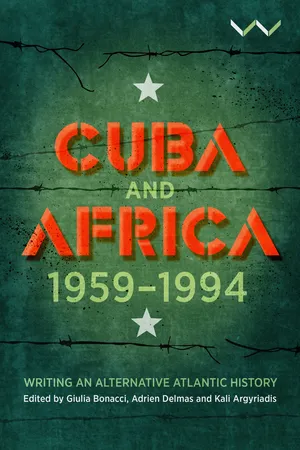
eBook - ePub
Cuba and Africa, 1959-1994
Writing an alternative Atlantic history
- 344 pages
- English
- ePUB (mobile friendly)
- Available on iOS & Android
eBook - ePub
Cuba and Africa, 1959-1994
Writing an alternative Atlantic history
About this book
Information
Subtopic
World HistoryIndex
Social SciencesPART I
POLITICS AND SOLIDARITY
CHAPTER
1
Cubans in Algiers: The political uses of memory
Algeria and Cuba first established friendly relations in the context of the Algerian War of Independence (1954–62). On 27 June 1961, Cuba was the first country in the western hemisphere to recognise the Provisional Government of the Algerian Republic (GPRA) in exile in Tunisia, Egypt and Morocco.1 In October of the same year, the Cuban government sent an emissary, Jorge Ricardo Masetti (1929–64),2 who was a friend of Castro,3 with a message of support for the GPRA. Then in December, in a decisive show of support, the Cuban ship Bahía de Nipe delivered weapons to the National Liberation Army (ALN), the armed wing of the National Liberation Front (FLN),4 before returning to Cuba with 78 wounded Algerian fighters and 20 orphaned children. The weapons were transported to Oujda in Morocco, headquarters of the ALN General Staff, under the command of Colonel Houari Boumediene.
This strong signal of support has remained in the Algerian collective memory,5 both official and public.6 Nor have the Cuban people forgotten the support of President Ahmed Ben Bella at the time of the 1962 missile crisis. Following an official visit to the United States, the Algerian president visited Cuba two days after US U-2 spy planes produced evidence of Soviet missile launch sites on the island.7 On that occasion, he proclaimed: ‘We will never forget all you did for our refugees in Tunisia and Morocco. Comrade Fidel Castro, the National Liberation Front of Algeria awards you the mujâhid medal of honour, as a token of our gratitude.’8
Ben Bella also supported Cuban demands for the return of the US naval base at Guantánamo Bay and celebrated the first anniversary of the Bay of Pigs victory over an American-led invading force. This political act is still commemorated in the official Cuba media. Fidel Castro subsequently made statements praising the courage of the Algerian people in supporting Cuba when the United States declared an embargo in February 1962. Whenever a Cuban leader visits Algeria or an Algerian official visits Cuba, Ben Bella’s gesture is remembered in official speeches and in the media, as well as in Granma, the official organ of the Cuban Communist Party.
Any discussion of Cuban–Algerian relations must include the issue of the Tricontinental Movement, whose three key figures were the Algerian Ben Bella, the Moroccan Mehdi Ben Barka (an opponent of King Hassan II) and the Argentinian Che Guevara.9 All three were instrumental in setting up the Tricontinental conference of solidarity between the peoples of Africa, Asia and Latin America, held at the Habana Libre Hotel in Havana in January 1966. The aim of the conference, which was attended by representatives of liberation movements from around the globe, with China and the USSR limited to observer status, was to create an anti-imperialist platform.10
But already before then, Che Guevara had paid two visits to Algiers in 1963 and 1965 to further the goals of the Tricontinental Movement, visits that were instrumental in creating the myth of Algiers as the world capital of revolutionaries.11 At that time, Ben Bella’s Algeria welcomed political activists fighting against dictatorships in southern Europe or governments controlled by Latin American oligarchies, as well as sub-Saharan anti-colonial activists and those fighting the apartheid system in South Africa. To support these movements, Che Guevara came to Algiers on 5 July 1963, Algerian Youth Day, which celebrates the country’s independence in 1962, and again in February 1965 on the occasion of the Afro-Asian solidarity conference, as part of a grand tour of the African continent. It was in Algiers that he made his famous speech criticising the Soviet Union for giving insufficient support to Third World revolutionary movements. He also attempted to shift away from the official Cuban position, although at that time Fidel Castro had not yet fully aligned his country with Soviet foreign policy; he was to do this later, in 1968, when he supported the Warsaw Pact intervention in Czechoslovakia to crush the Prague Spring.
Ben Bella’s presidency (from 1962 to 1965, when he was overthrown in a coup by Boumediene), represents the golden age of Algerian–Cuban relations. These had several dimensions: a political dimension, through support for Third World revolutionary activists; a military dimension, through Cuban military intervention in Algeria in 1963; and a medical and technical dimension, through cooperation with Algeria in these fields. From 1962 to 1965, thanks to Algerian support, the Cubans were able to strengthen their revolutionary networks in Africa and, to a lesser extent, in Latin America and Asia. Algeria and Cuba did not share the same state ideology, even if both regimes were seeking a specific path to socialism. However, the Algerian and Cuban leadership did have common policy orientations: the fight against colonialism and imperialism, and condemnation of the exploitation of the countries of the South by those of the North.
Algiers, an Afro-cuban Lieu de memoire?
If Algiers is a lieu de mémoire12 – a site vested with historical significance in the popular collective memory – of the anti-imperialist struggle at the time of Ben Bella, it is as the site of actual events that have been memorialised. Real historical events took place that contributed to the making of the myth of Algiers as ‘the Mecca of revolutionaries’ under the Ben Bella presidency. This was a term coined by the Cape Verdean activist Amílcar Cabral (1924–73) during an interview with journalists in Algiers, when he said: ‘Catholics have Rome, Muslims have Mecca, Jews have Jerusalem, and revolutionaries have Algiers.’
Havana became the capital of Third World revolutionary activists after 1965 in part because the Cuban leadership was able to benefit from anti-imperialist and anti-colonial networks set up in Algiers between 1962 and 1965. Previously, it was Cairo that had held this status. The Cuban leadership had first developed relations with the Nasser regime and with the more Marxist-leaning regime of General Qasim in Iraq. However, Egypt’s network of influence involved fewer sub-Saharan activists than that of Algiers. The Algerian regime, on the other hand, had gained from the FLN’s highly active diplomacy in sub-Saharan Africa during the Algerian War. According to Régis Debray,13 who discussed the matter with Guevara himself and with Jorge Papito Serguera, a commander in the Cuban Revolution and Cuban ambassador to Algeria at the time, the expansion of the Cuban revolutionary network in sub-Saharan Africa was mainly due to the Algerian FLN, which had extensive diplomatic and activist connections in the region after independence.14
Crucial in the establishment of this network of influence was the role of Frantz Fanon, the Martinique-born psychiatrist who practised in Blida in colonial Algeria. As a key FLN leader in charge of diplomatic relations with sub-Saharan Africa,15 Fanon had supported the idea of an African revolution.16 He was the first to refer to the African dimension of the Algerian Revolution, which he saw as a model for other revolutions on the continent. In June 1961, this idea was taken up by the FLN and enunciated in the Tripoli Programme,17 which stated that the FLN should support all national liberation struggles on the African continent. Fanon also had considerable influence on the Cuban Revolution. It was Guevara himself who introduced Fanon’s works to Cuba. As a doctor, Fanon offered a clinical analysis of the cultural alienation experienced by the colonised as a result of colonialism. Fanon’s works were published in Spanish between 1965 and 1968 with the support of the Cuban cultural institution, Casa de las Américas. Even though the Cuban Revolution had, with few exceptions, been led by a white creole elite of Spanish origin,18 Fanon exerted a powerful influence on Cuban intellectuals during the 1960s.19 Forgotten for a time (probably due to the Cuban Revolution’s alignment with the USSR), then rediscovered by Cubans in the 1990s after the fall of the Eastern bloc, Fanon advocated a revolution led by Third World peasants rather than by the workers, the latter being more in line with the Soviet Marxist-Leninist credo. Fanon had a similar impact on many activists, such as Amílcar Cabral in Guinea-Bissau and Steve Biko in South Africa. Biko himself was influenced by the theory that associated the black liberation movement with socialism via the concept of ‘black consciousness’, as set out in Fanon’s book Black Skin, White Masks (1952), one of the first works to theorise the ‘black condition’.20 Fanon gave the Algerian Revolution great prestige by ensuring that African people the length of the continent became aware of the event.
Among the key South African activists from the African National Congress (ANC) who received support from the ALN, mention must of course be made of Nelson Mandela, Oliver Tambo, who was in charge of the ANC’s diplomatic mission, and Robert Resha. In the wake of the Sharpeville massacre in 1960,21 the ANC sought assistance from the FLN in organising the armed struggle through its military wing, Umkhonto we Sizwe (Spear of the Nation), which confined its activities, initially, to acts of sabotage that did not target civilians. The South African activists were first housed in FLN bases in Morocco. During his FLN training in the early 1960s, Mandela learned to link armed struggle with political struggle by appealing to international public opinion, thanks to his discussions with Dr Chawki Mostefaï, GPRA ambassador to Morocco at the time.
During the Algerian War, the diplomatic struggle had been vital for the FLN in order to obtain support from the nations of the ‘South’ at the United Nations and to gain international recognition for the GPRA. This policy continued after Algerian independence. In the 1964 Charter of Algiers, the Algerian Republic guaranteed asylum for freedom fighters.22 According to Gérard Chaliand,23 editor of an Algerian periodical entitled Révolution Africaine, the majority of the activists in Algiers were African − around 3000 between 1963 and 1964. Activists seeking independence for Portuguese colonies (Angola, Mozambique, Guinea-Bissau and Cape Verde), in particular, were taken in by the Algerian regime. And it was the liberation movements of these African countries that were given the greatest assistance by Cuba in terms of military and medical cooperation, which continued once their countries gained independence at the time of the Cold War between the Eastern and Western blocs in the 1970s. Among the organisations present in Algiers were the PAIGC (African Party for the Independence of Guinea and Cape Verde), led by Cabral and established in the capital since 1963; FRELIMO (the Mozambique Liberation Front) present since 1964; and the MPLA (Popular Movement for the Liberation of Angola).24 Agostinho Neto had set up an MPLA office in Algiers in 1963.25 According to Mario Pinto de Andrade, ...
Table of contents
- Cover
- Title
- Copyright
- Contents
- Figures and Table
- Foreword
- Acknowledgements
- Acronyms and Abbreviations
- Timeline of Historical Events
- Introduction Reconfiguring the Cuba–Africa Encounter
- Part I Politics and Solidarity
- Part II Trajectories
- Part III Voices
- Part IV Reconstructing History, Reconnecting Roots
- Contributors
- Index
Trusted by 375,005 students
Access to over 1.5 million titles for a fair monthly price.
Study more efficiently using our study tools.
Frequently asked questions
Yes, you can cancel anytime from the Subscription tab in your account settings on the Perlego website. Your subscription will stay active until the end of your current billing period. Learn how to cancel your subscription
No, books cannot be downloaded as external files, such as PDFs, for use outside of Perlego. However, you can download books within the Perlego app for offline reading on mobile or tablet. Learn how to download books offline
Perlego offers two plans: Essential and Complete
- Essential is ideal for learners and professionals who enjoy exploring a wide range of subjects. Access the Essential Library with 800,000+ trusted titles and best-sellers across business, personal growth, and the humanities. Includes unlimited reading time and Standard Read Aloud voice.
- Complete: Perfect for advanced learners and researchers needing full, unrestricted access. Unlock 1.5M+ books across hundreds of subjects, including academic and specialized titles. The Complete Plan also includes advanced features like Premium Read Aloud and Research Assistant.
We are an online textbook subscription service, where you can get access to an entire online library for less than the price of a single book per month. With over 1.5 million books across 990+ topics, we’ve got you covered! Learn about our mission
Look out for the read-aloud symbol on your next book to see if you can listen to it. The read-aloud tool reads text aloud for you, highlighting the text as it is being read. You can pause it, speed it up and slow it down. Learn more about Read Aloud
Yes! You can use the Perlego app on both iOS and Android devices to read anytime, anywhere — even offline. Perfect for commutes or when you’re on the go.
Please note we cannot support devices running on iOS 13 and Android 7 or earlier. Learn more about using the app
Please note we cannot support devices running on iOS 13 and Android 7 or earlier. Learn more about using the app
Yes, you can access Cuba and Africa, 1959-1994 by Emmanuel Alcaraz,Bernardo J Capamba André,Elina Djebbar,João Felipe Gonçalves,Charlotte Grabli,Christine Hatzky,Héloïse Kiriakou,Michel Luntumbue,Pablo Rodríguez Ruiz,Delmas Tsafack, Kali Argyriadis,Giulia Bonacci,Adrien Delmas, Kali Argyriadis, Giulia Bonacci, Adrien Delmas in PDF and/or ePUB format, as well as other popular books in Social Sciences & World History. We have over 1.5 million books available in our catalogue for you to explore.