![]()
Family descriptions
![]()
Cupedidae | Reticulated beetles |
• antennae longer than head and prothorax together
• antennal insertions dorsal and almost adjacent
• labrum free and visible
• ventral side of prothorax with deep grooves for retention of legs
• tibiae without spurs
• tarsal formula: 5-5-5, tarsal segment 4 ventrally lobed
Reticulated beetles mainly inhabit forests, but also occur in open woodland and arid pastureland as well, from north Queensland to Western Australia and Tasmania.7 They are not common anywhere and quite rare in collections. At present there are only six described species divided into two genera in Australia.
Little is known about their habits except that the larva lives in firm, dry, but fungi-infested, decaying wood and the adults can also be found in the same environment. They may be pollen feeders, judging by the grains of pollen found in the gut of one species and the flower-visiting habits of another. They may be seen flying around infested timber on sunny days and some species are attracted to artificial light at night. The males of some species get attracted to laundry detergents (bleach). It is suspected that these substances may act as female sex attractants.
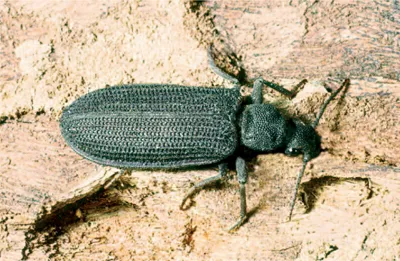
Distocupes varians (10 mm) is the only representative of this genus in Australia. It occurs in the coastal areas of eastern Queensland, in New South Wales, the Australian Capital Territory, Victoria and Tasmania. Photo: O Kelly
![]()
Ommatidae | Ommatid beetles |
• antennal insertions lateral and well separated
• antennae shorter than head and prothorax together
• labrum not distinct
• venter of prothorax without deep grooves for retention of legs
• simple fourth tarsal segment
• tarsal formula: 5-5-5
Ommatid beetles are rather similar in appearance to cupedids, although some species may have a metallic (bronze) sheen. At present only four Australian species are known. Before 1995 they belonged to the family Cupedidae. Ommatid beetles occur in western New South Wales, Victoria and South Australia in dense forests but, just like the cupedids, they also live in pastureland and in drier country, where they probably develop in subterranean, decaying, fungus-ridden wood, such as roots or fallen trees. Ommatids are rarely seen, most probably because of their cryptic life styles. They are sometimes captured by flight intercept traps or purely by chance.
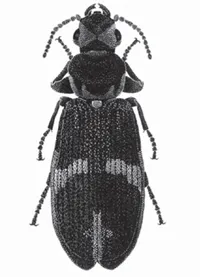
Omma masteri (subfamily Ommatinae) is a typical ommatid beetle. Drawing: B P Moore
![]()
Sphaeriusidae | Minute bog beetles |
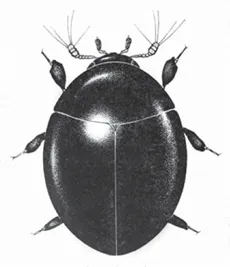
• small (about 0.8 mm long), shiny, dark brown or black, ovoid, pill-like beetles
• hairless, strongly convex on the dorsal side and almost flat on the ventral side
• only three abdominal sternites are visible ventrally
• short, 11-segmented, clubbed antennae, with longish bristles at the ends
Minute bog beetles can be found in wet mud, gravel, sand and under submerged logs and stones at the edges of streams and in boggy environments. They have piercing mouthparts and probably feed on algae. Because of their minuscule size and cryptic life style, they are difficult to spot, although they may be more common and more widely spread than one would think. They are rare in collections. The best method of finding them is to stir portions of riverside shingle into a pan of water and collect the beetles as they float to the surface.
Only two species occur in Australia: Sphaerius ovensensis in Victoria and New South Wales and Sphaerius coenensis in north Queensland.
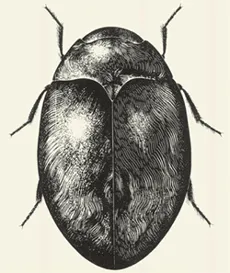
The tiny Sphaerius ovensensis lives in fine shingle at the edges of streams in Victoria and New South Wales. The adults can spend considerable time under water as they store air taken from the surface under their elytra. Drawing: F Nanninga, CSIRO
![]()
Gyrinidae | Whirligig beetles |
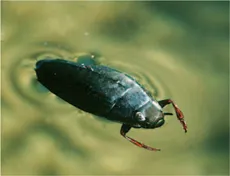
• boat-shaped, shiny, dark blue or olive-green, aquatic beetles, 4–18 mm in length
• entire body streamlined, antennae short (about as long as eye)
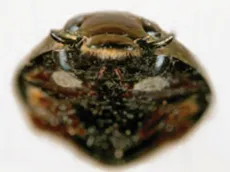
• eyes completely divided into upper and lower segments
• fore legs are long and modified for grasping prey, mid and hind legs are short, flattened, fringed with flattened swimming hairs
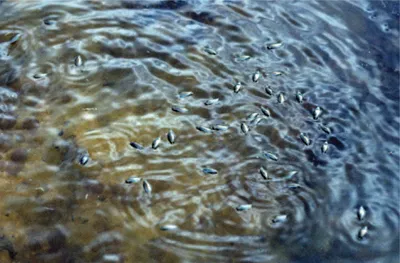
Whirligig beetles occur in clean, fresh water in most parts of Australia. The family is represented by four genera and 19 species in Australia. The gyrinid body is perfectly ‘streamlined’ for moving quickly in water, especially on its surface. They swim gregariously in continuous tight circles, whirling around on the surface. When disturbed, they quickly dive into deeper water. Whirligigs occur in still and moving water. They often congregate in large numbers; sometimes more than one species can be found in such groups.
Macrogyrus elongatus (subfamily Gyrininae) is about 8 mm in length. Whirligigs are the only beetles that make use of the surface tension of water for support.
The behaviour of whirligigs is distinctive as well as their appearance. They are mostly active during the day.
Extrasensory perception?
Whirligigs often capture other insects when they fall into the water. Although they have ‘four’ eyes, they often can’t see a potential meal, because the surface of the water is in their ‘blind spot’ – aligned exactly with the division between the upper and the lower sections of their eyes. Yet, they hardly ever miss a meal! How? Their antennae help them locate the prey, helplessly struggling on the surface of the water. The whirligig has a special organ (Johnston’s organ) located in the enlarged second segment of each antenna, which detects the miniature waves created by the struggling prey. This organ is also useful in more peaceful tasks, such as navigating without bumping into anything. A moving whirligig creates tiny waves which bounce back from any obstacles in its vicinity. The organ detects these echo-like waves, thus guiding the swimming beetle on a collision-proof course.8
The ‘four’ ...