![]()
Chapter 1
Ecological engineering, habitat manipulation and pest management
G.M. Gurr, S.L. Scarratt, S.D. Wratten, L. Berndt and N. Irvin
The management of nature is ecological engineering (ODUM 1971).
Introduction: paradigms and terminology
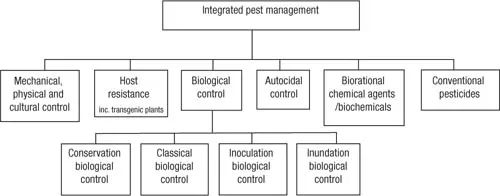
This book is essentially about the management of arthropod pests, though at least some of the principles described will have relevance to other pests, weeds and pathogens. Over recent decades, integrated pest management (IPM) – the combined use of multiple pest-control methods, informed by monitoring of pest densities – has emerged as the dominant paradigm. Each of the specific methodological approaches used in IPM (mechanical, physical and cultural control; host plant resistance; biological control etc; see Figure 1.1) has tended to become a specialised area of research with sometimes only limited communication between researchers across areas. Even sub-areas, such as the four forms of biological control (conservation, classical, inoculation and inundation) recognised by Eilenberg et al. (2001) (Figure 1.1), have tended to become the domain of specialists. This has led to calls for greater cooperation and exchange of ideas between different sub-disciplines. In the case of biological control, for example, Gurr and Wratten (1999) proposed the concept of ‘integrated biological control’, which uses conservation biological control techniques to support classical, inoculation and inundation biological control.
Figure 1.1: Biological control approaches in relation to other tactics available to integrated pest management.
© Kluwer Academic Publishers. Originally published in Eilenberg, J., Haejek, A. and Lomer, C. (2001). Suggestions for unifying the terminology in biological control. BioControl 46: 387– 400, Figure 1. Reproduced with kind permission of Kluwer Academic Publishers.
Conservation biological control (CBC) has been defined as ‘modification of the environment or existing practices to protect and enhance specific natural enemies of other organisms to reduce the effect of pests’ (Eilenberg et al. 2001). In practice, CBC is effected by either (1) reducing the pesticide-induced mortality of natural enemies through better targeting in time and space, reducing rates of application or using compounds with a narrower spectrum efficacy, or (2) by habitat manipulation to improve natural enemy fitness and effectiveness. The second approach often involves increasing the species diversity and structural complexity of agroecosystems.
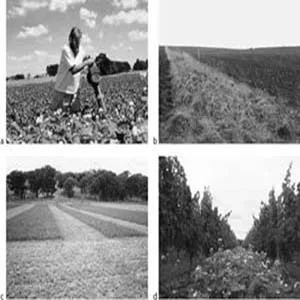
In the context of CBC, habitat manipulation aims to provide natural enemies with resources such as nectar (Baggen and Gurr 1998), pollen (Hickman and Wratten 1996), physical refugia (Halaji et al. 2000), alternative prey (Abou-Awad 1998), alternative hosts (Viggiani 2003) and lekking sites (Sutherland et al. 2001). Habitat manipulation approaches, such as those pictured in Figure 1.2, provide these resources and operate to reduce pest densities via an enhancement of natural enemies. For example, ‘beetle banks’ (Figure 1.2b) are raised earth ridges that typically run through the centre of arable fields and are sown to perennial tussock-forming grasses.
Figure 1.2: Examples of ecological engineering for pest management: (a) buckwheat strip in the margin of an Australian potato crop providing nectar to the potato moth parasitoid, Copidosoma koehleri (Hymenoptera: Encyrtidae) (Photograph: G.M. Gurr); (b) ‘beetle bank’ in British arable field providing shelter to predators of cereal pests (Photograph: G.M. Gurr); (c) strip cutting of a lucerne hay stand in Australia provides shelter to within-field community of natural enemies (Photograph: Z. Hossain); (d) New Zealand vineyard with buckwheat ground cover for enhancement of leafroller parasitoids (Photograph: Connie Schratz).
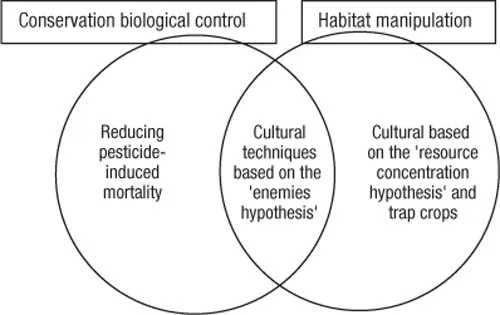
Figure 1.3: Comparing and contrasting habitat manipulation and conservation biological control approaches to pest management. Resource concentration and enemies hypotheses are as defined by Root (1973), see text for detail.
© Kluwer Academic Publishers. Adapted from and originally published in Gurr, G.M., Wratten, S.D. and Barbosa, P. (2000). Success in conservation biological control. In Biological Control: Measures of Success (G.M. Gurr and S.D. Wratten, eds), p.107, Figure 1. Reproduced with kind permission of Kluwer Academic Publishers.
During the winter, far higher densities of predatory arthropods shelter on the well-drained, insulated sites than in the open field. In the spring, beetles and other natural enemies emerge from the beetle bank to colonise the growing crop and prevent pest aphid outbreaks (Thomas et al. 1991). When herbivores (the second trophic level) are suppressed by natural enemies (third trophic level) in this manner, control is said to be ‘top-down’. Root (1973) referred to pest suppression resulting from this effect as supporting the ‘enemies hypothesis’. Importantly, however, within-crop habitat manipulation strategies such as cover crops and green mulches (components of the first trophic level, as is the crop) can also act on pests directly, providing ‘bottom-up’ control. Root (1973) termed pest suppression resulting from such non-natural enemy effects as the ‘resource concentration hypothesis’, reflecting the fact that the resource (crop) was effectively ‘diluted’ by cues from other plant species. These mechanisms are explored in detail in chapter 3, ‘The agroecological bases of ecological engineering for pest management’, by Nicholls and Altieri.
Though considerable attention has been devoted to testing the relative importance of bottom-up and top-down effects, they are not mutually exclusive and in many systems both are likely to operate (Gurr et al. 1998). Thus habitat manipulation, though it makes a major contribution to CBC, includes a wider series of approaches that may operate independently of natural enemies (Figure 1.3) and, as discussed below, constitute a form of ecological engineering. Examples of ecological engineering for pest management that operate largely by top-down effects are detailed by Pfiffner and Wyss in chapter 11, ‘Use of sown wildflower strips’. Natural enemies use such strips for resources such as nectar and pollen in ways explored by Jervis et al. (ch. 5, ‘Use of behavioural and life-history studies’). The push–pull and intercropping approaches described in the two chapters by Khan and Pickett (ch. 10) and Mensah and Sequeira (ch. 12) employ top-down effects, but the operation of bottom-up effects is also clearly evident.
Ecological engineering
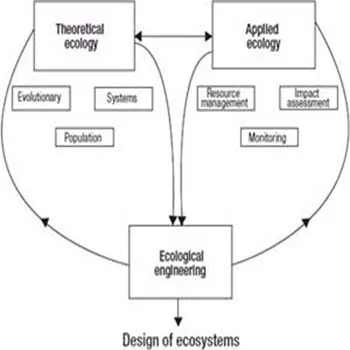
Odum (1962) was among the first to use the term ‘ecological engineering’, which was viewed as ‘environmental manipulation by man using small amounts of supplementary energy to control systems in which the main energy drives are still coming from natural sources’. In more recent years, Mitsch and Jorgensen (1989) have defined ecological engineering as ‘the design of human society with its natural environment for the benefit of both’. Among the characteristics of this form of engineering are the use of quantitative approaches and ecological theory as well as the view of humans as part of, rather than apart from, nature. Ecological engineering is a conscious human activity and should not be confused with the more recently developed term ‘ecosystem engineering’. This refers to the way in which other species shape habitats via their intrinsic biology rather than by conscious design. For example, termites alter the structural characteristic of soils (Dangerfield et al. 1998), and such ecosystem engineers thereby moderate the availability of resources to other organisms (Thomas et al. 1999).
Table 1.1: Applications and examples of ecological engineering.
| Application | Examples |
| Ecosystems used to reduce or solve a pollution problem | Wastewater recycling in wetlands, sludge recycling |
| Ecosystems imitated to reduce or solve a problem | Integrated fishponds |
| Recovery of an ecosystem after disturbance is supported | Mine restoration |
| Existing ecosystems modified in an ecologically-sound manner to reduce an environmental problem | Enhancement of natural pest mortality |
Adapted from and reproduced with permission from Mitsch, W.J. and Jørgensen, S.E. (2004). Ecological Engineering and Ecosystem Restoration. Wiley, New York.
Recently, Parrott (2002) has discussed the ecological engineering field as having evolved to incorporate a growing number of practitioners whose endeavour is the ‘design, operation, management and repair of sustainable living systems in a manner consistent with ecological principles, for the benefit of both human society and the natural environment’. Possibly, however, the most elegant definition of ecological engineering comes from Chinese approaches where a long history of complex land use systems was, in the closing decades of the 20th century, formalised into a ‘design with nature’ philosophy (Ma 1985). The existence of the well-established periodical Ecological Engineering: The Journal of Ecotechnology is evidence of the level of activity in this research field. This title reflects the synonym for ecological engineering, ‘ecotechnology’.
Figure 1.4: The relationship between ecological engineering, and theoretical and applied ecology.
Adapted from and reproduced with permission from Mitsch, W.J. and Jør...