![]()
PART 1
AN ECOLOGICAL AND BEHAVIOURAL APPROACH TO INSECT IDENTIFICATION
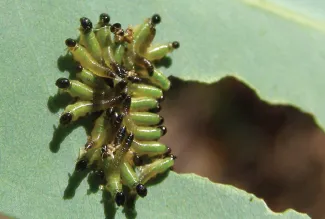
Newly hatched sawfly larvae ‘spitfires’, Perga sp. (Hymenoptera: Pergidae), at ‘Tilembeya’. Length 3 mm. They are feeding on a eucalypt leaf. Despite its high oil content and the presence of different anti-feedant compounds, including phenolics, eucalypt foliage probably supports the highest diversity of plant-feeding (phytophagous) insects of any plant group in Australia.
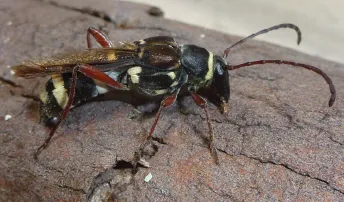
Wasp-mimicking longicorn beetle, Hesthesis sp. (Coleoptera: Cerambycidae) at Kambah, CNP. Length 25 mm. Mimicry is one of the most fascinating aspects of insect biology and illustrates how some insects have evolved a strategy to avoid being eaten by predators that hunt by sight. That is they come to resemble, in different ways, a well-defended or inedible model, such as a wasp, that predators avoid. This species has wasp-like yellow stripes, a wasp-like head and antennae and short wing cases exposing the narrow, membranous hind wings with a fold like a wasp.
Regional environments and where to find insects, focusing on the tablelands and ranges of south-eastern NSW
The Southern Tablelands of New South Wales (NSW) are characterised by a rolling plateau at 400–1000 m altitude, dissected by several river systems, and with a high mountain range to the west reaching 1800 m. The surrounding areas are similar in structure and are bounded by the coastal range to the east, the Blue Mountains to the north and the Kosciuszko range to the south. The climate is characterised by warm to hot summers and cold winters. Average rainfall is evenly distributed throughout the year but in the short term is highly variable from month to month. There is usually a high rainfall deficit in summer due to low humidity and high rates of evaporation. Most of the fluctuations in rainfall relate to the El Niño/Southern Oscillation (ENSO) effect, with relatively long dry periods, often lasting decades, broken by short but very wet periods of a few years. Rainfall patterns have a considerable influence on the life cycle and population fluctuations of many insects and of the plants that many of them depend upon. Rainfall is higher in the ranges to the east and west, whereas in the south there is a low rainfall, rain shadow area: the Monaro. In winter the sub-alpine areas of the tablelands and the alpine areas of the mountain ranges are covered with snow for varying periods.
The vegetation of the Tablelands is dominated by dry sclerophyll eucalypt woodland and forest, although much of the lowlands have been cleared for agriculture, mostly for grass production. Some areas of natural grassland are also present, mostly associated with frost hollows. The term sclerophyll refers to the nature of the leaves of the trees and shrubs, which are hard and tough to resist desiccation and this presents a particular challenge to insect feeders. The foliage is evergreen, which means that this food resource is available all year round.
The vegetation of NSW is classified into several different associations (Keith 2004) and some insects are restricted to the plants and habitats within these associations. Two of these associations are classified as endangered because they are now represented by only small fragments that continue to decline in size and quality due to urbanisation, infrastructure development and farming practice.
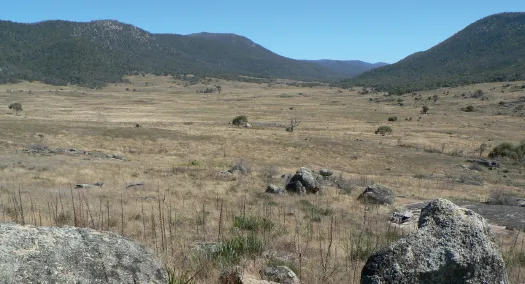
The first of these is natural temperate grassland. This habitat typically occupies frost-hollow areas on shallow soils, but its existence may have been encouraged by regular burning over the millennia by the Indigenous inhabitants. Most of these native grasslands have been converted to pastures of exotic grasses, leading to a complete loss of native plant and insect diversity. Quality ‘lowland’ remnants can be seen in the Michelago area of NSW, in some Australian Capital Territory (ACT) Nature Reserves and in some local travelling stock reserves. In the upland valleys of the Brindabellas and Snowy Mountains, there are extensive sub-alpine, frost-hollow grasslands with a different flora and insect fauna. Extensive areas of natural tussock grassland occur on the basalt plains of the treeless Monaro and other natural grasslands occur on the basalt plains of Western Victoria.
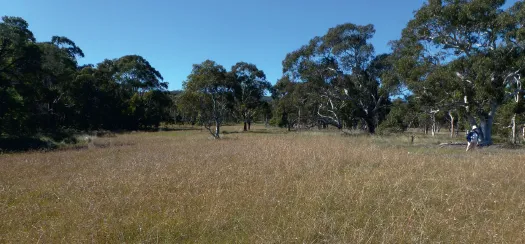
‘Lowland’ natural temperate grassland at Sweeneys Travelling Stock Reserve (TSR) near Bungendore. The grassland is dominated by kangaroo grass Themeda triandra and is bordered by snow gum woodland. This grassland supports a diverse grasshopper fauna, as well as other grass-feeding and flower-visiting insects.
‘Upland’ natural temperate grassland at Rendezvous Creek in Namadji National Park (NNP). A typical frost hollow grassland surrounded by snow gum Eucalyptus pauciflora and black sally E. stellulata woodland. These grasslands are dominated by tussock grasses Poa spp. and support a diverse insect fauna of upland grasshoppers, butterflies and other insects.
The second endangered association is grassy box woodland characterised by widely spaced, box-type eucalypts with an understorey of native grasses and forbs and relatively few shrubs. This association dominated much of the Southern Tablelands plateau until the last 200 years when the trees were cleared and the native understorey was replaced by exotic pasture plants. This association was also probably sustained by fire. Good quality remnants are hard to find but can be seen in several Canberra Nature Parks and reserves, in travelling stock reserves (TSRs), and in other reserves and cemeteries elsewhere.
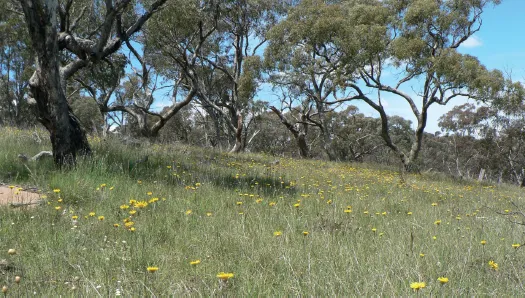
Grassy box woodland in the Burra Reserve with apple box Eucalyptus bridgesiana and candlebark E. rubida and an understorey of native grasses and forbs, including copper wire daisy Podolepis jaceoides shown here. There is a rich insect fauna of flower visitors and grass feeders including Key’s matchstick grasshopper.
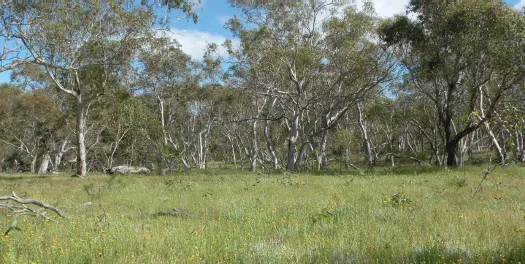
Lowland snow gum grassy woodland at Rowes Lagoon, Collector, NSW showing a rich mix of daisies and grasses in the foreground and scattered snow gums in the background. It also has plenty of regenerating snow gums from seedlings since grazing by sheep was stopped. There is a rich mix of flower-visiting and plant-feeding insects, the latter being especially abundan...